


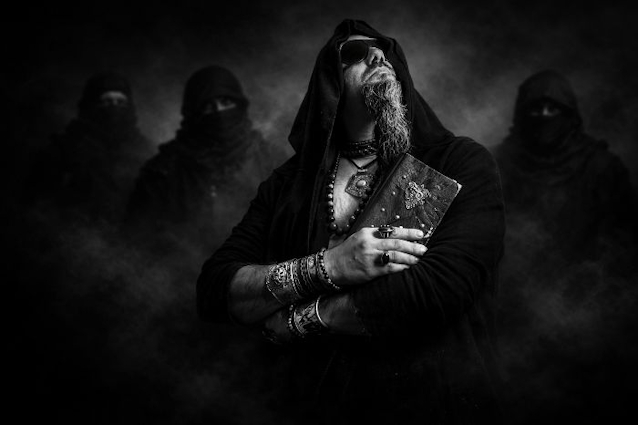
MELECHESH's ASHMEDI Preaches Peace, Solidarity And The Power Of Metal Amidst Turmoil In The Middle East
June 9, 2026By David E. Gehlke
The "Sentinels of Shamash" EP marks the first release from Middle Eastern extreme metal standard-bearers MELECHESH in 11 years. The outing — coming in at a robust three songs and 21 minutes — is an exotic blend of Mesopotamian metal laced with the appropriate blasts of extremity and traditional metal references, manifesting itself into a cauldron of spite and lore that only founding member and mainman Melechesh Ashmedi (real name: Murat-George Cenan) can produce. It also quells, at least for the time being, the desire from MELECHESH's fanbase for the full-length follow-up to 2015's fiery and majestic "Enki".
There are multiple layers behind the long wait in between releases for MELECHESH. Contrary to certain swaths of the internet, Ashmedi is not Israeli, he's of Armenian and Turkish descent and founded the band in Jerusalem in 1993. He eventually relocated the band to the Netherlands and has spent the ensuing years globe-trotting and immersing himself in different cultures, all the while building the MELECHESH brand. Ashmedi is proof in these highly divisive times that metal, perhaps more than any other genre of music, is borderless and has the power to bring people together.
Yet, Ashmedi's current living situation in Jerusalem has proven to be fraught during the ongoing Middle Eastern conflict, where, as he would tell BLABBERMOUTH.NET, missiles were flying over his house just days before we connected. Remarkably, Ashmedi was in good spirits and more than willing to dig into recent events and "Sentinels Of Shamash" days after its release.
Blabbermouth: Where are you right now?
Ashmedi: "Right now, I'm in Jerusalem. A few days ago, they suddenly stopped everything — the war just halted immediately. Before that, missiles were going over my house. I'd never seen anything like that in my life. At first it almost looked like science fiction, like where you see these interceptors and missiles flying like buses with fire, and you're like, 'What the hell is this?' It reminded me of those stylized drawings, like something unreal. I couldn't believe I was witnessing it."
Blabbermouth: That has to be terrifying. How do you process living in that environment?
Ashmedi: "It's terrible on every level. My family is neither Israeli nor Palestinian — we're expats. I have friends on both sides. I spend more time socially with Israelis just because of lifestyle overlap, but it doesn't matter to me. My family background is Armenian and Turkish, and I'm a Dutch citizen. I was born here, went to international school and grew up speaking English, Arabic and Hebrew. I see things from multiple perspectives. What I see is fear. People are scared of each other, and leadership on both sides feeds that fear. There's dehumanization, and then people react to being dehumanized. It becomes a cycle. I try not to get sucked into the news narratives because they oversimplify everything. When I travel abroad, people assume I'm either Israeli or Palestinian, and I constantly have to explain that I'm neither."
Blabbermouth: Does that get tiring? As in, having to clarify your identity?
Ashmedi: "It does. Even in Europe, like in Holland, I put up a Christmas tree just because I enjoy Christmas in a cultural sense. I like the Santa Claus vibe, the family dinners. People suddenly label me: 'Oh, so now you're this.' And I'm like, no, man. I come from Jerusalem; Jesus is technically from there too. It's not binary. That kind of thinking is insane. I get into trouble sometimes because I refuse to play along with those labels. One group might try to claim me, another might reject me, and then another might embrace me for the wrong reasons. It's constant projection. Eventually I just tell people: I don't care about your categories. What about me as a person?"
Blabbermouth: I've heard you refer to yourself as a "citizen of the world." Where does that come from?
Ashmedi: "From my upbringing. My first language was actually French, because I lived in Senegal as a child. My nanny was African. I have these memories of her carrying me on her back, taking me to the beach, fishermen letting me hang out with their kids. My mom trusted them; that left a strong emotional imprint on me. Then I came to Jerusalem speaking French, and then I learned Arabic, English and Hebrew at the same time. Later I picked up Dutch. But none of those languages feel like 'mine.' My roots are Armenian and Turkish, but even that is fragmented. It's a confusing thing. So yeah, I don't belong to one place. I've spent more time in the Netherlands with the band than in Israel. My nationality is Dutch. Yet people still label me based on where I was born or call me 'The Israeli Ashmedi.' It's like calling Marty Friedman [ex-MEGADETH] Japanese or Keanu Reeves Lebanese — it's not that simple."
Blabbermouth: Has it ever affected your safety?
Ashmedi: "Yes, very directly. There are places where booking us becomes risky because people assume things about me. A festival in Morocco wanted us, but they worried that someone might target me based on perception alone. They go, 'What if someone shoots you and goes, 'Oops!'' I was supposed to play Bahrain, but again, they're scared because they think I'm Israeli. Meanwhile, my brother works in an NGO [Non-Governmental Organization] and can travel there without issue because he's clearly not aligned with either side politically. It's frustrating. My friends in Israel feel the same way. This identity confusion affects real opportunities and safety. I see it even over in America. I wish people would stop because before, people never identified as a Republican or Democrat. It's sad. I love America. I went to junior high school in Los Angeles."
Blabbermouth: It's been a while since MELECHESH released new material. How are you feeling now that the EP is out?
Ashmedi: "Honestly, it's a relief. The hardest part was constantly saying 'soon' when things kept going wrong behind the scenes. It became frustrating for both me and the fans. I started seeing all these memes. [Laughs] At one point the excitement turned into skepticism, which was tough to see. Now that it's finally out, it feels vindicating. People are connecting with it, and it gives everyone their dose of the 'CHESH. It's vindicating."
Blabbermouth: Rob Caggiano [ex-ANTHRAX, VOLBEAT] played bass on the EP. How did this relationship start to develop?
Ashmedi: "Let me explain: We first connected back in 2006 when he messaged me on MySpace as a fan. That blew my mind — ANTHRAX was huge for me growing up. We stayed in touch, and years later, when I was struggling to finish the EP, he really stepped up. He invited me to New Jersey, gave me a place to stay, helped me relax, focused on my health, took me out to eat, and just treated me like a friend. We'd watch horror movies at night, drink wine, hang out. [Laughs] Then when I was ready, we recorded vocals at a slow, comfortable pace. He didn't just produce—he arranged parts, played bass, and understood my ideas instinctively. That's rare for me. Usually, I struggle to explain what's in my head. With him, it just clicked. So he pushed me to sing the best I can at the slowest pace possible. He even got extra gear because his gear was in Los Angeles. And then I had to go to L.A.; he had to go to L.A., so we met there and continued, but we didn't finish, so we continued back in New Jersey. He did all the singing and all that stuff for me, and he did the editing. In the end, the song 'In Shadows, In Light' is a bit long. It was supposed to be a two-part song, and I wanted it that way, but I'm like, 'It's going to be too much for the EP. I guess he's like, 'We'll make it into a song.' And then he's like, 'Can I produce and arrange a little bit?' One, two, three. I'm like, 'Boom! Perfect.' He has good taste, you know? And he goes, 'I'll play the bass.' It's really nice working with him, because I'm so tired of trying to explain music [to other people]. I'm like, 'How did it get out of my head, man?' [Laughs] He's always like, 'Can you do that part or that part?' I'm like, 'Exactly, that's what I'm thinking for the guitars. And he's like, 'Yeah, I'm in, man. Whenever you want. I love the band. I want to be involved.' I'm like, 'Anyway you want. If you want to come on the road, but I don't think it's for you.' He's a beautiful soul. Whenever there's a problem, he calls and tells me, 'Come to my place!"
Blabbermouth: Do you enjoy having someone to bounce ideas off of? Do you worry you're the only guy thinking about everything?
Ashmedi: "Well, you know, I always used to say when we got a new member of the band that we have a mentality of 'no filter.' They go, 'Look, I made something Middle Eastern!' I want to slap the guy! [Laughs] 'I'm like, what is that? I cancel 100 riffs to get the right riff. Come on, dude.' And then I say, 'If you do something, if you kick my ass, I'll kiss your hand.' [Laughs] I want the best for the band. People misunderstand, especially the guys who were toxic. It's not about ego — it's about the music. MELECHESH isn't just a band to me — it's something I'm responsible for maintaining at a high standard. I am a custodian, or I am a monk for the entity called MELECHESH. It's my responsibility because the band is a benchmark in the Near East. And when you are a benchmark, you're not going to be some cheesy, gimmicky thing. You've got to be credible. And when they hear it, they're like, 'This is credible.' Like it. Or don't like it, I don't care. This is credible, and you gotta set the standard. And we influence a lot of younger bands, but all of a sudden I'm impressed when there's bands I listen to, they come to me and say, 'You know, you influence us.' Like Max Cavalera [SOULFLY], he even said it in interviews on Blabbermouth. He came to us at a festival and was like, 'Hi, I'm Max Cavalera.'"
Blabbermouth: As if he needs an introduction!
Ashmedi: "Yeah! First I saw his son [Zyon] looking at me and looking at the phone, and then Max goes, 'I'm Max Cavalera. I love your music. I listen to it all the time. It's very inspirational.' And he dedicated the song to us when they're headlining the festival. The next day, my label sent him a shirt, and he's wearing it. He's doing an interview on the bus, and he goes, 'It's been a good summer. I got to see my friends in KORN and MELECHESH.' I'm like, 'Yeah, of course, MELECHESH.' [Laughs] And then he goes, 'I'd like us to cooperate together and play together.' So he wanted me to do something with him. But then our album came first, and he did guest vocals on the previous album ['The Lost Tribe' on 'Enki']. Then he did KILLER BE KILLED, and in the clip he's wearing our shirt, and then in the promo he's wearing our hoodie. At Brutal Assault in 2015, he played when we did. I'm drinking my whiskey because I finished my show. He sees me, and he takes the bottle. He puts it away. I'm like, 'Why?' Max goes, 'I want you to sing with me tonight.' I'm like, 'I haven't practiced your songs. I loved your music since I was a kid, but I won't remember the lyrics.' He said, 'It's okay.' [Laughs] We did 'Territory' with them. It was fluid; the words came."
Blabbermouth: You've been doing this since 1993. You've talked about metal being a global thing, and as we discussed earlier, you're a citizen of the world. Do you think it reinforces that metal has no borders?
Ashmedi: "Nowadays, there are some rotten guys that are buying the narrative of toxicity. It was never like that. I was in Indonesia. I went to a Dutch neighborhood. Everybody's there like, 'Don't go.' They have metal shops there. I just go in. [Laughs] They don't know English. They put me in a chair, get me a Coca-Cola. Cool, yeah. We just use sign language — the safest place in the world. But metal is global. Let me tell you something: When I moved to Holland, people went, 'How do you manage with an American drummer? [Referring to Sasha Horn, who joined MELECHESH in 2014 and departed the same year.] People there are like, 'How do you manage having a band?' I'm like, 'Metal is global, dude.' [Laughs] America's a big country, but the world is a bit bigger, it's just more hours on the plane.
"I don't like people telling me who I am, or make a false narrative about me, then they turn around and try to deny my identity. I exist in Jerusalem; it's a multifaceted place, and you need some nuance in the story. Two years ago, national TV in Israel did a special on me where they said, 'This is Ashmedi. He's not a Palestinian. He's living in Jerusalem. He came here. Everyone loves him, and he can't go 100 meters without someone hugging him. They embrace him.' And, to me, that's what Jerusalem is about. That's the story. And everybody goes back to a good story."
Blabbermouth: It is a good story, all things considered. We are all connected in some way, and metal reinforces that. However, it doesn't always feel that way for you, does it?
Ashmedi: "Yeah, yeah, I don't know. Someone told me what we do would never be art, like, 'Real artists come from their circumstance, from the environment.' JUDAS PRIEST came because they're from an industrial town [Birmingham, England], not because they were fans of the music. And this is rare that it's happening; you're a product of the situation. And I am, because when I was a kid, I felt no empowerment. And when I heard rock music, and I heard the guitar go [makes guitar riff sound], it was like a warm blanket. I'm like, 'Fuck you guys, I'm doing good.' You know, but that's the sad part: It can affect my job when I encounter these things. It delays the music. And now it's not definable; but it's a concept. It's a sphere. You can be black or red, but it's all sound. So that's difficult when they label you, and then, because of the labeling, you get screwed over sometimes. Like right now, Canada and Australia, I heard they're reluctant to do a tour because of Israel and all of this, but I have nothing to do with it."
Blabbermouth: That sounds like it could be the problem.
Ashmedi: "I'm not Israeli. I played in Dubai before there were diplomatic relationships with Dubai, you know, because I'm not Israeli. They go, 'No, but there are assumptions.' So that's it. I'm always like, 'Don't assume, please.' This is just the tip of the iceberg, bro. It's the tip. And there was a shadow-banning attempt on us on social media, like, 'Why is this happening?' From people I don't even know! I don't get it. Why bring everything into music? Let's say you like ketchup, and you wanna bring all your beliefs into making it. Dude, no matter who works there, it's ketchup. Leave it."
Blabbermouth: Talking about "ketchup" is a very American thing for you to say, Ashmedi.
Ashmedi: [Laughs] "I like ketchup so much. My guitar tech in America bought me a T-shirt that says 'I put ketchup on my ketchup' and it looks like the Heinz logo. [Laughs]'"
Blabbermouth: Ketchup is great, pickles not so much!
Ashmedi: "I like pickles, too. I like Middle Eastern pickles because they have brine. They are a little salty. [Laughs] By the way, I tell people that I discriminate against racist people."
Blabbermouth: Absolutely.
Ashmedi: "It's scientifically flawed. For example, look around the world: When you put a piece of lemon in a baby, they all have the same expression. Look at fathers when their daughters graduate or get married: they have the same puffed-up chest. We're the same. The real happiness is knowing we are the same. And some people, I fuck with them. I'm like, 'I know this Mustang over there, the red one is faster than the yellow one.' They go to me, 'It's stupid, it's all the same under the hood.' I'm like, 'No, the red one is faster than the yellow.' [Laughs]"
Blabbermouth: Thinking ahead, has the record company given you a timetable for the proper MELECHESH LP?
Ashmedi: "The label is like, 'Take your time. We have the EP.' The thing is, I already had songs for the EP that were supposed to be on the album, but I do have four songs or five new songs that are demoed, not complete, but I have them. If things go well and I don't have any issues with writing, it should be out in a year or two. Or in the year 2137. [Laughs] The plan is to think about entering the studio around this time next year. I just want us to take our time. So I hope that works, but for now the EP will sustain us. It's long enough for people to hear, and it's well received so far, which is really important to me."


 Prev
Prev 