


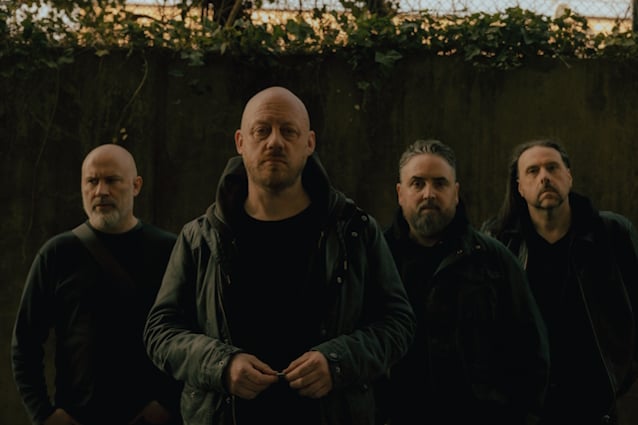
WARNING Released A Cult Doom Metal Classic 20 Years Ago; They Now Return With The Stirring 'Rituals Of Shame'
July 21, 2026By David E. Gehlke
The term cult gets applied more liberally these days than it should, but sufficient evidence exists that U.K. doom metal outfit WARNING's 2006 "Watching From A Distance" studio album is the exact definition of the term. Released on the small label The Miskatonic Foundation with nothing in the way of promotion, the album gradually — through classic word of mouth — captured the hearts and minds of doomsters worldwide for its earnest, heartfelt, achingly deep songs built on repetition and Patrick Walker's weary yet comforting vocals. This was doom in its most emotionally engaging form, coming from such a vulnerable place that many still struggle to label it properly, including the ongoing suggestion that it's the "most depressing album of all time," a claim that Walker flatly rejects.
Now signed to Relapse Records (who also reissued "Watching" last year),WARNING have returned with the five-song "Rituals Of Shame". Patterned after its predecessor, "Rituals" carries much of the same emotional weight (closing track "Teacher" is an unbridled triumph),with improved production and even more hypnotic guitar lines and melodies. It is the rare follow-up to a classic that delivers and, by all accounts, should give Walker and WARNING the kind of attention they've long deserved. However, as the frontman would tell BLABBERMOUTH.NET, attention and expanded budgets for WARNING, let alone the practice of doing regular interviews, is new territory for him.
Blabbermouth: How much has the legend of "Watching From A Distance" grown for you? Does its ongoing cult status surprise you?
Patrick: "That record came out on a tiny bedroom label, essentially, around the dawn of the internet, I suppose, but it came out to no fanfare. It came out to absolutely no press or publicity vehicle supporting it. There was none of that. Any reputation it has comes through word of mouth and an organic process of self-discovery. I think that's the main reason why anything I do, for anybody, nothing can compete with that. Anyone's experience with that record is through that self-discovery; like they've encountered it by themselves. That makes it a strong experience. You can't compete with that. [Laughs] It's more of a problem than anything, now, I think, for me, at least. I've said this before: All you can hope for when you make a record is that it's well accepted. If people are listening to it in five years, then that's great. This is a record that people are listening to a generation later and I feel really blessed as far as that's concerned."
Blabbermouth: When you say it's a problem, do you mean topping it is almost impossible?
Patrick: "I don't think any artist or creative artist's purpose is to do 'something better than.' That's never anyone's objective. You wouldn't say that the 'White Album' [by the BEATLES] is a better record than 'Sgt. Pepper'. Maybe you would. It's no less a record. It's not a failed record. It's the thing in itself, and every record, every thing should be a thing in itself. As far as that's concerned, no, but I do think the way people experience something will be affected by how they receive what came before. 'Watching From A Distance' is kind of rare in that respect. I think that's what makes it more unique than anything else."
Blabbermouth: Are you still bothered by people calling it "the most depressing metal album of all time?"
Patrick: "[Laughs] There's two things: One, is I wonder whether it's through people's lack of articulacy that they call it that now. They don't know what else to talk about, something that gives them a sort of, I don't know, like an overwhelming feeling of…maybe it ignites feelings of painful emotions in them. I don't know. But the main thing is that I never set out to make anything depressing. That's the last thing in the world I want to do: To do something depressing. I don't want to project negative emotions. I don't want to impose anything oppressive or bleak. I think I said this in the film that came out recently: The need to express or articulate pain is one thing. I don't want to make anything depressing. I want to make something beautiful or maybe stirring or engaging or something like that. It's the last thing I want to do. I also think it misinterprets what the record is about. A piece that just came out in, I can't remember what magazine it is, was Angry Metal Guy, one of these fucking things; again, they were talking about the record as though it was a breakup album or something like that. Nothing could be further from the truth. I don't know how anyone can interpret the lyrics of a song like 'Footprints' as about a breakup. [Laughs] I'm sorry to go on about it. It's so reductive. It's unimportant. A breakup is not the worst thing in the world. [Laughs]"
Blabbermouth: That's always the thing about the lyrics is that people can interpret them in many ways.
Patrick: "I'm even on the record two or three times, and I've said it: It shouldn't be interpreted this way. It makes no difference."
Blabbermouth: How did you decide to go back to WARNING? Was there any one moment that led you to do this record under the WARNING name?
Patrick: "I see it as the follow-up to the last 40 WATT SUN album [2024's 'Little Weight']. I see it as a part of my body of work. I think everything I've made has been natural, like a continuum. I think the follow-up to 'Watching From A Distance' is the first 40 WATT SUN record [2011's 'The Inside Room']. That's the record I was going to make, regardless of the name on the cover. All I knew at the end of 2024 was that I wanted to make a heavy record. There were things I wanted to talk about and express and hopefully communicate. I wanted to do that with heavy music. If I make a heavy record, it's going to sound like 'Rituals Of Shame'. When I wrote it, I wasn't writing toward it. I wanted to make a heavy record, and the only, I guess, 'choice' I had in all of this is: Do I put it out as the next 40 WATT SUN or do I put it out with the name WARNING on it? It wasn't a choice to make a WARNING record. The choice was which name to put it out under. Putting it out under the name WARNING, obviously, was beneficial to me. I got a lot of support that I wouldn't have had otherwise."
Blabbermouth: Andy (Prestidge, drums) plays with you in 40 WATT SUN. Can you talk about his contributions, as well as those from Wayne (Taylor, guitar) and Marcus (Hatfield, bass)? Did they impact the album a great deal?
Patrick: "Not a lot, but not to diminish their credibility, but I wrote the record in solitude. In June last year, Andrew and I went to the Arch Studio in Southport, and Andrew hadn't heard anything. One day at a time, I taught him the songs and worked on the drum arrangements, and then we demoed it. The record was made like that. Then I gave the demos to Wayne and Marcus, and when we reconvened in October, it came together like that. Wayne, I think, the best contribution from Wayne is in the song 'Night Comes Down'; this is the best example of how a contribution of one of those guys goes into the creative process. When we rehearsed that song, which was originally written, there's a twin guitar harmony about two-thirds of the way through the song. It was originally a riff. Wayne started putting a single harmony against it. I said, 'I really like that.' Then we turned it into a twin guitar thing. That was a really nice creative moment. Wayne adds embellishment. Marcus works out his parts. Essentially, the songs were written by me and demoed by Andrew and me. That's the sort of picture of the creative process in brief."
Blabbermouth: The record's lyrical themes are about some of the things you've experienced in the last few months. Was it a way to resolve anything?
Patrick: "I didn't resolve anything. I should start by saying that every record I've made, I think of it as a page-marker in the book of my life. I think, more or less, every record is a portrait of where I am at that time and sort of a response to maybe the last year or two. It's no different with this thing. I mean, it never resolves anything. It implies that it's therapeutic or something. Nothing changes for me. There's no resolution. I guess what I'm saying is that I still carry everything. It's hard to answer that."
Blabbermouth: The documentary you just released showcases the album's making in Southport. It seems like an idyllic place to record. Did it inspire you?
Patrick: "I can't say whether it was inspiring. It was comfortable. I had a larger budget for this record; I was able to make it in relative comfort. The Arch is a really nice space. I lived there last year with Andrew. I think we spent two weeks living together, just the two of us. There was a kitchen and bedrooms. There's a game room and a little cinema. That level of comfort made it a kind of peaceful process. Usually, I feel like I'm scrambling for time. I was able to make this album in comfort. Even when we got to record, I've never been able to spend so long making a record. We really took our time making it. It was nice. In that respect, it was enjoyable. But the writing process was the same as any other album, I think."
Blabbermouth: The cover for "Rituals Of Shame" is incredible. How did it come together with Tekla Vàly?
Patrick: "In 2017, when we were touring for 'Watching From A Distance', we were in Helsinki at a festival, Tekla made the piece of artwork for every band that was playing. She put on a display at the venue, a little art exhibition. I was blown away by it. I thought it was incredible. She had this unique, disturbing vision, and the work was harrowing, and I just said to myself, 'One day, I'd like to work with her.' Then, when we did the 'Watching' live album, I asked her to recreate the cover art pieces as real-life photographs, or reinterpret them, I should say. She did that beautifully. Then I came back to her for this. All I did was give her the album — I was in Italy, so it would have been late August or early September, so she didn't have a great deal of time. I sent her the album demos and the lyrics I was working on. Most importantly, I sent her a mood board. I just wrote a list of the record's themes. They probably wouldn't be any different than any other record I've made. [Laughs] I'm still writing about the same shit in some respects. I just gave her free license to do what she wanted. She came back with something beautiful. The only thing I specifically asked for was right at the last minute: I said, 'Could you make me another piece?' This image is in the lyric insert of the record. That's the only specific thing I gave her."
Blabbermouth: She was a really good find.
Patrick: "Yeah, and I think any creative work is about trust. The reason I've worked with Andrew on three records is that I trust his creative ideas and his vision. So much is about him as well. If I didn't, I stop working with him. It's like with Tekla, I think she's a genius. I'm very grateful to work with her."
Blabbermouth: Going back to what you said earlier about what you do in WARNING being so organic, this is another good example of that. In most cases, people are coming to you, but in this case, you were able to find someone like Tekla.
Patrick: "I'm lucky to have any music career at all considering, up until now, I haven't played the game. I've done more interviews in the past six weeks than I've done in the past 20 years."
Blabbermouth: That's wild.
Patrick: "I don't do interviews. I've never made a promo video. I haven't worked; until now, I haven't worked with a proper label. I don't have a stage shepherd. [Laughs] I'm an unattractive, middle-aged bald man. I'm lucky to have a career. [Laughs] Everything has been very organic. I'm lucky. It's based purely, hopefully, based on the strength of my work."
Blabbermouth: What kind of level of comfort do you have with interviews? Some musicians can do it all day. Others, it's more of an obligation.
Patrick: "I hated doing them for years. It's why I never did them. I usually did a couple for a record. I've always done a couple. I just never saw the point in doing them. I thought I was comfortable. People generally asked very clumsy questions, and I thought I've said everything I wanted to say on the record. If there's anything else I wanted to say, I would have said it. I never thought they made much difference, so I avoided them. The funny thing is that the more you do them, as with anything, the more comfortable you get. I'm sitting in my hotel room, drinking coffee and tea quite comfortably. It's okay. I'd rather not do a hundred interviews. [Laughs] It's more a question that I've chosen not to play the game."
Photo credit: Gobinder Jhitta (courtesy of Speakeasy PR / Relapse Records)


 Prev
Prev 