


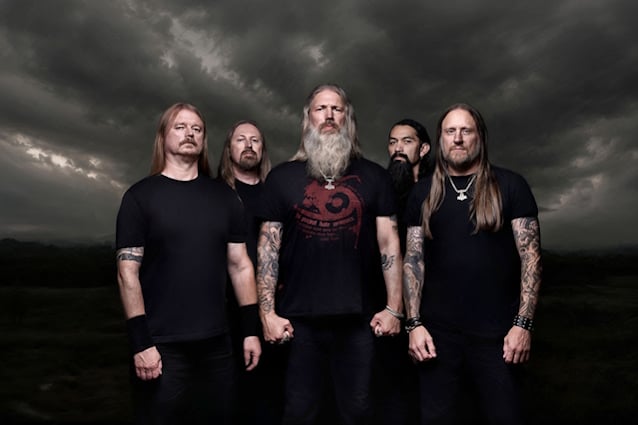
AMON AMARTH's New Album 'The Allfather Awakens' Lands On Global Charts
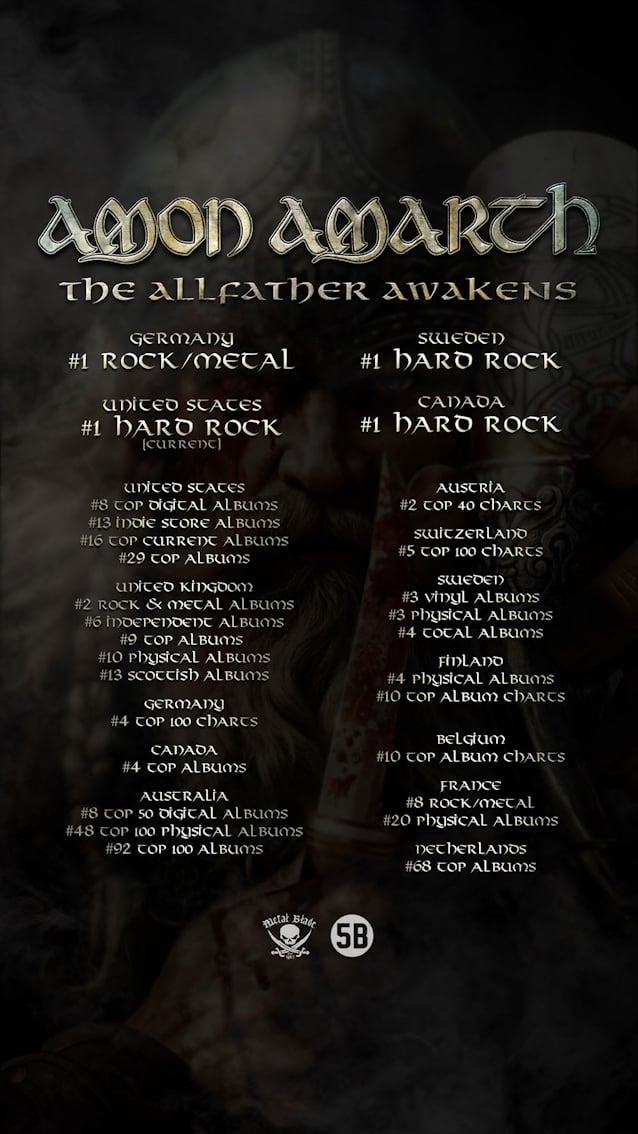
October 28, 2026Swedish metal legends AMON AMARTH's highly acclaimed album "The Allfather Awakens" has swept the charts across the globe. Released at the top of October via Metal Blade Records, the LP currently sits at No. 1 Hard Rock in the U.S., Canada, Sweden, No. 1 Rock/Metal in Germany, plus No. 8 Top Digital Albums and No. 13 Indie Store Albums in the U.S. Additional highlights include No. 2 Rock & Metal Albums and No. 6 Independent Albums in the U.K., No. 5 Top 100 Charts in Switzerland, No. 2 Top 40 Charts in Austria, No. 8 Top Digital Albums in Australia and more.
From AMON AMARTH's 1992 formation in Tumba, Sweden to the worldwide fame they've found in the ensuing years, their lyrical, live and recorded musical legacy speaks for itself. Three decades in and AMON AMARTH are larger and more vital than ever. "The Allfather Awakens" stands as another essential entry in the metal titans' discography. It's another step up, introducing previously untried efforts, an impressive and conscious musical and lyrical feat.
AMON AMARTH is currently performing "The Allfather Awakens" with an entirely new production inspired by Oden's legendary Golden Hall, transforming their iconic concert experience into a living extension of the new album.
As with previous records, Oden, the Norse "all father" who is a deity of war, wisdom, death, magic, and poetry, is the through-line in AMON AMARTH's lyrics and artwork. Once again, Oden is the band's inspiration, but "The Allfather Awakens" is not a concept album, rather a collection of historically inspired epic tales of conflict and sacrifice for a greater good.
"The Allfather Awakens" includes AMON AMARTH's first-ever acoustic excursion "Upphaf", which carries the solemnity of an oral history whispered under the shadow of the Allfather. The album's following singles "Gjallarhorn" and "Eight Legs Of Thunder" arrived as furious AMON AMARTH classics. The album's final focus track, "The Allfather Awakes", encompasses the album's overall theme — "wisdom, knowledge and facts need to become the guide for the future," cautions frontman and lyricist Johan Hegg.
To gain wisdom beyond mortal comprehension, Oden made the ultimate sacrifice — gouging out his own eye and casting it into the Well of Wisdom, Mímisbrunnr, in exchange for cosmic insight and foresight that would shape the fate of gods and men alike. Now, AMON AMARTH bring that ancient reckoning to life and they are extending Oden's offer to you. Those who received the eye know what must be done. Those who did not: seek it out. Sacrifice your sight. Gain your foresight.
AMON AMARTH took a new songwriting approach for "The Allfather Awakens". The album came to life across two recording sessions, months apart, at producer Jacob Hansen's studio in Denmark. AMON AMARTH began writing songs while touring, rather than waiting until they were off the road. The writing and recording process allowed the musicians to intensely focus on each track, resulting in an album where each song was treated as a single. Guitar-wise, AMON AMARTH opted for a slightly less modern approach sonically, moving away from 5150 amps and back to Marshalls. The music was written before the lyrics, setting the tone for the words.
Hegg told Steve Harkins of TalkShopLive about the lyrical themes covered on "The Allfather Awakens": " It's a themed album, I would say, where most of the songs, not all of the songs, but most of the songs, they are in one way or another connected to the Norse god Oden. And it's dipped into a lot of the mythological aspects of Oden from Norse mythology, but also some historical motifs as well, when it comes to Viking history and the Vikings' relations to that god, so to speak."Asked if he and his bandmates were "enthralled with Viking folklore" when they were growing up, Johan said: "I was interested in Vikings from when I was very young. And I think it started in a really silly way in a way because I was interested in history in general. Obviously I knew about Vikings, but I didn't get interested in them until my sister actually wrote with pencil runes on her wall. And I was amazed. I was maybe, like, nine or 10, and I was amazed that we had this written language in Sweden from a thousand years ago. So that's kind of where my interest started, and then I found that this awesome comic book series called the Valhalla series by a Danish cartoonist. And, yeah, it just rolled on from there, basically."
AMON AMARTH bassist Ted Lundström chimed in: "[Vikings were] an interest from a young age. And then when we started the band, when we [began working on music in] '92, we were just looking for our own little genre, to stand out from all the other bands in Stockholm and Sweden at the time. So we kind of put our interest from the Viking mythology into the band, which worked really good for us. There were a couple of bands before us that wrote about Vikings, but it was not too many, so it was kind of like a very small genre."
Hegg and Lundström also talked about AMON AMARTH's working relationship with Danish producer Jacob Hansen, who helmed "The Allfather Awakens". Johan said: "It was the first time we worked with him, and it was great. He's a good guy."
Ted added: "We went to [Jacob] on a previous tour we did in Europe. We had a day off in Denmark, so we called him up and said, 'We wanna come and have a chat and have a look at the studio.' So we got a good day talking to him about what we wanted to do and asking him what he could bring from his side to the new production, and everything felt really good. So he was very, very easy to work with. It was very smooth sailing, the whole recording session."
Asked if there were any moments when he wanted to get Jacob "in a headlock and tell him to leave", Johan said: "No, no, definitely not. I think maybe the other way around because I kept wanting to do other new takes and different versions of what I already did. But no, it was super smooth. I think he was very open to our ideas, I think, and what we wanted out of this recording. And then he came up, as far as I remember anyways, he came up with some cool ideas to enhance the whole production."
Regarding the songwriting process for "The Allfather Awakens", Ted said: "In the past, after we were finished with touring, we started the new album. But this time, since the touring was much longer than we anticipated in the beginning — we got a lot of cool tours we couldn't say no to — so we started, or mainly the guitar players, Olavi [Mikkonen] and Johan [Söderberg], they were starting riffing already and bouncing ideas on the tour, actually. So when we were finished touring for the last album, we already had a head start with a couple of good songs already in the backpack."
Johan added: "I also remember that for the first time... One of the things is that we haven't had a proper rehearsal room for over a decade. And I know especially Olavi misses the chance to work on his ideas in a rehearsal room environment. And I think one of the reasons why it worked really well to work on tour was that we could have a warm-up room with a setup with drums, like digital drums and small amplifiers, and they could jam out the songs in there, which I know that Olavi really likes to do. So I think that's also one of the reasons why it worked so well, that we had to write on tour, that we had that opportunity."
Hegg and Lundström confirmed that AMON AMARTH opted to record "The Allfather Awakens" by focusing on one track at a time as opposed to building the entire album by recording each instrument separately for all the songs that appear on the final LP.
"Yeah, that was one of the ideas we brought to Jacob, asking him if he was okay with doing [it] song by song," Ted explained. "And we also divided the whole album into two studio sessions. So we basically just had five or six songs each time, just to be able to focus 100 percent on each song. Because if you record 10 songs in a row, you really get like... It's so much riffs in your head, so it just gets less quality in a way. So we recorded like one song at the time with drums, bass, guitars, vocals, and it also gave Johan a lot of time to rest his voice until the next song was ready for vocals. So it was kind of a very relaxing and 100% focus on each song."
Added Johan: "And also the benefit is that you record the full song, and then you can leave it. And then at the end of the session, you come back and listen to the songs and see, 'All right, is there anything here we need to change? Is there anything that doesn't really work here? Would it be better to have this kind of drum fill instead of that?' And working the way we used to in the past, where you record all the drums for all the songs and then you break down the drums, then you can't change any drums, for instance, at the end of the recording session. So it is a good way to work because you can always do a bit of changes here and there… For the first session we had six songs, and we recorded those. And then we had to record a couple of more songs, but we had to write them first as well."
Photo credit: Sylwia Makris and Christian Martin Weiss


 Prev
