


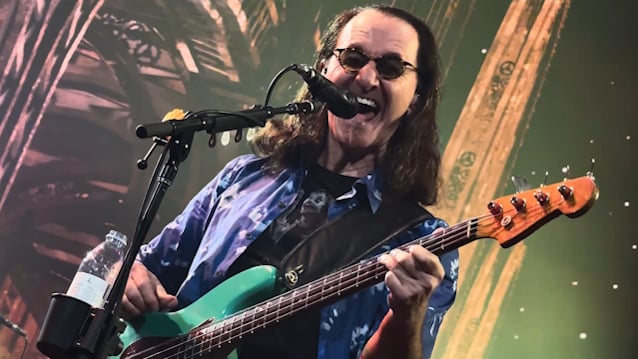
GEDDY LEE On Still Singing RUSH Songs In Original Keys: 'It Was Important To Me To Do As Many Original Versions For Our Audience As We Could'
August 14, 2026In a new interview with Brian Hiatt of Rolling Stone magazine, RUSH bassist/vocalist Geddy Lee and guitarist Alex Lifeson spoke about the band's "Fifty Something" tour, which launched on June 7 in Los Angeles. It is RUSH's first tour in over 10 years and the group's first run of shows since the 2020 death of Canadian rock legends' iconic drummer Neil Peart. The "Fifty Something" tour is also RUSH's first with the band's revamped lineup of classic members Lee and Lifeson alongside Anika Nilles, a German drummer who toured with legendary guitarist Jeff Beck in 2022, and newly added keyboardist Loren Gold, who is best known as touring member of THE WHO and CHICAGO.
Speaking about how he, after over five decades of singing professionally, decided to take his first lessons with a veteran vocal coach, Mitch Seekins, who works remotely from the small town of Ilderton, Ontario, Geddy said (as transcribed by BLABBERMOUTH.NET): "It was important to me to do as many original versions for our audience as we could, and I didn't want to have to start changing keys to every song and go into that whole bullshit. So how do I do that? Well, a friend of ours recommended this vocal coach for me. His name is Mitch Seekins, and he's a terrific guy. He's a great singer, lives in the country now, and that's his job. He coaches all kinds of people. It's really interesting. He coaches opera people. He coaches a lot of rock bands. He coaches one guy who does the play-by-play announcement at a horse racetrack. So, all kinds of people need vocal training, for various [reasons]... He coaches people that, for one reason or another, have started to lose their voice. And so he's very well-versed in analyzing what you got. So I started with him — what? — about a year and a half ago now. And the first few sessions, he was listening to what I had, and he said, 'Okay. Well, you've got a voice that the muscles are out of shape. So you haven't sung in 11 years. That's normal.' So after the first number of sessions, he said, 'Well, the good news is you still have that range in there, but we've gotta strengthen your voice so you can access it.' So that became the beginning of this whole exercise regime. It's no different than going to the gym and getting strong. I go to the gym four days a week, get my body strong. Well, you have to get this muscle [that controls your vocal cords] strong, and that's what I've worked on. And as we went along, he's very good at getting me to stretch my range and also give me confidence in my range. Part of it is learning new techniques to access your range so that you're not working so hard to do it. He would look at videos. Sometimes he'd come to rehearsal, and he would video me. I'd go, 'Well, that's embarrassing.' And he would show me the video and say, 'Look how hard you're working to hit that note.' But yet when we're warming up, you hit that note, and you're not working hard at all. So you have to learn, while you're standing there, to breathe at the right time — that's more than half of it — and to position your vocals and to take a more forensic look at how a voice makes a sound and apply it.' So it's been a year and a half, but it's paying off, and I'm pretty pleased at my progress. I think if I keep working at it, it'll keep getting better, I think. I hope. And I have to stay healthy."
After Hiatt noted that Lee is probably hitting notes that he himself couldn't imagine would be accessible to him again, Geddy concurred. "I thought, 'There's no way I can do that song," Lee said. "There's no way I can do that song. I can't hit those notes.' And he would listen to them and he'd go, 'Well, that's an E. That's high, but you can hit it. You're doing E in warm-ups.' And this is not E. This is an octave above everyone's normal E. 'And I've stretched you out to F sharp. I've stretched you out to G.' … So I was nervous to try some of those songs, and then he would encourage me, and I would do them. And I would struggle at first, and then I'd listen to them with him, and he'd go, 'No, you can do this. Try this. Breathe here. Remember when you're singing the choruses of 'A Farewell To Kings', make it bounce.' And that helps. All those little tricks — they're not tricks; they're exercises — help you realize, 'Look, I got this.'"
Geddy went on to say that he used to sing the classic RUSH songs in the band's earlier years "without any schooling and with more youthful verve. [Mitch] said, 'When I listen to your early records, I can't believe the way you're hitting those notes without even thinking about it.' Because it's a combination — it's what they call blending, where you're blending chest voice and head voice, and I did that instinctively my whole life," Lee explained. "And at a certain point, I didn't really work on the techniques to keep those high songs, so we just started dropping some of those super-high songs. And so that was a challenge for me to bring them back."
When Hiatt pointed out that a couple of the songs in RUSH's "Fifty Something" set are being performed a step down, Geddy said: "'Anthem''s down a step, and '2112' is down a step. Everything else is in the original key. Well, frankly, 'Anthem' sounds much heavier down a step. Sometimes you drop a step to make the song feel more powerful. And although I could do '2112' in its original key, I think it just sounds heavier like this now. Now that's partly an excuse and partly the truth. So, yeah, both of those songs I don't think have suffered. We were gonna drop 'Kings' originally. And then we went, 'Nah, it just sounds better in its original key, so we have to keep it in the original key.' So, we went through the whole catalog like that, judging if the keys were fine and especially with 'Freewill'. There was no way I would do that song unless I could hit that third verse, which is really the highest verse that I sing all night."
RUSH's setlist for "Fifty Something" is culled from a pool of more than 40 RUSH classics, with the band playing two sets a night that celebrate late RUSH drummer Neil Peart's life and legacy.
The 2026 leg of the "Fifty Something" tour, which will cover Canada, USA and Mexico, initially consisted of 22 dates, which sold out immediately, prompting the addition of more shows. The tour now totals 58 shows across 24 cities, with over half a million tickets sold for 2026.
In February, RUSH announced the addition of South America and Europe tour dates to the "Fifty Something" tour, in early 2027. The dates will be the first time the band has played in Europe since 2013 and 17 years since visiting South America.
RUSH performed in public with Nilles for the first time at Canada's Juno Awards in Hamilton, Ontario in late March. They played "Finding My Way", the first song from RUSH's first album, the band's only LP not to feature Peart.
The Juno Awards performance was Lee and Lifeson's first as RUSH since they finished their 40th-anniversary tour in 2015, although they have performed under their own names on occasion, including tributes to legendary Canadian singer-songwriter Gordon Lightfoot and Taylor Hawkins of the FOO FIGHTERS.
Peart died in January 2020 after a three-year battle with glioblastoma, an aggressive form of brain cancer. He was 67 years old.
RUSH waited three days to announce Peart's passing, setting off shockwaves and an outpouring of grief from fans and musicians all over the world.


 Prev
Prev 