


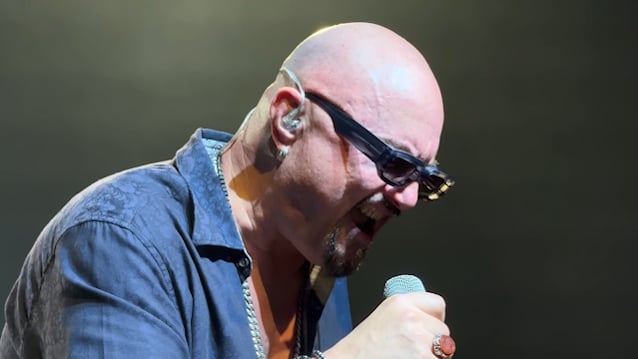
GEOFF TATE: 'I Found My Vocal Range Rather Early In Life'
April 19, 2026In a new interview with Cassius Morris, ex-QUEENSRŸCHE singer Geoff Tate was asked how he found his "vocal range" during his teenage years. He responded (as transcribed by BLABBERMOUTH.NET): "Well, I found my vocal range rather early in life. A friend of mine had a band and they needed a place to rehearse. And I had become recently responsible for my grandmother's house while she was on holiday. And so I was, like, 18 years old and I invited the band to rehearse at my grandmother's house over the summer, which was kind of crazy idea to do. Anyway, they rehearsed in her living room, and it became a band house. And she would call me now and then and goes, 'How you doing with my house? Everything okay?' I'm, like, 'Everything's great, grandma. It's beautiful. Don't worry.' [Laughs] Anyway, the singer for the band got really ill and couldn't sing. And the guitar player said to me, 'Gosh, I can hear you singing in the other room. You have a nice voice. And you can sing RUSH. And we wanna play a lot of RUSH. We wanna play this '2112' album that has just come out.' And he says, 'You can sing that.' I go, 'Yeah, I can sing it. No problem.' So I started singing with them. And so I found that I could sing really high, like Geddy Lee, and I could sing also very low, like Joe Cocker. And so I just found out, just by trying to sing different songs. And I've just been kind of working on it ever since."
Tate also talked about the changes in the music industry over the course of the last four decades, particularly as a growing number of artists choose the independent route and record their music at home studios as opposed to signing with a record label.
"It's completely different now," he said. "Yeah, absolutely different. Every commercial platform is different. The way you distribute music, the way we listen to music has really changed. With the invention of these little guys [earbuds], this really changed things 'cause they sound so good. The technology has progressed to a point where people wear 'em all the time now. Going about their daily business, they're listening to music, they're listening to a podcast, they're listening to the news, they're having a phone conversation with somebody else. They always have that earpiece in. And it's the way the world is working these days. And we try to make our music fit within that technological parameter as well.
"If you listen to, say an older album like [QUEENSRŸCHE's] '[Operation:] Mindcrime' that came out in 1988 — one of the very first digital records ever made; I think one of the first five actually released — and it sounds so, shall I say, antiquated by today's standards, just because of the progression in recording, and the progression in the technology has changed so much now. The bass response, the bass frequencies that we can explore and experience now are leap years away from where we were in 1988. The analog-to-digital converters were just really at the beginning of their development. And now they've got — I don't know — version 22 now that we're using. It's just really, really changed. Really changed."
Tate will release the third chapter in QUEENSRŸCHE's classic "Operation: Mindcrime" album series, "Operation: Mindcrime III", on May 3. The LP's first single, "Power", was made available in late March.
"Power" was written by Geoff and his guitarist/producer Kieran Robertson. It features vocals by Tate, drums by Rich Baur, bass by DISTURBED bassist and "Operation: Mindcrime III" co-producer John Moyer, guitar by Dario Parente and Amaury Altmayer, and synths and strings by Tate and Robertson. It was mixed and mastered by Juan Urteaga at Trident Studios in Pacheco, California.
Released under Geoff Tate's own name and not under the QUEENSRŸCHE banner, "Operation: Mindcrime III" is once again a concept album with a storyline following Nikki, a drug addict-turned-assassin manipulated by a shadowy figure known as Dr. X. However, unlike the first two installments, "Operation: Mindcrime III" will tell the tale from the perspective of Dr. X, "how the story happened from his point of view," according to Geoff. "Which is kind of interesting, I think, because we've only heard it from Nikki's point of view, and he's been sort of this victim throughout the whole story."
Originally released in May 1988, QUEENSRŸCHE's third studio album, "Operation: Mindcrime" took the quintet to an entirely new level. The concept, revealed through the songs, revolves around the character of Nikki, a recovering drug addict disillusioned with a corrupt society. Drawn into a cult-like revolutionary group headed by Dr. X (voiced by the late and beloved British actor Anthony Valentine),Nikki is manipulated to assassinate political leaders until his friendship with nun Sister Mary finally opens his eyes to the truth. Regarded as one of the greatest concept metal albums of all time, "Operation: Mindcrime" was certified platinum in 1991 in the U.S. and was ranked in the "Top 100 Metal Albums Of All Time" by both Kerrang! and Billboard magazines. Rolling Stone included it on a similar list, noting that "nearly 30 years after its initial release, 'Mindcrime' feels eerily relevant."
The original "Operation: Mindcrime" album weaved themes of religion, drug abuse and underground, radical politics. By contrast, 2006's "Operation: Mindcrime II" was regarded as an unnecessary sequel that many felt cheapened the original album, despite being a decent record in its own right.
In April 2014, Tate and QUEENSRŸCHE announced that a settlement had been reached after a nearly two-year legal battle where the singer sued over the rights to the QUEENSRŸCHE name after being fired in 2012. Guitarist Michael Wilton, drummer Scott Rockenfield and bassist Eddie Jackson responded with a countersuit. The settlement included an agreement that Wilton, Rockenfield and Jackson would continue as QUEENSRŸCHE, while Tate would have the sole right to perform "Operation: Mindcrime" and "Operation: Mindcrime II" in their entirety live.
Tate's replacement, Todd La Torre, has released four albums thus far with QUEENSRŸCHE: 2013's "Queensrÿche", 2015's "Condition Hüman", 2019's "The Verdict" and 2022's "Digital Noise Alliance".
Image credit: Scott Perry's Live Rock Music Concerts


 Prev
Prev 