


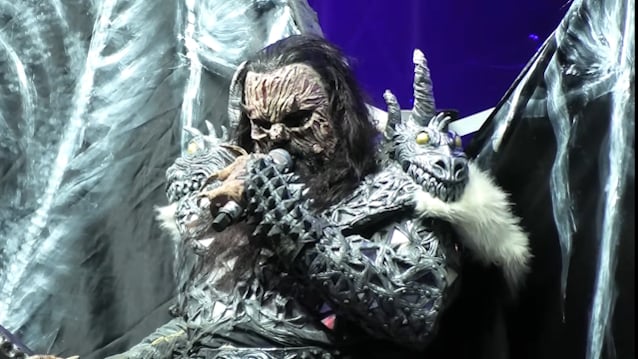
MR. LORDI Says Backlash From Heavy Metal Fans To LORDI's EUROVISION Win Was 'Quite Cruel': 'Those Daggers, They Go Deep In Your Heart'
April 5, 2026In a new interview with Chas Byrne's Rock Show, which airs on Portsmouth, United Kingdom's Express FM radio station, LORDI leader Mr. Lordi spoke about the band's upcoming appearance at the grand final of this year's Eurovision Song Contest. The Finnish hard rockers, who won Eurovision in 2006 with the song "Hard Rock Hallelujah", will perform at the event on Saturday, May 16 in Vienna, Austria. They will reportedly appear with other artists as part of the grand final interval act, which will be a "celebration" featuring a selection of "Eurovision all-stars" performing iconic songs from the contest's history, as part of the event's 70th anniversary.
Mr. Lordi said (as transcribed by BLABBERMOUTH.NET): "I guess they are having us old winners there to perform, which is nice, and a nice way to celebrate our 20th anniversary of the victory too."
Asked if LORDI's 2006 Eurovision win is something that he gets tired of talking about or if he has embraced it as just part of who he is, Mr. Lordi said: "No. The Eurovision itself, I have nothing negative to say about Eurovision itself. It's a good, fun TV show — well, because let's face it, that's what it is: it's a big TV show. I guess it's the biggest TV show in Europe. That's what it is, first and foremost, for me — it is a big TV show, with a lot of viewers and a lot of attention all around Europe… Everything that we've gotten through Eurovision is all positive, but we have had some negative side effects of winning the Eurovision, but that has nothing to do with the Eurovision itself.
"Being a metal band, if you will, or a rock band or whatever you wanna call it — I would call us nowadays already a classic rock band, depending on how you wanna define the genre that we're playing — being a rock band or a hard rock band or a heavy rock band or a heavy metal band or whatever genre you wanna label us, in our genre being in Eurovision is something — or not anymore, but it used to be something that is a sure way to brush away all your credibility as an artist [laughs] in your genre," he explained. "And we didn't realize that — we really didn't realize that. So we had a few years after the victory where we were actually suffering from that because we were considered as 'that Eurovision band'. And then you realize that there were a lot of people who thought that we are a band that was only formed because of Eurovision and forEurovision, and the song was written for Eurovision. And no — none of that could be further from the truth. I mean, none of the elements in what we're doing or what we did in Eurovision was done forEurovision, if you know what I mean. It was all done organically and naturally of the art that we're doing — the song, the performance, everything — and it just happened to have a forum like Eurovision. And the backlash that we got was pretty interesting. And looking back, it was quite cruel to have that from your own camp of people, meaning the metal people, that the metal people in some countries and in some circles were the first ones to attack us, and saying that, 'Oh, LORDI's a joke.' 'Ah, they're meant for children.' Ah, it's a joke. It's not real. Ah, silly, stupid rubber monsters.' So they wouldn't take us seriously in a way. And, of course, that kind of thing, it hurts — it really hurts you as an artist. I mean, those daggers, they go deep in your heart — they really go deep. So that kind of a thing. But then, years go by, time goes by, and then all of a sudden it's not like that anymore. But there were a few years after the victory that we were suffering from that, from the backlash."
After host Chas Byrne noted that LORDI's Eurovision success paved the way for other hard rock and metal bands to enter the competition, Mr. Lordi concurred. "Yeah, I think so. I think that's fair to say," he said. "From my opinion, I guess so, yeah. But many people don't remember that almost half a decade before we went, there was already NIGHTWISH that was entering the Finnish competition." Referencing the fact that Eurovision voting features a 50/50 split between professional juries and public televoting, each contributing equally to a country's total score, Mr. Lordi added: "Yeah, NIGHTWISH tried, I think four years before us already. They tried, but they couldn't qualify from Finland, because the televote, they would've voted NIGHTWISH to be the Finnish representative, but the jury, the Finn jury gave them, like, zero points and somebody else went instead."
Asked what he thinks was the "changing point" in Finland that allowed a band like LORDI to represent the country in the Eurovision Song Contest, Mr. Lordi said: "Protest. For the Finns to vote us was… Because when we went through that, it was an invitational contest — I mean, a competition that year. We were invited. We didn't even have the slightest thought ever that we should go to Eurovision — that was something that we never even thought of — until we were invited for the Finnish competition. So we were, like, 'All right. Well, okay, let's go.' And we, honestly, blue-eyed and all innocent, we thought, 'Okay, we just go there for the Finnish competition. There's no way we can win the Finnish competition, but we will just get some free P.R. on national primetime TV. There's no way we can win [beat] this other artist in Finland. But, hey, our new album is coming out, so we just get some free exposure on national TV in Finland.' And, to our big surprise, the televote, we won it by a landslide from the Finns — we won it so clearly. But once again, the jury did not; the jury didn't give us really [laughs] that much value, the Finnish jury. But by that time, when we knew that, 'Okay, we're gonna go there,' we already knew that if we go to Athens, to the actual main event of Eurovision, we have a good chance of qualifying in the top five or minimum top 10, which would have been the best Finnish ranking ever. We knew that — that is just mathematics; we knew that that's probably gonna happen. But in February 2006, we were still thinking that, 'Okay, we have no way of actually winning the Finnish competition.' That is a much, much, much, much more difficult mountain to climb."
When Byrne noted that LORDI received 292 points at the 2006 Eurovision, which, at the time, was the highest score in the contest's history, Mr. Lordi said: "That might have been a little bit of a surprise, but the winning itself was not that big of a surprise because we just calculated, because this was the first time Finland ever sent an artist that was already known outside Finland. That had never happened before. And most of the cases, in all the countries in every year, the artist that goes to represent any respective country, any country, the artist is not known outside your borders of your country. So it doesn't matter what track record you have back home, how many platinum albums you have home, because you are zero, you are nobody, nobody knows you. So we were in a very special position, going to represent Finland then, because we already been touring around Europe in the metal clubs and metal festivals and rock festivals and rock clubs for three or four years before we went. So we already had a fanbase around Europe in pretty much every country. So we knew that we will bring our own voters, the people who would not normally watch Eurovision, or at least they wouldn't admit that they're watching Eurovision, and let alone that they would vote, but that year they voted not necessarily because they would be fans of LORDI, but because they're fans of the genre. Our German record label at the time, Drakkar Records, they did an amazing campaign, they did a really good job of [promoting], to the metal clubs around Europe, that 'I vote for LORDI'. They made the stickers and the pins, and so all the metalheads, even they would not really be into LORDI as a band, but as a metalhead, for many people, it was their duty to vote for LORDI in Eurovision — as a protest. Like, 'Okay, hey, we're here, metal people. We're here.' So we already knew before we went to Athens that, 'Okay, this is pretty much something that most likely will happen. And let's just see how big are the numbers of the metalheads of Europe. And it turned out to be that, well, yeah, the biggest points ever by that time. So we brought in our own voters, in a way."
As for why no hard rock or metal artists have won the Eurovision Song Contest in the two decades since LORDI's victory, Mr. Lordi said: "That kind of thing — it's funny to think of it — that thing could only happen once. Because Finland, after that, has sent two other artists years later or a decade later. They sent THE RASMUS, which is very, very well known around Europe. They sent THE RASMUS and a song that was written by [noted pop and rock hitmaker] Desmond Child. And I don't think they even went into the top 20. So that whole thing didn't really work for them. So I think that only worked once. [Laughs]"
LORDI caused a sensation by winning the 2006 Eurovision with "Hard Rock Hallelujah", which in turn made the band's third release, "The Arockalypse", a hit throughout Europe. On the back of their Eurovision win, they scored a lucrative series of promotions including LORDI-branded cola, boiled sweets and credit cards; and played live at the MTV European Music Awards. A square was renamed in LORDI's honor in the Lapland city of Rovaniemi; a LORDI-themed postage stamp was issued in Finland and the group starred in its first film, called "Dark Floors".
With their monster-movie stage persona, LORDI seemed a most unlikely choice to represent their country in the Eurovision Song Contest. So you can imagine how many people were shocked when the group not only claimed top honors, but also earned the most points in the venerable event's history.
Back in 2017, Mr. Lordi admitted to MariskalRock that he was initially comfortable about LORDI's connection to Eurovision. "There was a time a couple of years ago — well, more than a couple — when I really, really, really hated that everybody's always asking about the goddamn Eurovision; there was a time," he said. "Nowadays I have come to terms with it. It's, like, okay, I'm actually proud that we are part of Eurovision history and I am proud that Eurovision is part of this band's history. I mean, it is a big part of our awareness. Because the awareness of the band would be so different, it would be so much smaller, without that one TV show ten years ago."
He continued: "I absolutely don't regret that — absolutely not. Because I have nothing bad to say about Eurovision itself, but the problem that we have had in the years is the people who actually don't know anything else except for the fact that we were on Eurovision. And that is a big stamp to get out of — it's like a fucking tattoo, you have a fucking tattoo on your forehead that says 'Eurovision.' And that is something that really, really, really drove me nuts some years ago; I was really struggling with that.
"I have come to terms with it — it's all right; I mean, it's cool," he said. "I am proud of it. And every May, when there's a new Eurovision, I know that my phone will start ringing and people will ask my opinions and then we get requests: 'Do you wanna come to this country's semifinals? Do you wanna come here?' And for years we said, 'No, we don't wanna. We don't want to.' But now, we're, like, 'Fuck it! Let's do it. What the hell?' I mean, c'mon, it's all fun, and it's part of our history, and the Eurovision, they really want us to come there, because, let's face it, we are one of those winners that people still remember."
In May 2023, Mr. Lordi was asked in an interview with Mulatschag TV if it was strange for him to see elderly people and 10-year-old kids in the front row at LORDI concerts following the band's appearance at Eurovision. Mr. Lordi said: "It was not that weird. Even before that, we were already a band that was touring and we had two albums out before that. And we've always been a band like, let's say KISS or Alice Cooper, for example, that we don't only gather certain age groups. Of course the diehards of any bands are in their 20s, but we've always been a band that we've always had little kids and even older people digging us. So in that sense it was no different. But since Eurovision, of course, the amount of those people, and when you see that these people have only seen that one fucking three-minute TV [performance] and that's all they know about the band, that was weird."
He continued: "I especially remember one moment in the summer of 2006, after a festival, I come down the stairs and I walk by the fence — like this barbed wire fence or something that is blocking the backstage area — and there are people waiting for autographs. And the weirdest thing is that you see these old grandmothers with their granddaughters and grandsons. And I'm dripping fucking blood — fake blood, but still I'm dripping blood — I have horns on my head, I have fucking red eyes and shit, and they're, like, 'Yeah', like they were fucking seeing Elvis or Jesus or something. And in that moment I realized that they don't see what this band is about. So that was weird. And eventually, a year or two years after that, when people only… They had some sort of a false image in their head what we were about… Of course it is the stupidity of themselves because they didn't bother to check it out. So when they came to our shows only because of that one song, so it was a long fucking 90 minutes before that song came out, when there's a lot of blood and guts and songs about anal fucking and all this shit. And they were, like, 'Why is LORDI changing all of a sudden? They should be family friendly.' Fuck that shit. We were never family friendly."
Mr. Lordi added: "When it comes to misconceptions… It's not about nationality and it's not about religion or it's not about age or sex or anything. It is like a default setting, like a false setting of a human that once you get some thought in your head, it is really difficult for you to let go of that. And when that false conception is shattered, your mind doesn't kind of understand it —'Why? What the fuck?' Because God forbid you cannot admit that you were wrong. That's how it goes."
Image credit: Damien


 Prev
Prev 