


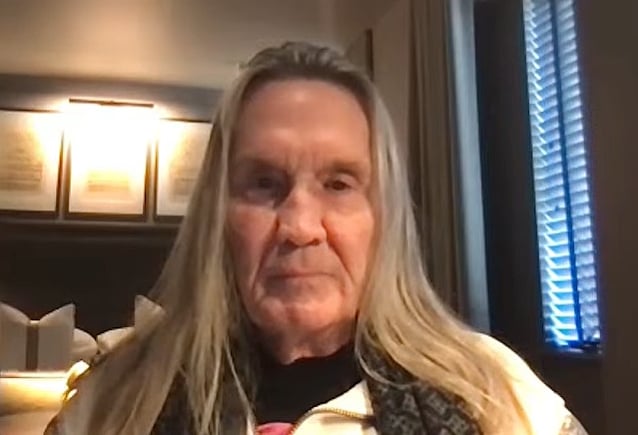
NICKO MCBRAIN Believes IRON MAIDEN Should Have Tuned Down At Least Half A Step To Accommodate BLAZE BAYLEY's Singing Voice
October 25, 2026In a new interview with Barry Robinson of Classic Album Review, former IRON MAIDEN drummer Nicko McBrain, who is currently promoting his autobiography, "Hello Boys And Girls!", spoke about the five-year period when the British heavy metal legends were fronted by Blaze Bayley. Singer Bruce Dickinson exited MAIDEN back in 1993, paving the way for the Bayley era and a string of four solo albums from Bruce. Blaze was considered an odd choice to replace Bruce considering that Blaze's singing voice is quite clearly a baritone in contrast to Bruce's tenor/alto range. Bayley fronted IRON MAIDEN from 1994 until 1999. The two MAIDEN albums he appeared on, "The X Factor" and "Virtual XI", sold considerably less than the band's prior releases and were their lowest-charting titles in the group's home country since 1981's "Killers".
Asked if there was any resentment in the MAIDEN camp surrounding Bruce's departure and whether he feels, in hindsight, that the singer's exit could have been "handled better", Nicko said (as transcribed by BLABBERMOUTH.NET): "Oh, yeah, without a doubt. I was the most outspoken one of the guys, out a lot of them, about the way that all went down with Bruce. And there was a lot of bad blood in as much as I thought, well, why didn't he wait till the end of the 'Fear Of The Dark' tour [to announce that he was leaving]? Why did he have to say he wanted to leave halfway through it? And my take was, why do I wanna... And I'm gonna be a bit rude here. I mean, it's well documented, but you've asked the question and I'll answer it. I felt, why do I wanna look at his sorry arse on stage every night and I know he doesn't wanna be there? It was a very personal inward thing for me. Then I'm thinking, 'Well, what about the fans? We're not giving them a subpar performance,' 'cause he didn't wanna be there. And all this kind of stuff, this malarkey was going through me noggin. But when he came back, we had a meeting in Brighton. Janick [Gers, MAIDEN guitarist], Bruce and myself drove back to London for last orders at the local pub in Chiswick that Bruce and Janick used to go to. And we talked about it, and I said to him, 'Bruce, I can't take back what I said and how I felt about when you left the band five years ago, six years back,' I said, 'but I love you and I'm glad you're back in the band.' And he looked at me and he put his arm around me. He says, 'I wouldn't have it any other way, Nick. I love you too.' And we've never spoken about it since. And that's so good, because we put it to bed."
When Robinson noted that MAIDEN's first post-Blaze album with Bruce, 2000's "Brave New World", was an "impressive comeback" effort, Nicko concurred. "Absolutely," he said. "Well, we went to Paris. We made the album at William Tell Studio, or the Guillaume Tell Studio. And, of course, we had the wonderful dynamic [with producer] Kevin Shirley twiddling the knobs. It was a new driver for us, sitting back there in the control room. And Kevin was great to work with. As you know, he's done every album with the band since, going forward. So there was that dynamic of the band being back together. You know, 'Oh, we're putting the band back together.' [Laughs] It's the old BLUES BROTHERS scenario. We had that, the excitement of being in Paris and doing it in this wonderful studio, and having Kevin. And it's a stunning album. And the sound was completely capturing the essence of the band, and I think Kevin has done a great job ever since with that, in that respect."
After Robinson pointed out that it must have been "tough" for Blaze to replace Bruce, Nicko said: "It was, honestly. Oh, and, of course, when Bruce came back, we had Adrian [Smith, MAIDEN guitarist] come on board. And Adrian was such a key instrumental part in the meteoric rise of the band. He was more of the commercial writer in the band. Well, he wrote most of the singles that we took off [albums] over the decades."
Nicko continued: "To be fair to [Blaze], we didn't transpose the songs. We should have gone down a note. We should've stepped it down half a step or a full step, because trying to sing that range that Bruce had, and Blaze was a totally different… Bruce is soprano, almost, and, [Blaze is a] baritone — there was a difference in the timbre of each of the voices. And I think it was very hard for Blaze towards that. 'Virtual XI' tour was really tough for him. And I think we really should have helped him out by transposing the key of the songs for him. But we didn't, and it was a tough time. It was like a dark cloud for me, that period of my life. And I know it was affecting just the general vibe in the band. And, obviously, when it was discussed to have Bruce come back with Adrian, that's when we had to say, 'Okay, Blaze, we've got Bruce.' And the wonderful thing about Blaze is not only that was he — I was like a mentor to him. I took him under my wing, being the granddad of the band, right? [Laughs] We used to hang out a lot, and I was his confidant. He'd talk to me about, what would Steve [Harris, MAIDEN bassist] think if I did this? What did he ... Da, da, ya, di, da. Anyway. So it was very hard at the end of the day to feel a little disappointed in the performances that he was coming up with. And finally, when we had the meeting with him, all of the band were present, and Rod [Smallwood, MAIDEN's longtime manager], and he took it on the chin, as they say. And he turned around, he said, 'MAIDEN is too good not to carry on, and you're gonna carry on with the best.' And that is still his attitude today. Although he was kind of disapp[ointed] — obviously, he was disappointed to not be the singer in the band anymore. But he was very, very gracious. Very gracious. And I love him for that."
In October 2025, Dickinson was asked by the "Talk Is Jericho" podcast, hosted by FOZZY frontman and wrestling superstar Chris Jericho, if he paid attention to what MAIDEN was doing while he was out of the band. Dickinson said: "No. [It's not that] I didn't have any interest in listening [to MAIDEN's Blaze-era albums]. I was just too busy doing my own stuff. So, it was kind of peripheral awareness, but in a way I was just, like, 'This is none of my business. I'm not in the band anymore.' And I wished Blaze well, 'cause when he joined the band, I thought, 'Wow.' 'Cause his voice is very different to mine. I loved what he was doing in WOLFSBANE. And I thought, 'Well, this is… I hope it works out the right way.' And sadly it didn't. But I love Blaze. I think he's a great character. There's not a malicious bone in his body. He's a great guy."
Asked if it was his or bassist Steve Harris's idea for MAIDEN to perform the Blaze-era songs "The Clansman" and "Sign Of The Cross" upon Dickinson's return to the band, Bruce said: "You know what? I actually can't remember. But when I heard it, I was just, like, 'Well, I think I could put some blood on the walls with that.' To be honest with you, not all of the songs that they did with Blaze, I think, would necessarily suit my voice. Because some of the songs they wrote for Blaze are not really in my range — they're a little bit low. Whilst Blaze would sing a particular tune with a lot of power, 'cause it was in his range, I would frankly struggle to make that tune sound as effective as Blaze, 'cause it's a little bit below where all the horsepower kicks in with my voice."
Back in 2018, Dickinson was asked by the "Rock Talk With Mitch Lafon" podcast why he agreed to perform some of the Bayley-era IRON MAIDEN material upon his return to the band in 1999. Dickinson said: "Well, you know, life's too short to go around chucking your ego around like that — it's childish, it's stupid. And, actually, some of those songs kind of worked [with my voice], some of them didn't, but you know what? They were all songs which a lot of IRON MAIDEN fans bought, and some of them, in particular 'The Clansman' and 'Sign Of The Cross', I think we really nailed those songs and I thought it was great material. Blaze's voice, obviously, was quite different than mine — it was a slightly lower register — and, actually, I wasn't complaining, 'cause I could use this kind of lower baritone tone and get quite kind of robust on it all. And I really enjoyed singing those songs."
Dickinson went on to say that he "had the utmost respect for Blaze, because he stepped into a situation that was extremely difficult for him. Because, manifestly, his voice was so different to mine and yet he had to try and sing some of those [older IRON MAIDEN] songs. He was in a difficult place. And he was a very, very nice guy, and still is a very nice guy, and I have a huge amount of respect for him."
Dickinson told the "Do You Know Jack?" radio show that he "was surprised" Blaze was chosen to replace him in IRON MAIDEN. "I was delighted for Blaze, but there was a whole bunch of other really good singers out there," he said. "I thought 'Wow, they could have picked somebody with a voice that could do what my voice did.' But they picked Blaze. Obviously, they picked somebody different, but that came with its own set of challenges. I just wondered whether anybody in the management was really giving anybody any serious words of truth on how hard this could be."
In August 2019, Harris was asked by SiriusXM's "Trunk Nation With Eddie Trunk" why was it important for MAIDEN to still play Bayley-era songs even though Dickinson had been back in the band for so many years. Harris responded: "We're doing 'The Clansman', which is from [1998's] 'Virtual XI' [album], and we're doing 'Sign Of The Cross', which is from [1995's] 'The X Factor'. We've done 'em before, anyway, with Bruce; he really likes those songs, so he was really happy to do 'em. And I'm not gonna complain, 'cause I'm happy with doing 'em songs. But I think it just mixes the set up a bit. I know that those albums are not as well known as some of the other albums, especially over here [in the U.S.], but they're really good songs, and live, I think, they come into their own. So, yeah, it makes for an interesting set."
Pressed about whether he still stands behind the material that MAIDEN wrote and recorded while Bayley was in the band, Harris said: "Oh, definitely. I said at the time that I thought a lot of people would, in the future, get into those albums a lot more and maybe understand 'em a bit more and give 'em more of a chance. And that's what's happening — loads of people are really enjoying those albums more now. I think there's some really, really good songs on both those albums, and they stand out to me as most of our other albums. But it's like anything — I think you need to hear the stuff a few times, and I think a lot of people couldn't get past the fact that we had a different singer, and it was one of those things. But it was well received more in the rest of the world, really; the U.S. was a little bit more awkward. But I think a lot more people are finding that they're giving it a second chance, if you like, and actually really enjoying 'em."
Less than two years ago, Blaze spoke to Tony Webster of "The Metal Command" about some fans' initial reluctance to embrace his era of MAIDEN. When Webster noted that Blaze's solo work over the last two decades has gone a long way toward "changing the narrative" of his time with MAIDEN, Bayley said: "Yeah, I think you're right, Tony. I'm hearing this a lot. People look back and they go… Some fans go, 'Of course I've got every IRON MAIDEN album, but the ones I haven't listened to are [Blaze-era albums] 'The X Factor' and 'Virtual XI'. And now that's all I can listen to that I haven't listened to a hundred times. I have to listen to those. And it's exactly what you say to me.
"'The X Factor''s got some incredible music on it, but the sound of it is so dark, and the way it was produced, it's not accessible like some of the other MAIDEN albums," Blaze explained. "You've gotta live with that for quite a few spins until you're tuned into what things are doing. Then you can get to the music. I think that was maybe a problem with it at the time. It's so dark and the sounds of things were quite different to what came before. People who did live with it, managed to find it. And it's different cultures as well, different countries. In Sweden and Spain, those albums, people loved them as much as every other [MAIDEN] album. But in other places, people didn't. It's a different thing."


 Prev
