


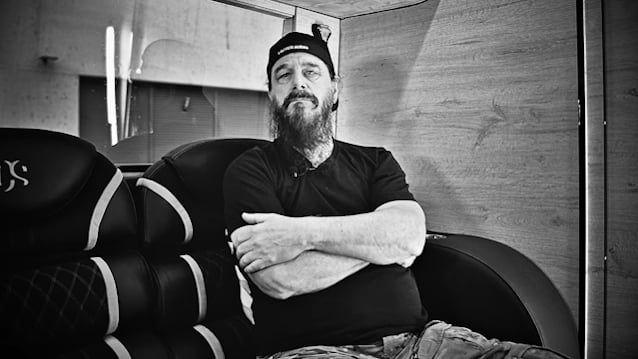
PAUL BOSTAPH On Joining SLAYER More Than Three Decades Ago: 'I Didn't Have To Try To Be DAVE LOMBARDO'
April 25, 2026In an interview with Drumtalk, the video podcast by German drummer and videographer Philipp Koch, SLAYER and KERRY KING drummer Paul Bostaph was asked how he developed his signature "relentless tom-and-snare rolls" which were first audible on his debut SLAYER studio album, 1994's "Divine Intervention". He said (as transcribed by BLABBERMOUTH.NET): "Well, that was a long time ago. But that was also the first album that I did as the new drummer of SLAYER. So I put a lot of time into working hard to improve my playing, to be the drummer that SLAYER needed, because the drummer that they had [before I joined], Dave Lombardo, is a great drummer. You just don't come into a band like that — I didn't; I didn't wanna come into a band like that, filling in for a drummer like Dave, not trying to be him — nobody will ever be him; he's his own drummer; he's a great drummer — but trying to be the best drummer I can be and give the fans what they expect."
Paul continued: "I was a fan myself, so I kind of already knew [what the fans would want to hear]. So I go back to when Nicko McBrain replaced Clive Burr [in IRON MAIDEN]. I was a big Clive Burr fan [and a] big MAIDEN fan, but when Nicko came in, when you put that needle on the record, which there was a record, you put the needle on the record and you're, like, 'Okay, come on, man. Come on. Just don't let me down.' And, boom, the intro for 'Where Eagles Dare' comes on, you're, like, 'Yes!' So that expectation in myself, in that moment, made me go, 'Dude, you have to work hard, because if you just try to be the drummer you are, that they accepted to be in the band, it's not good enough.'"
Bostaph added: "It took a year for us to work on ['Divine Intervention'] and record it. So I told myself I had one year to improve. At the beginning of that year, I was the same drummer, but at the end of the year — if you saw me at the beginning of the year and you heard me at the end of the year, you'd go, 'Whoa, what happened?' So I worked really hard to try to achieve that. The bottom line is the more you practice, the better you're going to get. Period. If you practice with the band for four hours, or however long that is, but if you show up early and you practice for an hour before the band gets there, you put five hours in of drumming a day. And on top of that, for thrash metal or for heavy metal, nothing can replace the intensity of playing with your band. So if you practice by yourself all the time, there's an intensity level to that. But when you go and you play with the band, that becomes way bigger. So nobody's ever gonna practice after the band is done. You wanna go home. You shouldn't be going, 'Well, I can play for two more hours after band practice.' You should probably have put all your effort into the music, and then it's time to go home. So the idea is get there early, if you can. Get there early, even if it's a half hour. Work on the ideas during that you have, [that] you're playing during your songs.
"I would always record rehearsals with SLAYER, and I would take the tapes home and I'd listen to them," Paul revealed. "And I would hear something I was trying to do, and sometimes it would just fall flat on its face, but I would know that there was an idea there that I hadn't played before that would work with what the guitar riffs were doing. The band didn't practice on the weekends, so on the weekends, I stayed back and I practiced by myself and worked on all those ideas. And then when Monday came around, when we started practicing again, I was able to nail parts and they became signature parts. And I worked really hard on that. So some of the stuff that happened on that record was totally improvised — it just happened. I was, like, 'Whoa.' Like the end of 'Dittohead', the very end roll in 'Dittohead', I didn't practice that. I had no idea what I was gonna do, and it just happened, and I was just, like, 'Whoa, I want that drum fill. That's cool.' And that happened in the recording studio. So some of the stuff in that record was not planned out, and there was other stuff that was planned out. So as far as the long drum fills and stuff like that, part of that has to do with playing with the band and knowing what fits with that band. Also, before we did that record, I did some touring with them and played their old songs, and some of their current songs from the record before. So I didn't need to play exactly what the other drummer played, what Dave played. I didn't have to try to be him, but when you listen to a SLAYER song, they have a certain sound, and phrasing is what's important. So if you phrase something or you put it in a place in a familiar spot that has a familiarity to what they played before, people will feel like it's the same, but it's different in some way. And what the different part about it is, is you — the drummer is different. But the phrasing is kind of close, where you put it in the song or just a particular type of fill. I think some of it was derived from playing with the band and the old material, 'cause that really helped me settle into being the drummer of the band. If we hadn't done the old stuff and I just would've joined the band, it would've take me a lot longer to figure it out. But since we'd already toured together, I kind of knew what worked and what didn't work, and that helped with the new album, with 'Divine Intervention'."
Bostaph was SLAYER's drummer from 1992 until 2001 and recorded five albums with the band — the gold-certified "Divine Intervention" (1994),the 1996 punk covers album "Undisputed Attitude", "Diabolus In Musica" (1998),"God Hates Us All" (2001) that received a Grammy nomination for "Best Metal Performance", and 2015's "Repentless", as well as the live recordings "War At The Warfield" (2001),also certified gold, and "The Repentless Killogy" (2019). In addition to SLAYER, Bostaph has been a member of FORBIDDEN, EXODUS, SYSTEMATIC and TESTAMENT.
Bostaph rejoined SLAYER in 2013 after Lombardo was effectively fired from the band due to a contract dispute with the other members of the veteran California-based thrash metal act.
Last year, Paul told BLABBERMOUTH.NET about his approach to the SLAYER gig: "When I went into SLAYER, obviously the first thing I had to do was learn Dave's parts. That wasn't my drumming style. I had to practice; I had to learn his parts. I had to learn the songs, but I already kind of knew them; it was the drumming that was challenging. It was somebody else's style. It was the first time in my life, although I had listened to records and played other styles, that I had to learn the style of a drummer as well as I could. When I got the audition, it was like, 'If you close your eyes and you hear something different, it's not going to be right.' It was about being as close to what Dave could do as humanly possible. That's what I tried to do. Obviously, it worked out in my favor. I was able to do it, and I got the gig. Moving forward, it was during the songwriting process that I learned the most. I toured with those guys first. I did about eight fill-in dates, and doing those gigs, I got more confident in playing with them. Kerry [King, guitar] and Jeff [Hanneman, guitar] were very unflappable. You couldn't do anything to get their attention on stage. But if you did something cool, they'd turn around and look at you. Once I got comfortable with them and the set and the songs, I would throw some stuff in there, like, 'I want to do this anyway. What are they going to do? Fire me?' And they loved it. Those kinds of things, that experience, moved over into songwriting. That first record [1994's 'Divine Intervention'] took us about a year. We were ready within the first six months, but Kerry and Jeff were watching NHL hockey. We had to wait another six months. For the first time, I really immersed myself in the parts. That first record, I improvised some stuff, but everything I did was not calculated; it was thought out. I taped every rehearsal and listened to it at night or the next morning to see if it was good enough. The benchmark was Dave. That standard he set had to be met as best as could be."
In a 2015 interview with Fuse, King stated about Bostaph: "Paul, I mean, he's a machine. I don't worry about him at all. He never would have been out of SLAYER if he didn't quit twice. It was never over anything personal — he was always my friend — so it was very easy for him to come back and be a part again."
Speaking to Loudwire about Bostaph's contributions to SLAYER's final album, 2015's "Repentless", King said: "I think it's just making the unit whole, more than anything. Of course, Paul can play the shit out of the drums. I didn't realize — and I don't mean this in a detrimental way to Paul — I never realized Paul had so many niche SLAYER fans who are just Bostaph fans; I didn't realize that, and a lot of people had mentioned that to me since Paul has been working on the record. And I think that's great, 'cause people are gonna be stoked when they hear what he did on this record. I used to say 'God Hates [Us All]' was his 'Reign In Blood' — Bostaph's. The new one is his 'Reign In Blood'. The new one's… I would play any song live."


 Prev
Prev 