


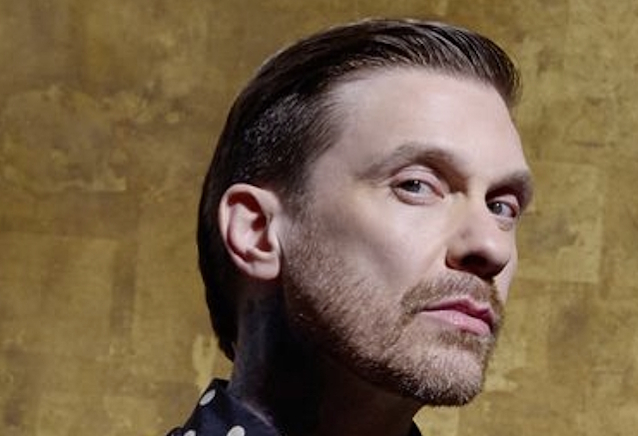
SHINEDOWN's BRENT SMITH: 'We're Living Proof That You Can Grow An Audience From The Radio'
September 20, 2025SHINEDOWN singer Brent Smith recently joined Billboard's "Behind The Setlist" podcast for a wide-ranging talk about the band's music and business. Smith explained the importance of radio for the band and how it has helped give SHINEDOWN a career in a way that streaming alone couldn't replicate. He also explained the writing of one of the band's new songs, "Three Six Five", and talked about the band's upcoming album and tour plans.
Asked what he thinks has been the secret to SHINEDOWN's success so far, Brent said (as transcribed by BLABBERMOUTH.NET): "I think there's a couple of things. I live by the motto that the secret to success is to never arrive. Once you figure that out and understand that there's always a bigger mountain to climb, depending on who you are, what you have to say and how you want to present yourself to the public from a global scale as an artist.
"I think we're very, very lucky because we've always looked at SHINEDOWN as everyone's band," he continued. "So even from the beginning, that ideology of, 'Is it a rock band?' — yes, it's a rock band, but that's not everything that we are, because we're not influenced by just one style of music or one genre. We have a pretty vast palette. We swim in a pretty big ocean.
"I've had people say it to me before, they're like, 'Are you a rock band? Are you a pop band? Are you a country band, a metal band, an alternative band?' I'm, like, we're just SHINEDOWN. We would like to think that there's something for everyone. The other side of that is whether you've been a fan of the band from day one or you're just kind of finding out who the band is, the way we've always seen it is our audience allows us to evolve and to be ourselves. So they want us to not give them the same song over and over again. They don't want the same record over and over again. So that makes it very challenging for us in the studio because you don't ever wanna write a record or write music for an audience per se. I do kind of come from the Rick Rubin school — when I'm saying that where it's, like, if you're walking into a studio and you're saying to yourself, 'I'm gonna write this album,' or 'I'm gonna write this song today because I wanna win an award,' that's not the way to do it, I don't think. I think that you have to write it because you have something to say. So I think that there's an authenticity to what we do, or at least I hope there's an authenticity to what we do, that the public can see is very genuine with us. So I think that's where some of the longevity comes from.
"In North America and Canada, I've gotta be honest, 'cause I'm not taking anything away from any other territory from a global scale, but specifically in North America, the reason this band has had the career that it's had thus far, and while we're very proud of the last 20 years, we're focused on the next 20 years and beyond, is broadcast radio, terrestrial radio," Smith explained. "Even with the consumption of streaming and how there's an open floor now, which I think is great — I mean, for the discovery of new music — but when you're in a band, what I can tell people, and this is just from my experience, streaming will get your music played, but radio will give you a career, 'cause it gave us a career and it continues to do that. So radio is a big part of the success of the band in North America. And also because we're on multi formats, 'cause we are on alternative radio, we are on active and mainstream radio, we are on pop radio, we are on alternative radio, we are on hot AC, we're on AC… Once again, SHINEDOWN is everyone's band — eight to 80 and beyond.
"I know that's kind of a long-winded [answer], but it's a lot to unpack because we take the music and we take the brand very, very seriously, but we also take all the program directors and the APs [associate producers] and the music directors that have been with us from day one that are still with us and the new stations that are with us…
"Rock and roll is most certainly not dead, and radio is most certainly not dead," Brent added. "We're living proof that you can grow an audience from the radio."
Asked what he thinks it is about radio specifically that has helped SHINEDOWN so much, Brent said: "I think specifically the one thing about radio is that it's localized. We'll just utilize North America for a minute here. You have 50 states in the U.S., and inside those 50 states you have multiple cities. And inside those multiple cities, you have multiple towers from AM to FM, and then you have different formats inside of those cities. So you're curating a very specific audience in those states and in those cities. What makes them original? What makes them true to who they are? What are those markets like? What are the people like in those markets? What are they into? You have the sports teams. You have the culture. You have the dynamic of education, you have the dynamic of the restaurateurs, the art districts. There's all these different things, but in each one of those states, it's very localized in what they're into, what their identity is. So those radio stations are very, very proud of their culture and are proud of their people. Now, granted it's a lot of work because you've gotta go into all of those different markets and you have to go into all those cities. And for a band like us, one of the things that we have to be very strategic about, because we care so deeply about radio and those formats, we have to make sure in certain cities, if we're being played on six radio stations, each one of those stations, we need to be able to go in and say hi, say thank you, do promotion, do very specific events. So you have to tailor your touring cycles and your album cycles to making sure that you're able to get into those fundamental markets. And it's not just the A markets or the B markets, it's also the tertiary markets. That's another thing about radio that's really, really powerful. A lot of times people will talk about the A markets, like the big cities, but they don't realize some of those tertiary markets, they have just as many people and you don't want to neglect those markets.
"The tour that we just got finished with, the 'Dance, Kid, Dance' tour, there were two legs of that tour," he continued. "And the way that I see it is the first show on the first leg was in Des Moines, Iowa. And the first show on the second leg, or the first two shows on the second leg, was the Boston Garden and Madison Square Garden. Well, yes, they're different markets. But the reality is that the Des Moines arena holds 15,000 people and the Boston Garden and Madison Square Garden hold 15,000 people, the way it's scaled. So, you see what I'm saying? They're still the same magnitude of the public. So that's a lot of why it's important for us personally, is you wanna build it grassroots, because when you go outside of America, it's a little bit different. When you talk about the scale of streaming and consumption and YouTube versus Spotify, Deezer, what you get in the European markets, the U.K. markets versus what you do in Australia or South America or Asia.
"So that's kind of a long-winded answer, but the fact of the matter is you keep coming back, you keep touring those cities in North America. Our band has kind of always looked at it — you wanna steadily be growing, you wanna steadily be climbing those mountains because you don't want this massive rocket ship, and then all of a sudden it's, like, well, how much further can you go before you drop off? And then it's also the idea of keeping up with the Joneses. Everybody's, like, 'Well, you were this. Now you're this. Now you're that.'
"Look, it is a very competitive industry now, not only in the world of recorded music and streaming and all those different elements, views on YouTube and all of that, but just the touring aspect of how artists make money now, a big chunk of it is in touring and merchandising and can you fill a room up, no matter what size, whether it's five or five hundred thousand, 'cause we played for both," Brent added. "And you have to constantly remember that people evolve. Your younger audience is gonna get older. You're gonna gain a new audience. But specifically with radio, radio has just always worked for us to be able to grow our awareness and our audience in North America."
SHINEDOWN recently made history (once again) as the band's latest single, "Killing Fields", reached No. 1 on the Active Rock Mediabase chart. This is a massive moment for the band as it solidifies their 23rd single at the format. This marks the third No. 1 for the band this year with their No. 1 at Alternative for "Three Six Five" and two No. 1s at Active Rock with "Dance, Kid, Dance" and now "Killing Fields". In addition, it further solidifies their record of holding the most No. 1s, Top 5s and Top 10s in history on the Mediabase Active Rock chart.
Fresh off their massive "Dance, Kid, Dance" arena tour, where they sold out Madison Square Garden and performed at some of the countries’ most iconic venues, including Kia Forum in Los Angeles, SHINEDOWN's song "Three Six Five" also hit Top 20 at Top 40 radio. SHINEDOWN is the only rock band currently on the Top 40 chart as "Three Six Five" continues to reach new audiences with its message of love and loss. The song has been charting at five radio formats after hitting No. 1 at Alternative, Top 10 at Hot AC and AC, No. 16 at Active Rock, all in addition to reaching Top 20 at Top 40 radio.
SHINEDOWN recently took home two trophies at the iHeartRadio Music Awards, where they won "Rock Artist Of The Year" and "Rock Song Of The Year" for "A Symptom Of Being Human". The awards were in celebration of the banner year they've had as "A Symptom Of Being Human" has hit nearly 125 million global streams and charted at five radio formats, including a No. 1 at Active, Top 10 at Alternative, Top 10 at AC, Top 15 at Hot AC and a Top 20 at Top 40.


 Prev
Prev 