


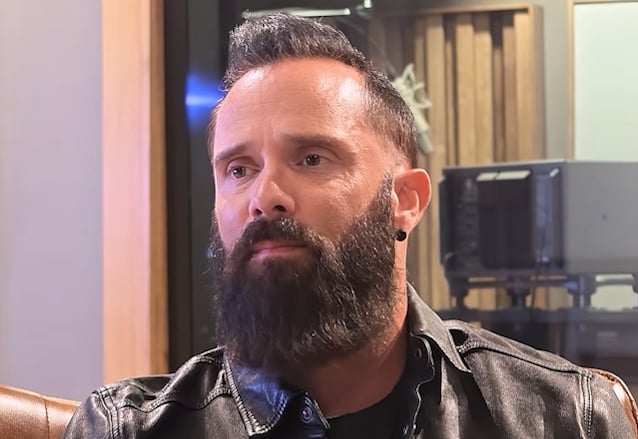
SKILLET's JOHN COOPER: 'I Know That Some People Feel That Christianity Doesn't Belong In Rock Music'
October 10, 2026In a new interview with Brian Storm of Rock Feed, John Cooper, the frontman and bassist for the Grammy-nominated Christian rock band SKILLET, talked about how regularly speaking about his faith in secular spaces and voicing his opinions on hot-button social and political issues has resulted in some fans feeling completely alienated by the musician's stance. He said (as transcribed by BLABBERMOUTH.NET): "I understood when I began speaking out about some things that it was going to just offend some people. I also understood, because I'm not a complete moron, that even in the beginning when we were trying to release [SKILLET's 2009 hit] 'Monster' to radio and whatnot, I know that some people feel that Christianity doesn't belong in rock music. Sex, drugs, rock and roll — how are you gonna stick Christianity in there? It's almost like 'you're ruining the fun' and 'this isn't your world'. And I understand that. And that doesn't bother me. I know where they're coming from. And so for me, it's almost, like, yeah, I know that, but I disagree.
"I don't think that fans care," Cooper continued. "I know that because I have a whole lot of friends who are not Christians who don't feel that way, and they never care... So I think the fans will — they will vote with their money. They'll vote with buying the records. They'll vote with buying tickets to the shows. And you just gotta know on the front end, and you gotta be confident. That kind of goes back to you saying being a lead singer, you just gotta be confident about who you are and be, like, 'Hey, I'm not here to try to impress anybody. I'm being myself. You may buy it. You might not.'
"When it comes to fans and people that hate, I just think that the world we have created is just what it is," John added. "We've created a monster where to disagree with someone means hating them. So if I see somebody that comments online, and they're, like, 'Oh, gosh, here the Jesus lover goes again. I wish he'd shut up,' I don't think that person hates me. I'm just, like, well, they don't like Christianity, and it's not my business. Again, I'm a libertarian when it comes to this. I'm, 'Do you. No problem.' If somebody comes on and is, like, 'I'm really mad because there was a prayer walk right outside of my business, and I don't think that should be legal,' I don't go, 'They hate Christianity, and they're trying to put us in jail.' I don't do that. I just go, 'Yeah, that's not what they want.' And I can understand why they wouldn't want that, but some other people do want it.
"What my faith dictates for me is that I pray for my enemies," John said. "And when I say enemies, I don't mean that I view them as enemies. It means that it's people that I think some of them might think that they are my enemy or whatever it may be, people that don't like me, don't agree with me. My faith dictates that I'm supposed to not just love them. I'm supposed to pray for them. And that's a really good thing to do, and that will just put water on any fire that's happening in me. It just douses water on it.
"And here's the thing. I think that people would be very hard-pressed… I'm not saying it's impossible, but they would be hard-pressed to find a person who has met me from any walk of life — I don't care what that walk of life; you choose it — that would say, 'I met him and he treated me poorly.' You will not find that," John said. "And so I think what it is, is there's a difference between loving people and being, like, 'Oh, we can totally get along,' but still holding to your personal conviction of something that you believe. And I think we need to learn to do that better."
Cooper also once again talked about the backlash he faced during the coronavirus pandemic when he spoke out against protocols around masking and vaccinations for concerts. He said: "I think in 2020, when I started speaking out about that, there was an initial 10% of our fanbase that immediately unfollowed, stopped listening. There's no question. Maybe 15%. And I remember thinking, like, 'I don't want that,' but I just felt I had to do it. I do think that there were some fans that were, like, 'Look, I've always liked SKILLET. Now I love SKILLET.'"
After Storm noted that SKILLET "probably gained a lot of fans from that as well", John said: "I think it took about two years, because we did not feel the gaining. It hurt. It hurt for about two years. And that was fine with me. Everybody's gotta do what they gotta do. You don't wanna listen? I get it. But I was, like, 'Okay, that's the way it's gotta be.' There were some people that I think that went, 'You know what? That means that John is putting his money where his mouth is. He's been talking about this Christian stuff for all this time, and now he's standing up saying, 'Hey, I think it's the right thing to do to make a stand. It's gonna cost me, and that's okay with me.' And I think that solidified people into, 'I like this guy.' And I even saw that with people that were, like, 'Hey, I'm not into the Jesus stuff, but I just appreciate that you put...' They'd say to me, 'You put your balls out there, man. I like that.' And we began getting some of what I call the Joe Rogan [controversial U.S. podcaster] crowd. I don't think they're necessarily religious or conservative even."
SKILLET released a new independent six-song EP, "After The Storm", on October 9.
Produced by David Cowell (SLEEP THEORY) and the band's own Korey Cooper, "After The Storm" marks both a return to SKILLET's heavier musical roots.
SKILLET will support "After The Storm" with a nationwide U.S. Live Nation headline tour beginning this month.
The band now averages more than 12 million monthly Spotify listeners, while its six-times-platinum anthem "Monster" has surpassed five billion global streams and earned a place in Spotify's Billions Club.
Earlier this year, SKILLET's European headline tour drew the largest international crowds in the band's history, including record-breaking ticket sales at Zénith in Paris.


 Prev
Prev 