


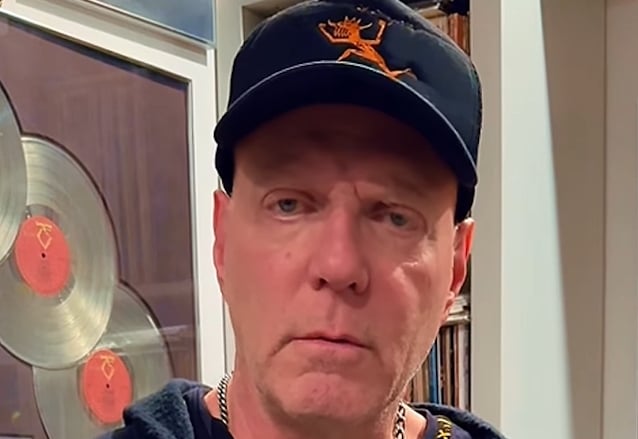
TWISTED SISTER's JAY JAY FRENCH: 'The Record Industry Is A Criminal Organization'
February 28, 2026In a new interview with "Reckless" Rexx Ruger of the Pod Scum podcast, Jay Jay French, the guitarist and manager of the legendary heavy metal band TWISTED SISTER, addressed the fact that Spotify pays artists between $0.003 and $0.005 per stream, among the lowest rates for any music streaming service. He said (as transcribed by BLABBERMOUTH.NET): "Well, first of all, the artist never made a penny on bootlegging [before music streaming], and that happened like crazy. So when people talk about no one's getting paid, at least people are getting paid now. Because everybody does pay for a service — everyone does. So money does come in. Back in the old days, you were losing a fortune on bootlegs, you were losing a fortune on record labels ripping you off because there was no guarantee that whatever they were selling, you could actually prove. Now every track is logged by computer.
"There's two sides to this situation," French continued. "There really are two sides. The record industry is a criminal organization. They screw artists left, right and sideways. They always have. And so what?! Artists are gonna get screwed some way, somehow.
"Trying to figure out a way to divide that penny up so that people get paid is certainly difficult and, sure, the royalty rates need to be improved," Jay Jay added. "But the fact that artists never get paid for radio play. Let's talk about that. Terrestrial radio doesn't pay an artist a cent. There was a story in The New York Times several years ago. It was a headline. We all in the business knew that this was not a secret. It said 'Aretha Franklin's 'Respect' played seven million times on radio. Aretha Franklin's income from those seven million: zero.' Well, that's because performing rights societies, ASCAP and BMI, and the publishers colluded with Congress 70 years ago and said, 'Performing rights societies, we shouldn't pay the artists. The artists can go and tour and sell records. We're promoting them by playing it on the radio. We're helping them. We shouldn't pay them.' And so terrestrial radio has never paid a cent. And then n, on top of that, when you go to an arena to watch a hockey game, baseball game, football game, and you hear a song like [TWISTED SISTER's] 'We're Not Gonna Take It', a friend of mine goes, 'Yo, dude, Giants Stadium, 'We're Not Gonna Take It'. Ka-Ching.' I go, 'Yo, dude, 'We're Not Gonna Take It'. Zero.' ' What do you mean?' I said, 'They pay ASCAP [and] BMI fees to play a billion songs, and they don't have to pay us a penny.' The publisher gets paid. The publisher gets paid. The artist gets paid nothing. That's just the way it works. Now, SoundExchange has flipped that around, and online has flipped that around. Now all that gets logged, and now we get paid. But for the longest time, the artist never got paid — just the writer got paid. Yeah. Now, with SoundExchange, the artist gets paid, the label gets paid, and the publisher and the writer get paid zero. So that's the attempt at trying to reconcile it. And I'm not telling you anything is perfect, because nothing is perfect, and it can always be better. But just remember — in those days you made money selling records and you lost money touring. Now you make money touring and you give your music away for free, which is why tickets cost so much. Because in the old days the record sales, theoretically, were buoying the whole business and helping you out."
Back in January 2022, Jay Jay spoke to A Discussion With Dean Cramer about record labels' reputation as crooks who rip off artists at every turn. He said at the time: "Rock and roll, let me be clear, is a criminal enterprise. The record labels are criminals. It's simple as that. They're just legal criminals. So when you're in a cesspool of criminality, whether it's obvious criminality, in other words, whether it's blue-collar criminality where someone is threatening your life with a gun or it's white-collar criminality, you're dealing with criminals. So you're dealing with the sleaze, the lowlives, the lying. You don't believe any of this shit 'cause everyone lies. So you kind of have to get used to it."
French previously discussed music's long history of record companies taking advantage of artists in an April 2021 interview with Canada's The Metal Voice. At the time, he said: "There's two levels of a rip-off. One is contractual rip-off, which is just — that's just the nature of the game; that's how it is, like it or not. And the other is somehow that management's really taken from you. Now, I'd say most bands don't understand the record company deals that they sign, and they don't understand how small the percentages are. I mean, THE BEATLES were making a half a penny a single and six cents an album with the royalties. I think that JACKSON 5, I think most Motown acts were making two, three, four, five cents an album.
"There are clauses all over the contract," he continued. "I do a talk on this. I said, 'How much money do you make on a million-selling record?' And this is by contract — no one's stealing from you; this is just the way the contract's written. If you look at a contract back in 1984, and let's just say, for the sake of this example, the band made a dollar a record, which is very high, but let's suppose the band got a dollar a record. And you sold a million records, and you have a platinum album on your wall. And friends go, 'Oh man, a million records. You must be really rich.' But what does that really mean? Well, in the contract, to begin with, the contract says it's 15% free goods, which means the record label is allowed to not pay you on 15% of record sales, 'cause they supposedly sent it to the press for reviews, except if you're on a million-selling record, you're not sending 150,000 albums out for review, but you can claim that you can. So, they withhold royalties on 15%, which is $150,000. So now your million is basically $850,000. On top of that, there's a breakage fee of 10%, because… Records haven't broken since Moby Dick was a minnow, but back when shellac records were made, it was in the contracts; that's another 10%. So that's 25% off the top. So right away, you're not being paid on a million [copies]; you're being paid on 750,000 [copies]. Then there's a 20% container charge to make the record or the CD, so they subtract that. So automatically 45% of the royalty-bearing records are now gone, okay? Now you're [left] with $550,000. Well, suppose you made a video. Then that gets subtracted. Suppose there's recording costs, which is another $300,000. And then there's promotion costs for the record, which is probably $100,000 if the record is successful. You're down to what? $200,000? You take the $200,000 and you send it to your business manager and your manager, they take out 20% and 5%. And maybe the band is left with $100,000, $150,000. A five-man band breaks it up, [and] it's $30,000 each before taxes. You get the mathematics here?"
French added: "Contracts were designed to make the record companies money. Now, in defense of the label, labels sign a hundred bands, [and] 95 [of them] fail, so they make their money off the 5% that succeed, and they make a lot of money. However, it is the only business in which you pay back the label and then you still don't own the product. That's the biggest problem I have with the theory of record labels. If the band wasn't charged back the cost of making the record, then I'd say, fine, okay. But if you're making me pay you back and I still don't own it... You know, Taylor Swift brought this to light to people, and people said, 'Oh, this is so terrible. Taylor doesn't own her music.' No one owns their music. This isn't new. This is the way it is. It's the way it's always been. THE BEATLES don't own their albums, and THE ROLLING STONES don't own their masters. A couple of artists do, but generally, 99% [don't]."
In addition to founding TWISTED SISTER, a world-famous heavy metal band that has sold more than 20 million records worldwide, French is one of the top entrepreneurs in rock. After taking over as manager in the 1970s, French developed TWISTED SISTER into the most heavily licensed heavy metal band in history, leading the group to perform more than 9,000 shows in forty countries.
French's two biggest hits with TWISTED SISTER, the rock anthems "We're Not Gonna Take It" and "I Wanna Rock", have become two of the most licensed songs in the history of heavy metal, appearing in hundreds of TV, radio and internet commercials, movies and TV shows. French currently oversees all music licensing and all business regarding TWISTED SISTER.
In addition to his career as a musician, manager, producer and executive producer, French is a highly sought-after keynote speaker. He was also a contributing writer for business magazine Inc.com, penned a BEATLES column for Goldmine called "Now, We're Sixty Four" and wrote an audio column for Copper, an online music and high end audio magazine published through PS Audio.


 Prev
Prev 