


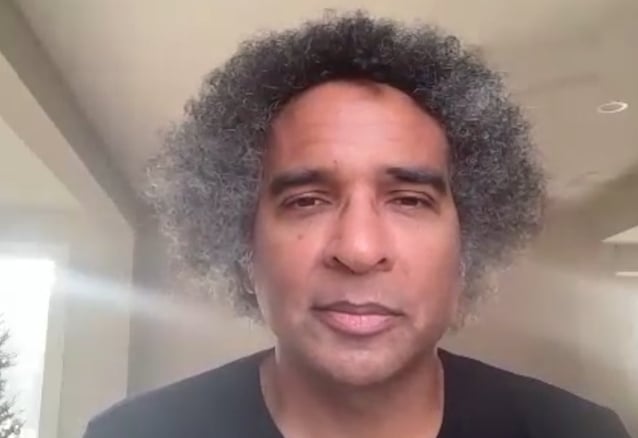
ALICE IN CHAINS' WILLIAM DUVALL 'Rises To The Challenge' Of Writing And Recording With METAL ALLEGIANCE
January 14, 2026By David E. Gehlke
Perhaps the most "metal" of the core 1990s Seattle grunge bands, ALICE IN CHAINS has long hung around the periphery of the genre since holding their own as openers on the legendary 1991 "Clash Of The Titans" tour featuring ANTHRAX, MEGADETH and SLAYER. Several of the band's studio forays have qualified as "heavy." However, few would rightly classify them as a pure-metal outfit, even though the original frontman, Layne Staley, was an admitted fan of KING DIAMOND, VENOM and SLAYER. That said, ALICE IN CHAINS enjoys a rare distinction in this corner of the music world: they still enjoy mainstream rock radio play and can easily slide onto a bill with any number of metal's heavy hitters.
Staley's replacement, William DuVall, is now dipping his toes into the water with the all-star METAL ALLEGIANCE and the song, "Black Horizon", on which he wrote the lyrics and sings lead. DuVall's trademark mid-tenor serves as the brooding accompaniment to the technical mastery of guitarist Alex Skolnick (TESTAMENT),drummer Mike Portnoy (DREAM THEATER) and bassist Mark Menghi, a pairing that will carry over into the live setting in 2026. With the track due for release in mid-January and future ALICE IN CHAINS work potentially imminent, BLABBERMOUTH.NET snagged DuVall to learn more.
Blabbermouth: You came up in the hardcore and punk scene with NEON CHRIST and B'LAST and now play in a metal-adjacent band. What is your relationship to the genre?
William: "Your phrase is pretty apt: 'Metal-adjacent.' [Laughs] I regard myself as a musician. The genres, and I know everyone says this, and I know how trite or pretentious it can sound, but my whole thing growing up was trying not to be boxed in. I started playing at eight years old, and I was very lucky to be exposed to a lot of the greatest of the greats right from day one. [Jimi] Hendrix was the one who set me on the path, and the cousin who turned me onto music that got me rolling. He had this small, but very cool record collection that had Roy Ayers, SANTANA and WEATHER REPORT, Stanley Clarke. We started record collecting together. And this is still the '70s, so it was all about headshops, record stores that had records in crates and incense going and bead curtains, that stuff was still a thing. The whole post-'60s vibration was still in the air in terms of 'Music is supposed to say something, even if it's instrumental, there are messages in the notes.' I came up with all of that. Genre was not a big thing, because everyone that I really dug, they would have been badass anywhere. Coming up with that and now all of these years, I still carry that, but I also recognize the need, the practical need, to get into categorization when you're discussing music or when you're trying to sell or market music. It's one of those things where I see the necessary evil of it.
"As far as 'metal,' there are some bands that would clearly be classified as metal that I really like, just because of them doing their thing in such a way. The songs are good, the sounds are good, the tones are good. The first three or four or five METALLICA records are always going to stand the test of time just because it was such a new thing when it was happening, and I remember when it was happening. I was more on the punk rock side, but I remember Danny Lankford, the bass player in NEON CHRIST. Danny was big into tape trading. He was also a big metalhead. The way he got into the band was just showing up every day at our rehearsals, just to sit there. He brought a guitar. He had one of those Ibanez Destroyers. He brought it, but he couldn't really play it. He couldn't riff out like that. I said, 'Hey, man. Have you ever tried bass? I'll give you a bass.' I was punk rock, but he was metal. He had the hair and everything. He was big into tape-trading. I remember hearing METALLICA before they had a record out. We were mailing back letters and tapes to kids around the world. METALLICA, when they had Dave Mustaine in the band, we had a tape of a live show with Mustaine. I was really familiar with METALLICA before 'Kill 'Em All'. They were badass. We loved IRON MAIDEN. We got into [BLACK] SABBATH. I remember C.O.C. The very first time I saw them was in 1983. They came down, and they still had Eric Eycke on vocals. I saw the 'Eye For An Eye' C.O.C. , and they became brothers. They would do a section of 'Volume IV' SABBATH [hums riff]. They used to cop that intro for one of their songs. They just copped it. They were one of those bands who were like, 'We play punk rock and thrash, but we're not throwing away our BLACK SABBATH records.' There was that relationship. It continues to this day. I'm glad to see now that the barriers have come down to a large degree because it used to be pretty serious. In those days, them were fighting words. [Laughs]"
Blabbermouth: Very true. Then, eventually, it didn't matter as much the kind of clothes you wore or the length of your hair.
William: "BLACK FLAG's 'My War' was an affront to a lot of people. And them growing their hair out. That was the business, man. You can't imagine how divisive that was. I clearly landed on the side of, 'Look. They're still genuine as far as I can tell. They're getting better. The music was getting more intricate.' I loved it."
Blabbermouth: What did you get out of doing METAL ALLEGIANCE and working with Portnoy, Alex and Mark on "Black Horizon"?
William: "I think it is a nice kind of departure. It's the kind of thing that presents a welcome challenge. I'm not going to write anything like that. There's definitely some stuff Alex Skolnick can do on the guitar that's not part of my thing, but even if I were to write some of the riffs like that, that's just not where my particular focus lies, even if I were able to do some of it. It's not where I want to go. It's really great when you get something where, 'This is where those guys want to go.' Then I can just say, 'Well, yes, send the music.' Then they send it, and I'm able to listen, and I react as a listener first, but then, as a writer and put on the writing cap, so to speak. That kind of music puts me in a similar mindset as the GIRAFFE TONGUE ORCHESTRA, where all this stuff is happening. There is a lot of information coming at you, and there are a lot of shifts in tone and mood, just even within one song. It puts you in this mindset where I have to write myself a role to play in this."
Blabbermouth: Were you surprised to get the call to do it? Your vocals settle nicely into the song.
William: "I was pleasantly surprised to get the call. It came out of nowhere, even though I had a little bit of communication with Mark Menghi beforehand. It was a surprise. It was like, 'Oh, wow. Okay. Would I like to do a song with them?' They sent it, and I was like, 'Oh, okay!' What was interesting was that they sent the music, and immediately the title 'Black Horizon' came to mind. Then, the narrative, this sort of kernel of the narrative, came to mind almost right away. The music, again, conveyed this idea of movement, and that made me think of a journey. At the time, there was all this stuff going on every other week about some new rocket launch and 'We're going to Mars. We're going to colonize Mars!' I was like, 'Well, okay. Whether that happens or not, it put me in the mindset of 'What might the journey of the first civilizations to colonize Mars be like?' Not astronauts, not pilots, not trained military personnel, just regular people. The first regular people to take that trip, and that's kind of what set me off on that path. Then, taking that narrative of possibility and putting words and melody to it. That took a bit more time. The initial idea came quickly but fleshing it out took a bit more time. The music presents all of these challenges, and you want to rise to the challenge as a singer. It's almost like writing myself a role, then acting it. That's what it was like for GTO and 'Black Horizon'."
Blabbermouth: Would you do something like this again?
William: "I don't know what the future holds for it, but I'm certainly pleased with the results of this. It's really cool. And it is a departure from, and it's a welcome departure. It will be interesting to perform it."
Blabbermouth: You are now easily the longest-tenured frontman for ALICE IN CHAINS. What goes through your head when you think about the last 20 years?
William: "I'm still processing all of that. I suppose, in a lot of ways, we'll all four be processing everything that's happened for the rest of our lives. I don't know that we'll ever be able to fully reconcile everything and tie it up in a neat little bow and say, 'Ah, yes!' But, yeah, 20 years. That's a piece of time right there. It's definitely a trip. There's a lot to unpack there. That's a process. Meanwhile, though, we are just living life. I will say that I'm glad that we've been able to keep it moving for as long as we have. Bands are certainly not easy. The music business is certainly not easy. It's absolutely not getting any easier, the whole business that goes with making and releasing music for people who came up when we did and the way that we did, we were just talking about tape trading. The way I came up versus what is happening now, it would be hard to script anything more different. I think most of us, in the early 1980s, wouldn't have been able to imagine what's happening now, good or bad. I'm saying we couldn't imagine this technology. Or, if we were to, it would be in a science fiction sense, like 'Star Trek' and the Invisiphone. Now, it's manifested in real life, with all of these effects on everybody. It's a trip. I'm glad that throughout all of that, ALICE IN CHAINS is still a thing and we're able to make all the records and write all the songs and play all the songs that we have. It's not an easy thing. It does make a lot of people happy. The longer that one goes, the further along the path one gets in this life, the more one comes to realize how profound that is, just to make somebody else happy."
Blabbermouth: I would be remiss if I didn't ask if there was any movement on new ALICE IN CHAINS music. Is there?
William: "We will get together before too long, and we'll see where it's at, where we are and where it might go. It's more or less always been that way."
Blabbermouth: Like a no-pressure situation?
William: "There is immense pressure, but I would say that we are fortunate enough to hold more of the cards in the deck than perhaps some other bands or artists. There are other bands that hold most of the cards in the deck that they're playing and have a lot of sway in what they do and do things on their own timetable, but we're fortunate to be one of those. That is another thing that we've never taken lightly. There is pressure. It's no joke, but a lot of it is self-generated, and that remains the case to this day. I don't know what the future holds. Goodness knows, it seems like every other day we're being reminded that no one is guaranteed tomorrow. We'll have to see. And this is a unique time because we've gotten to this milestone, because when you put out one album, and you climb that mountain to do all of that. Everything that was going on back then was frenzied and insane, but then you do it, you put it out, you tour, and people are receptive, so you live the frenzy of making it, then you live the frenzy of the reaction to it. Then, it's all about: 'You have to do another one.' So you do another one. Then it's like, 'Well, I mean, come on. You've got to at least do one more, so have the trilogy.' We do that, then you do worldwide campaigns around all of those things. After that, it does change. It does. There's something about doing the three records, doing campaigns around them all; we're in a place we've never been, like we always have been. Now, let's say there's a shift. I don't know what's going to result from that, but it's an interesting place and an interesting time right now."


 Prev
Prev 