


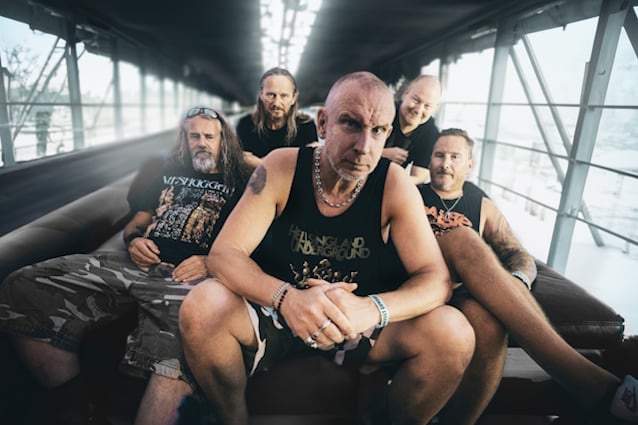
CLAWFINGER Remains Guided By Its Anti-Racist And Anti-Fascist Ideals: 'We Have The Platform To Say What's Wrong In This World'
March 3, 2026By David E. Gehlke
Rap-metal wasn't a dirty word in the early 1990s when Sweden's CLAWFINGER broke onto the scene with their "Deaf Dumb Blind" debut. Fronted by the acerbic, cutting raps of Zak Tell and backed by abrupt, heavy riffage, CLAWFINGER was the Scandinavian response to the likes of BIOHAZARD, MORDRED and even FAITH NO MORE, whose song "Epic" has received ample credit for inspiring the style. No topics were taboo for CLAWFINGER, especially politics and racism, the latter of which was addressed on "Deaf Dumb Blind" lead single, "N*****". Backlash and a misunderstanding of the song's content have led to CLAWFINGER never performing in North America, an occurrence unlikely to change given the current political climate and some of the lyrics on the band's first studio album in 19 years, "Before We All Die".
"Before We All Die" is the right record for the times, running through anti-war, anti-fascism and anti-racism topics with an appropriate amount of straight metal and nu-metal stylings. It picks up where CLAWFINGER left off in 2007 with "Life Will Kill You", an album that preceded the band's short-lived hiatus that started in 2013 and ended in 2017. By all accounts, the early reception to "Before We All Die" has been positive, something that guitarist Bård Torstensen addressed in a chat with BLABBERMOUTH.NET.
Blabbermouth: Why now for a studio album from CLAWFINGER after 19 years?
Bård: "Back in 2007, we released the last album ['Life Will Kill You']. The Napster thing happened. Suddenly, you couldn't sell any records! We'd been doing it professionally for 16, 17 years, and suddenly, you have two feet to stand on. One was taken away. We had one foot to stand on. That's the live playing. Our management said, 'If you want to do this, you have to be on tour all the time.' We were like, 'No, I don't think so.' [Laughs] We have families, so we decided, 'Okay, let's do all the good gigs. Let's do all the good paid gigs. Let's do all the fun gigs and have a job at home.' That's what we did. Automatically, you don't meet up that much to write. It went for four or five years, then it was like, 'Hey, anyone interested in making a song?' 'Yeah! Why not?' Then we met up, and we did a song. It might not have been a good song, but it was a song. Then, every other year after that, it was like, 'Hey, let's make another one.' In the end, we started getting into the groove. Everyone has a home studio, and we could connect this way now. We started working on ideas. I'm in Norway; the keyboard player [Jocke Skog] lives in northern Sweden, like, fucking far away. And Zak lives in Stockholm. We started sending files and working on the files: 'Hey, I have an idea on your idea.' Suddenly, we had five songs. We had a meeting with our management, and our manager said, 'Hey, guys. Let's make an album before we all die.' It's like, 'Yeah! You got the title! This is the title of the album!' That's how it started. We just continued writing songs, and in the end, we had an album. It's more like the way life works."
Blabbermouth: Is it safe, then, to say that the CLAWFINGER split back in 2013 was friendly?
Bård: "Yeah. It was like, 'We can't do this anymore. I can't stay on tour for ten months a year.' That's not possible."
Blabbermouth: You were likely touring so much after "Deaf Dumb Blind", then carried that on for the next decade.
Bård: "We played 150 gigs a year. That took its toll on family life, if you think of it. Of course, after that, we became established, which allowed us to be a little bit picky. In the beginning, you have to do different things. You know how it is: You have to build it up."
Blabbermouth: Where did you want to take the band for "Before We All Die"? It's got a nice mix of classic CLAWFINGER with some modern elements.
Bård: "It's a weird thing. We make songs without thinking. We make all of these songs, and in the end, we always find a way to link them together. The only thing that was really conscious on this album was that we needed a song that was named the same as the album. We needed a title track. And we needed a song about the ongoing wars. That's two tracks we needed. That was, after all the other songs were made. Then, we made these songs at the very end of the session. Then, we could see all the pieces falling into place. It was pure luck; I don't know. It's the way we do it: always. Like, 'Oh, yeah. We can take out this song and put this in.' Now it means something. It gave the album a wholeness. We are stupid fuckers who make songs at the beginning, then, luckily, we can glue them all together in the end. It's very important how you list the songs. The order of the songs; it's very important to have them in order to make a good album."
Blabbermouth: Was this a fun record to make?
Bård: "It's the easiest going record we've ever made, at least for me. I can speak for myself, but it feels like it's the same for the other guys. It was a good atmosphere, everything. The ball was rolling all the time. In the early years, we could be fighting: 'I want this song.' 'I want to work on this song.' 'You want me to work on that song?'"
Blabbermouth: Was some of that going on when it came time to do "Use Your Brain" in 1995?
Bård: "For 'Use Your Brain', it was, 'Get the hell home and make a record.' We were on tour, and it was like, 'You go home and make a record in three months.' It's like, 'Uh, okay.' We tried. We worked like hell because 'Deaf Dumb Blind', we had three years, from 1990 to 1993. This one was like, 'You have a few months now. Go for it.' You know, also, these things can be good for the writing process. Sometimes, I can work on a song, I have a song at home for a different project or for CLAWFINGER. It's like, 'It's not good enough yet.' Then, six years later, it's like, 'Yeah, maybe…' If you get a deadline, then shit happens."
Blabbermouth: Were you given a timeline for "Before We All Die"?
Bård: "When we got to seven songs, they gave us a deadline. It was like, 'Thank you!'"
Blabbermouth: Do you get involved much with Zak's lyrics? Obviously, the new album captures much of what is going on around the world.
Bård: "Number one, when it comes to writing lyrics, he's in a different division than we are. We are on the same page regarding the topics. Maybe you could say that he writes 98 percent of the lyrics. Maybe Jocke or I can come up with a song title or a couple of lines we can start working with. Or, he misses something, and we can fill in or help him. He's the lyricist in this band."
Blabbermouth: Do you think CLAWFINGER has a unique perspective as sort of an outsider coming from a Scandinavian country where things are a little more stable?
Bård: "You know, we are so lucky. I definitely think we can say we are on the outside looking in. Of course, it's easy to say something. I think the most important thing is that we are not here to change the world. We are here to try to pinpoint things we see around us that aren't fair. I guess that's the answer to it."
Blabbermouth: Right from the start, CLAWFINGER was pretty upfront about things that should be universal by now: Racism is wrong, fascism is wrong.
Bård: "It's also like none of these bands are writing lyrics about this stuff. There are some really underground bands that go directly in your eye with these things, but there are not many bands that are mainstream like us, even though we aren't mainstream, but you understand what I mean. We are not black metal or in a niche. A lot of people who listen to our music aren't metalheads. I really wonder why. We got a lot of good reviews because it's good that someone is pinpointing these things. Lucky for us, but it's important for us."
Blabbermouth: At its core, CLAWFINGER has been one of the few bands to point that out. It's risky to do these things. It's possible these other bands are worried about losing fans by taking a side.
Bård: "That's too bad. We have the possibility, the platform, to say what we mean and say what's wrong in this world. I would feel really bad if we didn't use it. My conscience would be fucking dead if we didn't use it."
Blabbermouth: It's interesting that a Scandinavian band is leading the charge here.
Bård: "They would never let us play in the States, but that's okay because of [anti-Donald Trump song] 'Scum'. The world is black-and-white these days. It's this or that side. We were going to do a release show in Stockholm. When we booked the venue, everything was fine. Suddenly, two weeks ago, we got a message that they wouldn't have us."
Blabbermouth: Because of your lyrics?
Bård: "I think so. It was an American / British-owned venue. I think they discovered who we were. We got cancelled. We just had to find a new venue, and we did. I think the world is really weird these days. It's scary. You can't have an opinion and be respected, even though we're talking about humanity, basic stuff."
Blabbermouth: I guess it's odd that it can be controversial to speak out against racism and fascism.
Bård: "Exactly. I don't understand it. It is very black and white. It's diverted. Everything is like, 'Either you are there, or you are not.' You can't join in the middle and talk about it."
Blabbermouth: Is it getting black-and-white in Sweden and Norway?
Bård: "It's getting worse every year. It's really weird. We never experienced it here, but it's the same as everywhere else."
Blabbermouth: The internet isn't helping. You didn't have this 30 years ago.
Bård: "It feels like the world, the developed world, has taken a step back. Maybe we have to start over again and find out about all of these issues that were obvious, like, five years ago."
Blabbermouth: Switching gears, you're one of the first true rap metal bands alongside MORDRED. How did you feel when rap metal exploded later in the '90s, especially a band like LIMP BIZKIT?
Bård: "I've seen the music business and what it does. First, it's like you have a hit and you are the big thing. Then, suddenly, 'I'm getting tired of this. Next!' That's the way it is. We still played gigs and made money. We are not here to sell ten million copies of an album. We do this because we think it's important for us. We had a parallel career, maybe, on a much smaller level, but I didn't care. It's nice that some of them say, 'CLAWFINGER is an inspiration.' That's nice to hear. I mean, we started making rap metal in 1990. Then, we worked at the hospital and met up with Zak. He was walking the corridors of the hospital and rapping like hell. It's like, 'Hey, let's bring him in. Let's try to make some riffs with him on top.' The only thing we heard before that, on that kind of style, was PUBLIC ENEMY and ANTHRAX, and RUN-DMC and AEROSMITH. Also, 'Epic', by FAITH NO MORE. That was the only inspiration we had. We tried to work on it for a couple of years, then everything exploded for us. It was really nice."
Blabbermouth: You never shied away from being a metal band. Has that factored a lot into your more recent years when it comes to shows?
Bård: "We were still playing metal festivals. The metal audience is very loyal to the music. It's like being the supporter of a football team: 'This is my team.' Heavy metal is my team. That's the way it is. We are grateful that we liked and chose this style, so we can still be here. It's all because of the fans that we're still here. They never gave up on us."
Blabbermouth: Would you also say that the current 1990s renaissance has helped your cause?
Bård: "You know, when we told each other, 'Okay, let's do it. Let's make an album.' It was absolutely only because we wanted to do it ourselves. We didn't think about, 'Maybe we'll get a hit.' It was like, 'Let's do this before we all die.' It was exactly that. We've gotten 10/10 reviews, like five of them. I was just stunned. Now, it's like, 'Oh, shit. Everything is a bonus.' All we wanted to do was release an album."
Photo credit: Peter Bjöns


 Prev
Prev 