


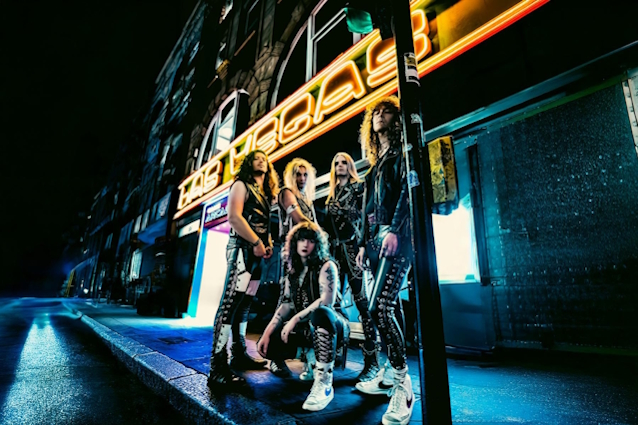
Meet The K.K. DOWNING-Approved TAILGUNNER
January 27, 2026By David E. Gehlke
Described as the "bastard child of IRON MAIDEN and JUDAS PRIEST," the U.K.'s TAILGUNNER are among the latest looking to improve upon their home country's spotty track record of producing new metal bands worthy of their esteemed predecessors. TAILGUNNER's development has been accelerated. They formed in 2022, then followed up with their "Guns For Hire" debut studio album the following year, which led to a deal with Austria's Napalm Records. They also caught the eye of former PRIEST guitarist K.K. Downing, who became the band's champion and producer for their sophomore outing, "Midnight Blitz".
Having Downing as producer comes with an array of benefits and is certainly a worthy selling point. To their credit, TAILGUNNER largely delivers the goods on "Midnight Blitz" with a healthy serving of rousing choruses, twin guitar breaks and NWOBHM references. With the album's release and a run of dates across Europe on the horizon, BLABBERMOUTH.NET grabbed bassist and founding member Thomas "Bones" Hewson to learn more about TAILGUNNER and Downing's involvement.
Blabbermouth: You started in 2022, and a few years later, you're on Napalm Records. What made them the right home for TAILGUNNER?
Thomas: "It's great now to be a part of Napalm. For me, they are the best metal label in the world, especially in terms of developing new bands. That was really important to us. We wanted to be with a label that really believed in us as a band and could grow our career. Where we were previously, it was a label with some really great bands, but mostly bands that had mostly made a name for themselves 40-plus years ago on another label. With Napalm, we look at a band like POWERWOLF, a decade or so ago, they were a club band, and now they're playing arenas. That's a very inspiring career trajectory, and we aspire to follow it. We feel we're in the right place to do so."
Blabbermouth: Is there any concern that this is happening too fast for you?
Thomas: "We're fortunate. We put out the debut single ['Guns For Hire' in 2022], and straightaway, we were able to tour and play shows. I took a bit of a risk before the band launched and before anyone knew who we were. We put out 'Guns For Hire' from the debut, and people responded very well to it. We were able to do a tour in the U.K., which got us noticed. We got the first record deal, then it went from there. We put out the debut, and it grew and grew. We're fortunate that we've never had to slog it as a local band."
Blabbermouth: There is the longstanding adage of having your entire life to write your debut album, then only a short time to write the second one. Did that apply to "Midnight Blitz"?
Thomas: "To be honest, we're very fortunate that it didn't happen. I know it's a stereotype of the 'difficult' second album, but, really, with the debut, I wrote the record over the course of forming the band; I never written songs before. I never wanted to be a songwriter. I always aspired to the Cliff Williams [AC/DC] role, which is standing in the back and playing bass."
Blabbermouth: Then you come to the front for backing vocals. That's a very Cliff Williams type of thing to do.
Thomas: "All I wanted to do was join a band with great songwriters, but it never happened for me. I was forced to do it myself. I started teaching myself to write songs purely to have something to show people and say, 'This is what I want to do.' It was a difficult process putting together the debut, and it kind of happened by accident, where I ended up with a whole record. With 'Midnight Blitz', we had a full lineup, played over a hundred shows, and shared the stage with some really awesome bands. It's very difficult not to feel inspired by all of those things happening. I think the big thing for us this time was that, when I was writing the debut, I was still living with my mom. I wrote it in the garage. There was no band. It was all an idea in my head. This time, we had a deal with Napalm, we played with SAXON, and it didn't feel like we were pretending anymore. It felt like, 'Okay, this is a legit band. We have fans and people who like what we do. Maybe we can do it.;"
Blabbermouth: It's admirable to admit that you've never written songs until recently. Who, then, did you lean on as a guide?
Thomas: "Everything that I possibly could. Probably not always the most obvious inspirations. It's no secret, and I'll never shy away from the fact that we sit in the middle of MAIDEN and JUDAS PRIEST, but I didn't just listen to those bands. I listened to the bands that inspired MAIDEN and PRIEST, so SABBATH, URIAH HEEP, THIN LIZZY, WISHBONE ASH and RAINBOW. They were a huge influence on me, especially the [Ronnie James] Dio stuff. I really like that era. Everything. There is great songwriting in all sorts of styles. At least in my opinion, I'm not going to tell anyone how it should or shouldn't be done, but you can listen to all sorts of genres of music and be creative. Again, it's not a very metal thing to say, but I really like ABBA. I think they're one of the most creative bands ever in terms of songwriting. Something that I'm really proud of is that there's a lot of melody and hooks in our music. That comes from a band like ABBA."
Blabbermouth: How did you get involved with K.K. Downing?
Thomas: "Someone, somewhere, somehow, managed to get our debut EP in front of K.K. That would have been at the end of 2022. I don't know who it was. If I ever find out, I'll buy them some beers. [Laughs] He heard the EP and loved what he heard. The first time I met him, K.K. , he said he'd been waiting for a band like us to come from the U.K. since the early days of DEF LEPPARD. It was such a great vindication of everything we've been trying to do. We felt the same way. There are some amazing bands around, but as far as I'm concerned, we, in Britain, invented and largely perfected metal with SABBATH, PRIEST, MAIDEN, MOTÖRHEAD, VENOM, you name it. We didn't really do anything within that style for such a long time. I think that's because where the U.K. is responsible for the genesis of so many genres of music, sometimes, there's more placed on being inventive than there is on being good. I read it all the time about bands that I love, saying, 'Well, they're great. It's nothing new.' It's like, 'Who cares if it's not new? Let's talk about whether it's good.' I think that was something we wanted to achieve, and something K.K. saw in us very early on. We stayed friends, and when it came to finding a producer for the new album, we wanted someone with a large amount of experience. Of course, K.K. co-produced alongside [Rob] Halford and [Glenn] Tipton and Tom Allom, all of the classic PRIEST albums. We reached out to him, and fortunately, he was interested."
Blabbermouth: Was he hands-on in the studio? Did he ask you to change the songs if he didn't like something? If he says, "Thomas, this riff sucks." What did you do?
Thomas: "[Laughs] There was a great kind of mutual respect. Yeah, he could be like that. He would make us redo things. The thing is, we're very sort of brutal and savage with ourselves about the quality of what we're recording anyway. That was beneficial to K.K. We're not a sloppy band. We don't let things pass through that we aren't fully satisfied with. We're very much on the same page. The one thing he taught us is that no detail is too small to be considered. Sometimes, that was slightly maddening. I have a raw, visceral way of working. I like to just plow through, whereas he likes to stop and think. [Laughs] It was a great thing to learn that way. There was mutual respect. I told K.K. , 'You're not producing the album for us not to listen to you and take your advice.' No one could argue with his experience. But, at the same time, he said, 'Ultimately, the band has to be happy with the product because you're the ones who will go and tour this stuff and stand behind it for the next 20, 30, hopefully 40 years.' There was a great mutual respect there."
Blabbermouth: Were you at all starstruck and/or nervous at first when K.K. was in the room with you?
Thomas: "No, because we already played with K.K. on the very first KK's PRIEST show. That's when we met. Then we toured the U.K. together. When we'd hung out plenty, especially on that tour, we'd drink backstage after the tour or get a takeaway curry and just hang out. At that point, it became quite normal. The only two things that I have to say about being starstruck: It's a weird, Twilight Zone thing. On one hand, it's 'Oh, it's our friend, Ken.' On the other hand, it's 'That's K.K. Downing!' There was one instance where he and I were standing in the control room. Everyone else left, and we both had a guitar. I was playing some riffs and just jamming. He sat there soloing over these riffs. I'm thinking to myself, 'Am I Glenn Tipton right now?' [Laughs] The other occasion was when we were doing some writing for the record. We needed an extra song. I was sitting there, and K.K. had an assistant. He programmed a drum line, and K.K. handed me a guitar and said, 'Okay. Write some riffs over this drumbeat right now.' I've got K.K. Downing in front of me. I've got a guitar. I write on the guitar, even though I'm a bass player. I'm not a good guitar player, but I can write riffs. I've got one of the most iconic guitarists of all time going, 'Alright, let's see what you got, dude.'"
Blabbermouth: Did you come up with anything then?
Thomas: "It didn't work out for a track on the record, but we did get some pretty awesome riffs out of it. We'll see in the future."
Blabbermouth: Are you the type of band that records songs with the live environment in mind? PRIEST often said that it wasn't always a consideration when writing.
Thomas: "What I do is the same type of approach, and it's something I spoke to K.K. about. Sometimes he would laugh because I would say pretty much the same thing that he used to, which is, 'Let's get it right in the studio and then we'll worry about how it will be played live.' I've never been one for the approach, 'If you can't do it in the studio and it's going to be difficult to do live, then you shouldn't put it down on tape.' I'm all about making the records sound as good as possible, then we'll figure out how to do it live. I think you have to challenge yourself as a band. Certainly, some of the things I've learned as a bass player are, 'Don't worry about if you can't play something when you write it. You'll improve.' I could never play 'Guns For Hire' when I wrote it. Now, it's leisurely paced. You improve."
Blabbermouth: Is it safe to assume, based on your age, that you will be taking this out on the road as much as possible?
Thomas: "Absolutely. That's the best part about being in a band. I love playing live. Heavy metal lives in the bars, clubs, halls and arenas. That's the most fun thing about being in a band. I love being onstage in front of a crowd."
Blabbermouth: Economically, how are you going to make this work? I think we all know the realities of the music business, especially for a young band.
Thomas: "We're caught in between a stage right now where we're too busy to have real jobs, but we're still breaking through. We're not sitting here counting the money by any means. It's funny because when you start in a band, and you're a local band, it feels like the hardest thing in the world is to go from a local band to a band that can tour. That's so true. It turns out that really, the hardest thing is to go from being a band, like an internationally touring band, to being a fully professional internationally touring band. That's where it's difficult. You've got to make enough money just to survive this stage of your career until you're a little more comfortable. We're hungry for it. That's the difference: You have to be prepared to sacrifice a hell of a lot just to survive to get through those kinds of early years."
Photo credit: Tunde Valiszka


 Prev
Prev 