


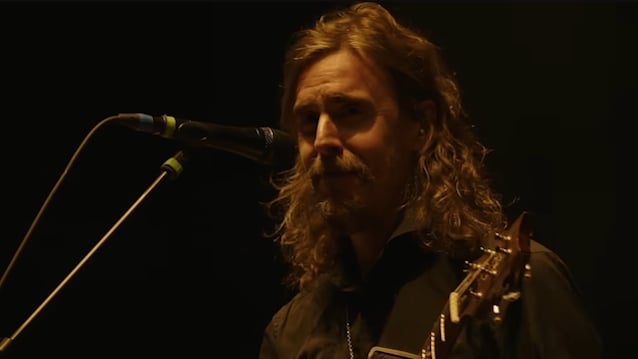
MIKAEL ÅKERFELDT Battles Dislike Of Touring As OPETH Remains At Height Of Band's Popularity
February 17, 2026By David E. Gehlke
OPETH has routinely played to packed houses since 2001's "Blackwater Park". They've headlined the legendary Red Rocks Amphitheater. They've headlined the legendary Royal Albert Hall. And, more recently, they headlined two sold-out dates at the legendary Sydney Opera House. OPETH could easily tour nine months out of the year and have little problem filling venue halls. Herein lies the rub: It's not what songwriter, vocalist and guitarist Mikael Åkerfeldt wants to do.
Touring has been an albatross for Åkerfeldt ever since the Swedes started logging serious miles on both sides of the pond in the 2000s, when OPETH's profile dramatically rose, despite playing blatantly uncommercial progressive death metal. And even when they made the perilous jump to less metal-flavored avenues on 2011's "Heritage", people kept coming out to see the band. Åkerfeldt certainly realizes what he has: An excellent, stellar lineup (filled out in 2022 by Finnish wunderkind drummer Waltteri Väyrynen) and a die-hard fanbase willing to accept any of his creative whims. It's just that Åkerfeldt would much rather be at home with his family and working on new music than spending countless hours on a bus.
Circa early 2026, Åkerfeldt is doing his best grappling with the literal act of being on the road, which is exactly where he was when BLABBERMOUTH.NET grabbed him for a chat as OPETH made their way across North America with countrymen KATATONIA in support of 2024's "The Last Will And Testament".
Blabbermouth: You have previously stated that you dislike touring. Has that changed or gotten better now that you're doing bigger and better venues?
Mikael: "It's probably for the worse. I don't particularly enjoy touring that much. There are aspects that I do like. The shows in themselves are the highlight of the day, I would say. But if you're not feeling it, they can also be a bit of a curse. I've been battling insomnia connected to touring, like nervousness. I put a lot of pressure on myself for some reason — more now than before. The insomnia has made me feel quite wobbly and insecure when we play shows. Once I'm up there, it's kind of business as usual. After a couple of songs, I don't feel as wobbly, and after a while, I might be able to enjoy it. Touring, for me, is like working in a factory. It doesn't feel 'musical' to me. We're chasing the recorded versions and trying to play them as perfectly as we can. Of course, we can never do that. We sound good; I think the band sounds better than ever. I sing well. We're tight. We are better than ever, but we're still chasing a ghost, I think, up there. I don't necessarily feel that it's creative work. It's repeating something that you did, in some cases, many years ago. When I'm in the zone and feel confident, I like that type of interaction with the crowd. Of course, I'm fucking amazed that people are coming to see us, more so now than ever. We're doing really well. I feel like an ungrateful bastard for not enjoying it as much, but it's always been like that for me. I love the creative work. I really want us spend more time writing music, as opposed to repeating old music."
Blabbermouth: Was it always this way? Like, when you were touring all the time after "Blackwater Park"?
Mikael: "Me, like many other people with my background, like musicians or artists, you want to 'make it.' In the early days of touring, that's exactly where I wanted to be. I'm a bum. I didn't have anything going for me in my working life until this band. I wanted to show the naysayers — basically, the whole of Swedish society — that it's a pipe dream to think you're going to play this weird music and that people will like it and travel the world. It felt impossible. Once I started touring a lot, I was exactly where I wanted to be. Then I guess we overdid it to some extent. That allure of touring lost its luster. After that, it was a normal thing for me. You do a record, then go on a world tour. Then it started to get less and less exciting. At the same time, I developed my musicality, so in that sense, I still feel that I have more and more to give. I'm constantly interrupted by the notion of touring and actual touring."
Blabbermouth: Jumping ahead, then, you've done "special" gigs at Red Rocks and Royal Albert Hall. You're doing a gig next summer in Pompeii. Is that a way to sort of bridge that gap of not wanting to tour but needing to do shows?
Mikael: "It doesn't feel like that. I don't want to be a downer. I'm excited to play in Pompeii because of its historical value. As a tourist, it's cool. I'm sure once I'm up onstage, it's going to hit me at some point, 'Wow. It's a huge thing.' Like, playing Royal Albert Hall and all of these venues that we've done. It's amazing to think back, like, 'Wow. Did that happen?' Just the other month, we did two sold-out shows at the Sydney Opera House. It's like, 'That's crazy for a band with the music that we have.' In advance, I don't get excited. It's afterward. A year later, I'm like, 'That's cool! We did that.'"
Blabbermouth: Will the day ever come when you sit down with (longtime manager) Andy Farrow and tell him you no longer wish to tour?
Mikael: "It's been an ongoing conversation for 10 or 15 years. I constantly say that. I constantly feel that, but I also feel responsibility toward the band, our crew and our fanbase. I do it more for them than for myself. If I don't move, nobody moves. It sounds like a glorious position to be in, but it's a bit of a cross to bear. I feel a bit stressed about that. It also goes against my nature because I chose this line of 'work' because I wanted to do what I wanted to do. Now, sometimes, I'm not doing what I want to do when I'm touring."
Blabbermouth: It's a catch-22.
Mikael: "Yeah. I'm not miserable. It's not exactly what I love the most about being a musician. Without question, my favorite thing about being in this band is the creative side, sitting in the studio, recording records. Even during the writing process, when the only one who's hearing new material is me, I'm not even playing it to anyone but myself. I sit there and go, 'That's good. That's amazing.' Nobody else but me. That feeling that I can still make something from nothing, that I feel is cool. That's a feeling that I can't really describe. It beats all the other, the attention and all of those kinds of things and touring the world and being 'successful.' That primal feeling that I'm able to do something with music is a lovely feeling."
Blabbermouth: This is an ongoing thread for you. It can't be easy when you have people who want to see the band, yet you want to spend time at home doing other things.
Mikael: "No, it's not very easy. I love to be at home. I'm what you say in Sweden, a 'home pig' with my daughters, girlfriend and cats: that's where I feel I can relax. A few weeks before a tour, I start having these stress symptoms. I'm like, 'Why can't I sleep tonight?' It's like, 'Oh, shit. I have a tour coming up.' It's related to touring. I certainly hate leaving my daughters and girlfriend. For that reason, I'm never excited about going on tour. Once I'm out there, of course, it kind of gradually gets better. On the last couple of tours, I have felt wobbly because of insomnia. It makes your headspace much more insecure. It puts added stress on an already stressful situation."
Blabbermouth: Switching over to Waltteri. Can you speak to what he's done with the back catalog? He also did great on "The Last Will and Testament".
Mikael: "You throw anything from our back catalog at him, and he'll show up at our rehearsal room, and we have a 20-minute song, and he nails it. All different aspects of drumming for this band — it's not easy. Going from really fast, double-bass drumming and even blast-beats and rock drumming to almost jazzy drumming and weird time signatures. At the same time, you have to keep some kind of pulse and tempo of the song. He's very clinical in his playing. We play shows, and every time we come off stage, he goes, 'Ah, it was terrible for me.' I go, 'What do you mean?' He says, 'I fucked up the entire set.' I say, 'It sounded perfect. I didn't hear anything.' I'm picky; I would hear something. He's an incredible drummer. We haven't worked so much with his drumming creativity because when I demo things, I'm a pretty good drummer in my head. I play on a pad in the studio and create the drum patterns. I played the songs to everyone in the band, including Waltteri, and I told Waltteri, 'The drums that I've come up with for the demos are open for your interpretation. You can do what you want. To my ears, this works with the song. If you want to use this idea, it's perfect for me. If you want to alter it, I'm all ears, as long as it gets better.' He was really happy with the demo drums. I think he stuck to 90 percent of those ideas. We haven't worked in the sense of where, 'Where do you go here? What can you do there?' We haven't worked like that for a long time. I sit alone in my studio, piecing together the songs and presenting them to the band. They learn them, and we go and record. We haven't really 'jammed.'"
Blabbermouth: You talk about getting excited about the creative process, maybe that's another layer to that, getting together with Waltteri.
Mikael: "Definitely. I would love that. Then, I think, the music would have to be freer because I write everything, like all the details, down to the tiniest detail, for the demos. If we're going to jam, I'm thinking it's going to change the whole nature of our sound. We've never worked like that. We could develop into some fucking Kraut rock band, lingering on one note for minutes. [Laughs] Of course, that would be cool and fun to do, but I'm not sure if it's fun to listen to. I'm definitely open to all sorts of developments when it comes to the creative side of this band. I'm also a creature of habit. When I start writing, I know that I can't leave things open. I have to finish all of the ideas down to the smallest detail, because that's just who I am."
Blabbermouth: As you said, it may take a turn to somewhere you don't want to go.
Mikael: "I'm conscious of our 'heritage,' no pun intended. I am responsible for this band, and for our 'legacy', and also, for myself, of course. I've done some shitty things that I don't like now, but at the time, it's like, 'This works!' More so in later years and in records, I'm more thorough. At some point, we'll die and won't be able to do more music, if you know what I mean. At that point, I want to leave not a spotless legacy, but something unique to us. I'm not interested in doing, 'Let's do a standard death metal record!' [Laughs] It's fun and all, but does the world need that? I think we have carved out our own niche in the metal scene. We have something, and within that niche, we have allowed ourselves to grow and do something different. Between some of our records, you can almost not tell it's the same band."
Blabbermouth: "Orchid" to "Pale Communion" is a big jump.
Mikael: "Exactly. Our fanbase has accepted that, and maybe, to some extent, they count on us to throw them some curveballs, and I am too because of my record collection. I love to be in that position, but in the end of the day, it has to be good."
Blabbermouth: How important has "Heritage" been to OPETH's career? You mentioned at the time that it would have been difficult to do another "Watershed". It's a pivotal album.
Mikael: "You see so many bands with our background that are stuck in a rut, doing the same shit. I'm not saying it's shit, but the same stuff. I'm not going to mention names, but listening to some of these bands, I wonder, 'Are they having fun in the rehearsal room putting together something that sounds exactly like they did 20 years ago?' I admire that. A part of me really admires that. Like, 'How can you not be bored with yourself at this point?' But, for me, that wouldn't work. I want to move on. 'Heritage' was one of those, like you said, 'pivotal' moments for us, for good and bad. The whole experience of doing that record and touring that record, for the first time in our career, getting some shit or flak for it, like, all of a sudden, a lot of people said they hated the new album. I wasn't used to that. I was used to everyone going, 'This is great!' What happened was that the band at the time stuck to our guns and got really close. Like, 'It's us against a lot of people who, all of a sudden, think that we're completely down the wrong path and that we should quit playing.' We got much tighter, and we believed in this idea more because it offended people. [Laughs] It was lovely. I remember touring for 'Heritage' when people were booing, like, 'Come on, man! Play metal!'"
Blabbermouth: Play "Demon Of The Fall"!
Mikael: "Exactly. Also, we sounded so good. It was lovely. I really loved that tour. I was a complete mess as far as my mental state. I was really tired, but once we were onstage, there was so much space in that new music that I could finally hear us playing. I didn't just listen to what I was doing; I was a cog in the machine. I could really enjoy playing those songs, as opposed to looking down at the fucking frets on my guitar. I could lean back and really enjoy it. Some of those gigs that we did for the tour, which was the biggest tour we had done, were magical."
Blabbermouth: The aforementioned "Demon Of The Fall" is in the set, as is "The Grand Conjuration" and "The Drapery Falls". Are these going to be the heavier songs that you'll regularly lean on?
Mikael: "We look at the setlist depending on what we're doing. For this U.S. tour, we looked at what we did on the last U.S. tour. There's about a 60 percent difference between tours. We're playing three new songs: we're still promoting the new album. We're doing '§1', '§7' and '§3'. We previously did 'A Story Never Told', and we rehearsed '§6' and never got it right, so we'll probably skip that one. This set is a metal set. It's not subtle. We even have stage diving, crowd surfing, and mosh pits, which are fun. It's leaning a lot on the heavy material. With the songs in our catalog and what we decided to play, it's more about what we play well than about mixing it up. We have tried to play obscure songs. For one, the crowd is like, 'What's this? What's this song?' Also, if we don't play it well, I feel it would be counterproductive. At the end of the day, some of these 'evergreens' have always worked. We play them well; we're relaxed, we put on a better show, I think. Of course, if you're like a massive OPETH fan and you know the entire catalog inside out, you might think, 'Ah. 'The Drapery Falls' again. Fuck it.' I understand that. [Laughs] It's more important to feel that we're confident and be a great unit up there. On this tour, we're doing a quite obscure song called 'Godhead's Lament'. It's from 'Still Life', which we haven't played in a while. It's fun. We play it well, and I feel like, 'Yeah, this is good.' We change it up every so often. Also, most of our songs are so long, in our way, if we change three songs, that's a good 40-minute difference in set time."
Blabbermouth: Are you having fun with the more "metal" vibe of these shows, then?
Mikael: "Yes! I like it. I am a metal guy. I love it, but I've changed my approach toward touring. After playing all of 'Heritage' for that tour and some songs that fit alongside it, I'm not touring for me now. My integrity is close to zero when I'm touring. [Laughs]"
Blabbermouth: We won't make that the headline!
Mikael: "Ah, do it! But in my 'Heritage' days, my integrity was 3,000 percent: 'Fuck this. We will do what we want.' Now, I want people to leave the show happy, like, 'I loved that show.' So far, so good. That works. That's the only thing I care about: Putting on a good show for the people who are there. I leave my integrity at home until I get into the studio and write new songs. Then, I don't worry about what the crowd wants."
Blabbermouth: Are you thinking about starting a new album cycle soon?
Mikael: "I cannot say much, but I have a project that I'm doing in May. Hopefully, it will materialize, but I am doing something in May. That's going to be fun. Then, I might have some project as well, like, for me, not for the band. I'm a bit burned out, as you can probably tell. I would really need a break from the band and be regular Mikael, not band Mikael".
Blabbermouth: Hanging at home with your daughters, cat and girlfriend.
Mikael: "Yes, and my records. I'm a really good househusband. I wish I could be paid for it. I'll get up at six in the morning and cook breakfast for everyone. Sometimes my daughters show up, and sometimes they don't, but I'm up. [Laughs] I'm not going to scare people who are reading this: OPETH is not going to split up. If we do, we're going to disappear. It's not going be a big hurrah, 'final tour.'"
Blabbermouth: So you're saying there won't be a five-year farewell tour for OPETH?
Mikael: "That's not going to happen. We're going to disappear. Honestly, I don't think we'll ever stop playing. We love each other, and we love playing together. I think there's probably going to be less touring. If we do less touring, it will mean more music and more frequent releases. That's what I really want to do. Maybe, if I feel like, 'Oh, I think we should do a tour,' and see if there are people out there who like us, we can do that. First and foremost, I want to spend more time with the creative side of things."


 Prev
Prev 