


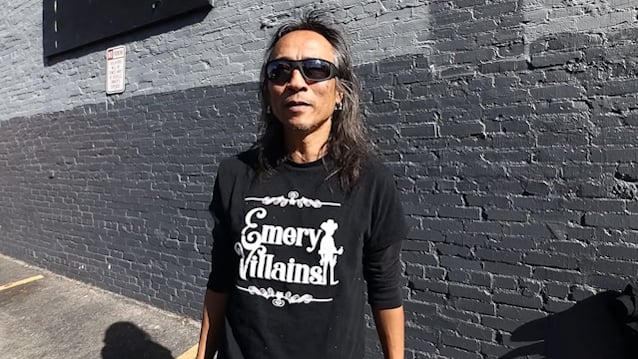
DEATH ANGEL Guitarist TED AGUILAR Reveals His 'Gripe About Today's Metal' Bands
June 11, 2026In a new interview with Pipeman, DEATH ANGEL guitarist Ted Aguilar talked about how early San Francisco Bay Area thrash metal bands all carved out their distinct sounds by blending complex guitar work, New Wave Of British Heavy Metal melodies, and progressive structures to differentiate themselves from the rest of the acts on the scene. He said (as transcribed by BLABBERMOUTH.NET): "There's nothing against the metal bands of today, and the good thing about it is there's a lot of them — maybe a little too much sometimes. It's oversaturated. And they're keeping it alive. They're carrying the torch. But I grew up in a time where thrash metal, ANTHRAX sounded different from OVERKILL, DEATH ANGEL sounded different from TESTAMENT. They had their own sound, but it was thrash. Of course, they were all influenced by the New Wave Of British Heavy Metal and punk rock, and, of course, METALLICA; everyone was influenced by METALLICA and EXODUS, 'cause they were in the forefront. But everyone just said, 'We want that aggression, but our style.' For example, [DEATH ANGEL singer] Mark [Osegueda] doesn't sound like [TESTAMENT singer] Chuck Billy. Chuck Billy doesn't sound like [VIO-LENCE frontman] Sean Killian, and no one sounds like Zetro [former EXODUS vocalist Steve Souza]."
Ted continued: "My gripe about today's metal, and this is just me and it's no diss to these bands, I can't tell who from who… And I think metal nowadays, there's some incredible players — like, oh my God, they could run circles around us, and they're very talented, where then it's just, like, you figured out your instrument together as a band: 'Let's write songs. Let's do covers.' You were figuring it out together, where in this day and age, and, again, there is no diss, 'cause there's amazing musicians out there. Incredible, like, oh, man, I wish I could do it. What's in the water today that you could run circles around everyone? But it's just the YouTubers and the influencers or whatnot, where then it's just, like, you had to figure out, you had to be a band together. There's something about being in a room together, with everyone learning from each other, bouncing ideas, instead of you're all by yourself, then you finally join a band and you're so used to being by yourself, you don't know how to click with another musician… That's the organic way back then. It's just, like, you get in a room, 'let's play', and you go home and you kept playing. You write, you come back, 'Hey, guys, I got this idea,' and you work on it together. Now — I mean, pros and cons. There's pros and cons to everything. Like anything in life. You have the technology where you could write riffs and send it to somebody, they learn it, and you could record. But you still gotta get in a room... There's a synergy where a human contact — you get to see someone's face, how they feel about it, what they contribute, and maybe the disagreements or whatever."
DEATH ANGEL recently launched the second leg of its "Act III" U.S. tour. The excursion, featuring guests VIO-LENCE and INCITE, kicked off May 1 in Phoenix, Arizona and will wrap June 21 in Santa Cruz, California.
DEATH ANGEL is a pioneering American thrash metal band formed in 1982 in Daly City, California, and a vital force in the legendary Bay Area thrash movement. Emerging as teenage prodigies, the band quickly built a reputation for blistering speed, technical precision, fearless songwriting, and ferocious live performances — qualities that continue to define them more than four decades later.
Formed by cousins Rob Cavestany (guitar),Dennis Pepa (bass) and Andy Galeon (drums),alongside vocalist Mark Osegueda and guitarist Gus Pepa, DEATH ANGEL cut their teeth in local clubs before exploding onto the international stage with their 1987 debut album "The Ultra-Violence", recorded when Galeon was just 14 years old. Its complex arrangements and explosive energy immediately distinguished them within the Bay Area scene. They followed with 1988's "Frolic Through the Park", which featured the breakout single and MTV favorite "Bored", even leading to the band hosting "Headbangers Ball". In 1990, their major label debut "Act III" (Geffen) revealed a more dynamic and melodic dimension while retaining their thrash intensity. With MTV airplay for "Seemingly Endless Time" and "A Room With A View", and a feature in People magazine, the album cemented their status as one of thrash metal's most musically adventurous acts.
After reuniting in 2001, DEATH ANGEL embarked on a powerful second chapter — one that would become among the strongest stretches of their career. Rather than leaning on nostalgia, they delivered a run of acclaimed releases that fused classic Bay Area aggression with sharpened songwriting and modern production. Beginning with "The Art Of Dying" (2004) and continuing through "Killing Season" (2008),"Relentless Retribution" (2010),"The Dream Calls For Blood" (2013),"The Evil Divide" (2016),and 2019's "Humanicide", the band refined their attack while expanding their dynamics. Across these albums, intricate riff craftsmanship, blistering tempos, and socially aware lyricism became hallmarks of their modern era. "Humanicide" earned DEATH ANGEL a Grammy nomination for "Best Metal Performance", further solidifying their place among contemporary thrash metal's most vital and respected forces.
In 2025, the band unveiled two standalone singles, marking their first new material in several years and signaling the next phase of their evolution. "Wrath (Bring Fire)" delivered a high-velocity assault rooted firmly in classic Bay Area ferocity, while "Cult Of The Used" emerged as a sharp, socially charged anthem driven by precision riffing, thunderous rhythm work, and commanding vocals. Together, the releases reaffirmed DEATH ANGEL's creative momentum and uncompromising intensity.
To celebrate the 35th anniversary of "Act III", DEATH ANGEL launched a special anniversary tour performing the album in its entirety. The run combined full-album performances with select classics from across their catalog, offering longtime fans a rare and immersive experience. The tour included major U.S. markets and multiple hometown Bay Area performances — including two advanced sold out shows at the legendary Fillmore — underscoring the album's enduring impact. The "Act III" anniversary tour continues into 2026 and 2027, with additional dates to be announced.
The current lineup — Mark Osegueda (vocals),Rob Cavestany (guitar),Ted Aguilar (guitar),Damien Sisson (bass),and Will Carroll (drums) — has remained intact for nearly two decades, forming one of the most stable and formidable configurations in the band's history. That longevity translates powerfully to the stage, where DEATH ANGEL continues to tour extensively across North America, Europe, South America, Asia, and Australia, appearing at major festivals and headlining club and theater dates while maintaining their reputation as one of thrash metal's most electrifying live acts.


 Prev
Prev 