


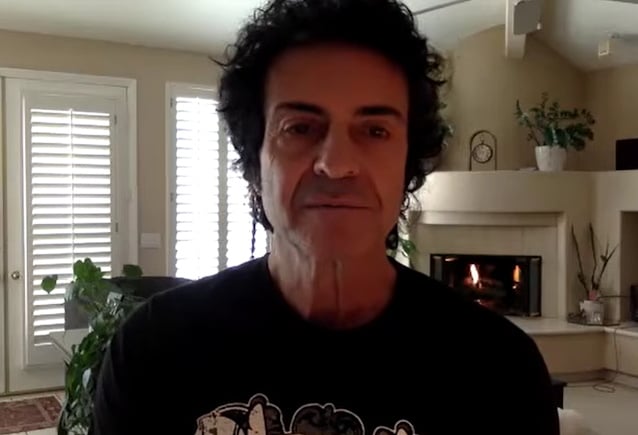
Former OZZY OSBOURNE Bassist PHIL SOUSSAN Dismisses JAKE E. LEE's Claims Over 1987 Firing, Defends 'The Ultimate Sin''s Legacy
November 29, 2026Former Ozzy Osbourne bassist Phil Soussan has flatly rejected longtime allegations from ex-bandmate Jake E. Lee that Soussan helped orchestrate Lee's 1987 dismissal from Osbourne's solo band, calling the notion "laughable" given manager Sharon Osbourne's tight control over the camp.
Speaking with Remzi "Jam Man" Yates of Rocking With Jam Man, Soussan also addressed the 40th anniversary of Osbourne's 1986 album "The Ultimate Sin", offering his theory on why the late metal icon frequently dismissed the record — and pushing back on Lee's version of how their tenure together ended.
When asked about Lee's 2018 assertion that Soussan lobbied behind the scenes to have the guitarist fired following the breakout success of the Soussan-co-written hit single "Shot In The Dark", Soussan brushed off the accusation.
"It's just nonsense," Soussan said. "I don't wanna spend too much time talking about this stuff because it's nonsense, but Jake obviously had his own reasons that he didn't really wanna be involved anymore. Anybody who knows Sharon Osbourne knows that you can't open a window without getting her permission, so the idea that I had that much power is just laughable."
The comments revisit a lingering rift stemming from November 2018, when Lee told The Metal Voice that he and Soussan "did not have a good relationship" during "The Ultimate Sin" era. In that 2018 interview, Lee claimed that Soussan — after scoring a hit with "Shot In The Dark" — wanted to become Osbourne's primary songwriter and collaborated with producer Ron Nevison to push Lee out. Lee also alleged he had twice talked Osbourne out of firing Soussan over his stage antics earlier on the tour, adding, "So the fact that he helped me get fired in the end and then he only lasted a couple of months before he got fired? Karma. Karma, motherfucker." In a separate October 2018 interview with Eonmusic, Lee noted that he actually learned he had been fired from his roommate/guitar tech, who heard it from Soussan and drummer Randy Castillo right after Sharon Osbourne had taken Lee out to dinner without being able to bring herself to deliver the news.
Soussan also addressed Sharon Osbourne's reputation as a manager during the Rocking With Jam Man chat.
"Everyone's gonna have their own story and their own experience," Soussan noted. "I found Sharon to be a very tough business person. Sometimes, when she was representing you, that could be a good thing, and sometimes when you're trying to negotiate with her, that can be something that's tough to deal with."
Following Lee's 1987 exit, Soussan himself parted ways with the Osbourne camp ahead of the "No Rest for the Wicked" sessions. In a May 2021 interview with "The Five Count" radio show, Soussan explained that he chose to leave after failing to reach the business deal he wanted, stating that although he subsequently experienced temporary accounting and late-payment delays, he never joined former Ozzy bandmates Bob Daisley and Lee Kerslake in suing the Osbournes.
Earlier in the Rocking With Jam Man interview, Soussan weighed in on "The Ultimate Sin" reaching its 40th anniversary — and why Osbourne himself repeatedly criticized the album, famously telling Rolling Stone that producer Ron Nevison "didn't really do a great production job" and calling it his least favorite solo record.
Soussan argued that Osbourne's distaste for the LP had more to do with shifting musical trends and image than the quality of the material, noting that the album transformed Osbourne from a cult metal figure into a mainstream household name.
"I think you have to try to figure out why he would say something like that, because it was a pivotal album," Soussan explained. "It was one of his most successful albums ever. And by pivotal, what I mean was that prior to 'The Ultimate Sin', Ozzy was very much an underground metal artist. 'The Ultimate Sin' changed that and turned him into a commercial, public name. Everybody knew who he was, and after that, the rest is history. So I think it was a very, very important album because it led him into being a well-known commercial artist."
As for why Osbourne later distanced himself from the album, Soussan pointed to the late-'80s and early-'90s musical shift back toward heavier, gloomier roots.
"Why he might not have liked it is, I think, after that there was a whole resurgence in BLACK SABBATH with grunge music and all the darker side of BLACK SABBATH," Soussan said. "And 'The Ultimate Sin' was pretty glam — I mean, there was a lot of sequins and sparkles and all kinds of shit like that — and we kind of started off a whole movement, I suppose, in the '80s of a sort of '80s glam rock movement. And perhaps that was something that he wanted to kind of separate into two things, which is maybe why he says that. However, the success of the album speaks for itself."
In an August 2025 interview with the "Talk Is Jericho" podcast, Soussan similarly divided Osbourne's career into three distinct chapters, describing "The Ultimate Sin" breakthrough as the moment Ozzy's commercial trajectory suddenly accelerated into the stratosphere.
Back in May 2021, Soussan discussed his decision to leave Osbourne's band during an appearance on "The Five Count" radio show. Asked about the "weirdness" that went on between him and Ozzy's camp following his exit from the group, Phil said: "Let me clear this up once and for all. There wasn't that much weirdness that was going on. I think what happened was I was in a position where I was not able to cut the deal that I wanted. I wanted to do certain things; I wanted to cut a certain type of deal. And kudos to Sharon. Listen, she basically presented this to us in a very simple way. We were there, and we were being hired to do our best work — the best work that we could possibly do to make Ozzy sound and look as good as he possibly could. And we also knew that if we were not okay with that situation, there's probably three dozen people waiting in the wings that would gladly come along and do what we were doing."
He continued: "It got to a point where I was being expected to write more songs, and I wanted to kind of boost up my publishing and what have you, and for whatever reason, I was not able to cut a deal that was acceptable with Sharon, and I couldn't really get the same deal that I wanted. And at the moment, I just said, 'It's time for me to move on.' And it was a difficult decision — you leave the biggest band in the country. But I said, 'You know what? I've done it all once. I did one round, one tour, one this, one that, and let me move on and see what happens.' And I left. And I think she might have been a little upset about that, about the fact that I left. But for whatever reason, we had some accounting issues. So all of a sudden, I was having a hard time getting paid, and my accountants went back and forth a few times. And all of this got resolved eventually. It was just a payment thing — it was, like, late payments and stuff. And I don't know what the motivation was, or whatever it was, or if there was even a motivation — maybe it was just 'out of sight, out of mind' — but once I wasn't in the band, people weren't jumping to take my call about things like that. So it got resolved, and it got resolved in probably 1992 or 1993. And ever since then, everything's just been fine."
Soussan went on to say that he had heard "some really weird stories" about why he supposedly left Ozzy's band, including that he had sued Osbourne over unpaid royalties. He clarified: "I was asked to join a lawsuit that [former Ozzy bassist] Bob Daisley had, but I never joined that lawsuit; I didn't have anything to sue anybody about. I think Bob and Lee [Kerslake, former Ozzy drummer] had some issues that were going on, but when they called me, I just said the same thing I just said to you. I said, 'Why would I wanna do this?' So that was it. But all of a sudden, you hear these stories that we were in court. We never went to court. I never sued anybody."
"The Ultimate Sin" reached No. 6 on the Billboard 200 chart and was certified platinum in the United States on May 14, 1986, by the RIAA and and double platinum in October 1994. It was the follow-up to "Bark At The Moon", which was the first Ozzy album to feature Jake E. Lee on guitar following the tragic death of Randy Rhoads.
The writing sessions for "The Ultimate Sin" were by disagreements over songwriting, with Jake, who claimed he had been cheated out of the credits he deserved on "Bark At The Moon", later telling Ultimate Classic Rock that he demanded a revised contract before agreeing to contribute. Daisley was dismissed during the making of the LP and Soussan was brought in as is his replacement. Ozzy later invited Daisley to come back to help with the lyric writing, which Bob had shouldered the bulk of since the start of the singer's solo career.
Seven years ago, Ozzy said that "The Ultimate Sin" was his least favorite album he has ever released as a solo artist. Although it was out of print physically at the time (but available on streaming services),the 1986 LP has been certified double platinum. "[Producer] Ron Nevison didn't really do a great production job," Ozzy told Rolling Stone. "The songs weren't bad; they were just put down weird. Everything felt and sounded the fucking same. There was no imagination. If there was ever an album I'd like to remix and do better, it would be 'The Ultimate Sin'."
Daisley, who is credited with all the lyrics on "The Ultimate Sin" apart from "Shot In The Dark" (which is credited to Soussan and Osbourne),later said he was also heavily involved with the music writing on the LP.
"I did write the album with Jake and then Ozzy and I had a falling out and he fired me and he was going to fire Jake as well," Bob explained in an interview. "I've never been a 'yes' man. So a few weeks later, he called me and he had Phil Soussan on bass but I'd already written a lot of the music with Jake, so they knew they had to credit me on the songs anyway, so I guess he thought he may as well get his money's worth and asked me to come back and write the lyrics also. I did that as sort of a paid job. I write it, you pay me and take it and go. So I spent a few weeks writing the lyrics for the whole album. Then they recorded it. In a way, I am glad I am not on that album. It's the one album I didn't really like."


 Prev
