


KISS Manager DOC MCGHEE On Band's Impact: 'There's A Little DNA Of KISS Throughout Our Industry'
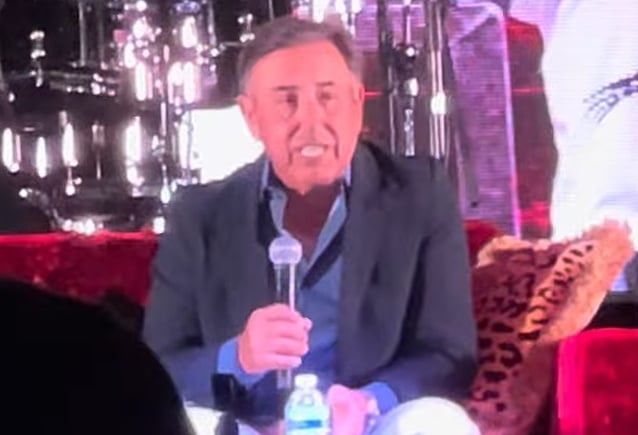
November 24, 2026On November 14, longtime KISS manager Doc McGhee participated in an "Ask Doc" question-and-answer session with fans who attended "KISS Kruise: Land-Locked In Vegas '26", a destination event held at the Virgin Hotels resort complex in Las Vegas. A few excerpts appear below (as transcribed by BLABBERMOUTH.NET).
On KISS's 1996 reunion tour:
Doc: "You have to remember, this is 1995, '96 — the height of grunge. This is where everybody was, 'Kill your mother,' and 'I'm pissed off,' and torn jeans and no production and everybody wore a little cat on their t-shirt. To have four guys standing in makeup with their arms in the air standing on the world was probably not the smartest thing to do at the time, but I thought, 'People want to have fun, and KISS is fun.' It's non-political; it crosses every [demographic]; it checks all the boxes. I said, 'We'll bring it back the way they started, instead of trying to do something that you move into or change or morph into. [That's] not KISS. KISS was these four guys, these four knuckleheads who got together to do this crazy stuff that they did, and that's what I brought back. It was pretty simple."
On the decision to launch the reunion tour at Detroit's Tiger Stadium:
Doc: "When you're launching something, I've never been a Plan B guy. I only look at Plan A, and that has to be the biggest, baddest thing to do, or don't do it. I always say, 'If you're going to run with the big dogs, you can't piss like a puppy' — so, don't do theaters and don't go do this [or that]. Do what you do. Detroit is one of our strongholds forever — 'Detroit Rock City' and everything else we've done in that city, to Cadillac, Michigan, all those things. It was just a natural to say, 'If you're going to come back, come back where you were, which is on top.' And it worked. In 20 minutes, we sold it out — and not in a digital world. This was analog — you had to go down and wait in line, and get to the kiosks to buy your tickets. I was sitting there at Ticketmaster at 5:30 in the morning in L.A. when we went on sale and watched the numbers come in… It was exciting."
On KISS's appearance at the 1996 Grammy Awards, their first appearance in makeup since unmasking on MTV in 1983:
Doc: "It was exciting to walk into the Grammys for the first time that anybody had seen KISS in years in makeup. Nobody knew we were coming. It had to be a total surprise. We gave a Grammy with Tupac [Shakur]. It's KISS and Tupac, and Tupac looked at us like we were Ronald McDonald on acid… We walked down into the green room in makeup, [and] the first person I saw was Sting, and [then] Alanis Morrisette. You could hear a pin drop, and I thought, 'Oh, fuck — these people are going to…' I had no idea. And all of a sudden, they stood up, and everybody [gave us a] standing ovation. And we never said anything — the deal was, come in, don't say a word, because I wanted people to say, 'Is that really KISS?'"
On how KISS changed live entertainment and influenced his other clients:
Doc: "When I started in the '70s, I didn't know KISS. I was managing James Brown, Isaac Hayes and Diana Ross — all kinds of different things than rock music. But I always liked big stuff, so I always watched KISS as a kind of template of where I wanted to go in entertainment. It was so interesting to me [because] I grew up in an era where the British Invasion was just nothing on stage but talent, and then it got very esoteric. Then, all of a sudden, KISS came, and it was mind-blowing, even though it was pretty archaic when they started compared to what we do today. The DNA of KISS has stayed with me through the years of saying, 'If it's worth doing, it's worth over-doing'... Everything kind of started in my world of production because of the DNA of KISS, understanding that they took it to levels that nobody had taken it to — because I don't know if anybody wanted to go there. It was so out there at the time, and it was so different that they were the only ones that were out there. That stayed with me, not just through MÖTLEY CRÜE, but through BON JOVI and SCORPS and SKIDS and GUNS. I think there's a little DNA of KISS throughout our music industry."
On whether he'd consider writing a memoir:
Doc: "If you ever want to dig deep into your shit, write a book. It's very difficult. I wrote it — it'll never come out — just for myself. It started out to be called 'Shit Happens', and then it went to, 'Everyone's A Bull Rider Until Someone Opens The Gate', to 'The Mind's A Fucked-Up Thing'. All those iterations of it, I realized that it's not my place to tell stories to the public about my artists. I'm dad, and they chose me to be that person. It's a private thing between us. I'm on documentaries all the time, so at the moment, I don't feel like it's necessary to put a book out. I don't have that much [else] to say."
Doc is acknowledged as one of the music industry's most legendary artist managers. His unparalleled reputation is grounded in universal respect within the industry. Under his guidance, his artist clients have sold more than half a billion records, thanks to a roster that boasts some of rock's biggest acts, including BON JOVI, MÖTLEY CRÜE, GUNS N' ROSES, SKID ROW, SCORPIONS and HOOTIE & THE BLOWFISH.
McGhee began managing KISS prior to the band's 1996 reunion tour and has represented the group ever since.
McGhee appeared in the VH1 reality series "Supergroup" along with Ted Nugent, former SKID ROW frontman Sebastian Bach and Jason Bonham. He was also seen on the AMC reality series "4th And Loud", which chronicled his, Gene Simmons's and Paul Stanley's roles as owners of the Los Angeles Kiss Arena Football League (AFL) team.


 Prev
