


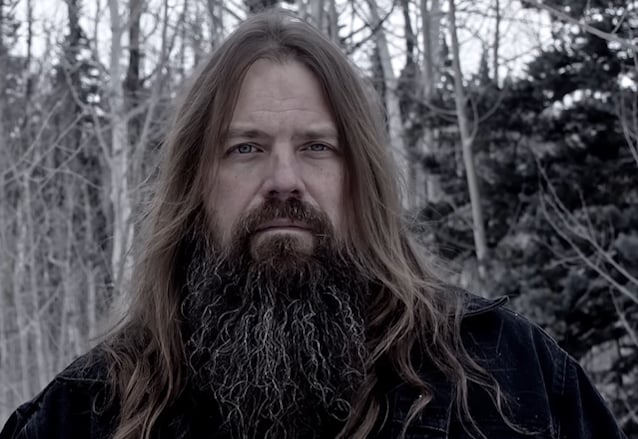
MARK MORTON Says LAMB OF GOD's Success Is 'Really The Most Unlikely Story'
February 25, 2026During a recent appearance on The Jasta Show, LAMB OF GOD guitarist Mark Morton spoke about his memoir, "Desolation: A Heavy Metal Memoir", which came out in June 2024 via Hachette Books. Co-written with Ben Opipari, the book explores both Mark 's life in music and his tumultuous path through addiction and into recovery.
"It was just a weird thing, man," Mark said (as transcribed by BLABBERMOUTH.NET). "The book is called 'Desolation: A Heavy Metal Memoir', for your listeners that don't know. It's been out now for a year and a half. And it's really kind of three stories in one kind of all blending together. It's basically this story of me being this sort of anxious, kind of shy, uncomfortable kid that finds guitar and finds the music and it just takes over my entire psyche. And then it follows the journey of [the pre-LAMB OF GOD band] BURN THE PRIEST into LAMB OF GOD that is really the most unlikely story, really. I mean, it's kind of a trope; it's like a Cinderella story. The degree of success we've had would've never made sense at any point if you'd have tried to have said 'script that' or 'plan that'. And it all sort of happened by accident, and it kind of details that. And then it also details just my descent into alcoholism and drug addiction, and then my coming out of that. And all those things, stories kind of intertwine. And there's some tragedy in there and there's some comedy in there, some funny stories and some sad stuff, too."
Regarding why he chose to read the "Desolation: A Heavy Metal Memoir" audiobook himself and not hire a voice actor to record it, Mark said: "Really, that boils down to — there is a section of the book where I discuss the birth and death of my first daughter. And I frankly just would never want anyone else to tell that story. I wouldn't have felt comfortable with someone else voicing that story. And beyond that, I didn't have any reason not to do it.
"I'll tell you this, and you know this — I didn't know this until I did it — doing voice work is tricky," Morton explained. "It's a skillset that I didn't have, and by the end of it, 'cause it took me, like, five days to do the book, to read it and record that. And I did it in a studio with a producer, et cetera, et cetera. But it's a tricky thing. You become very well acquainted with your own sort of speech impediments and idiosyncrasies and throat gurgles. And you learn when to not eat, when to eat, how much to eat, what to eat, when to drink water, when not to drink. You can't be too hungry, but you can't have just eaten, and your body's just making all this noise that you gotta work around. It's wild."
After Jasta noted that the audiobook has to follow the written version "word for word", Mark said: "Yeah. I mean, that, to me, is easier because I'm just simply just reading it. But kind of learning to be aware of your breath as you're reading and that kind of stuff, it's stuff that I walked into it not even thinking about. I've never listened to much of it. I've listened to clips here and there."
Asked if he feels like a different person because he co-wrote the book and then voiced it and shared it with the rest of the world, Mark said: "I didn't co-write it — I wrote it. I wrote every single word."
Elaborating on Opipari 's involvement with the book, Morton said: "Ben was a friend already. And the way the book came to be was, he has a place down at the beach in North Carolina, and we go down to that area of North Carolina, outer banks in North Carolina, pretty much every summer for vacation. And he was down there at the time. We were having coffee, and I was telling him some goofy story, music stuff. And he was, like, 'You've got a book in you, man. You should write a book.' And he's an English professor, and he works teaching lawyers how to write better and that kind of stuff. He's like a consultant. And he's, like, 'Let's write a sample chapter, just for fun, and see if we can get any interest.' And I was, like, 'All right, I'm down to go that far.' And we wrote one chapter, sent it to the one publishing company. We were, like, 'If we wanted someone to put this out, who would it be?' So we sent it to that company, and they were, like, 'Let's do a book.' I was, like, 'Oh, no.' So then I had to decide, like, am I gonna do it? I wrote every word. And the interesting thing about that is I don't type very well, so I wrote a hundred thousand words [very slowly]. So it took a lot of time on my laptop. So, hours to dollars, I probably made five bucks an hour writing this book. And then Ben would sort of edit and fix grammar, and if I said something twice, he would sort of — he just kind of cleaned it up. But no, he didn't write anything. I didn't recite anything. It was all written. Um. And so when I read it, it's not like I was reading something for the first time. I wrote every word."
Mark added: "To your question, I did not feel — it wasn't cathartic. It wasn't some self-discovery. That makes for good bylines, taglines about a project. But it wasn't, because everything in there, it's my story, it's my life. So all that stuff I've lived and I have as learned and lived experience."
Back in July 2024, Morton was asked by Full Metal Jackie's nationally syndicated radio show what the most surprising thing was that he discovered about himself in the process of putting together "Desolation: A Heavy Metal Memoir". Mark said: "Yeah, that's an interesting question. I went into this wondering, I went into the book project wondering if it would be cathartic or therapeutic or this process of self-discovery, as you alluded to. I'm not sure that it was, Jackie. I think the big takeaway for me… I essentially wrote the book just to see if I could do it, and it wound up being a mountain of work. And it was kind of — the joke was on me, because, yeah, I could do it, but it was a monumental project. But also, I think the big takeaway for me was just this sense of relief and gratitude that I had gotten past so much of the stuff that happens in the book.
"My life has by no stretch been a sob story," he continued. "There's a lot of just absolutely thrilling things that I've been fortunate enough to be a part of, and there's a lot of humor in the book, but there's some tragedy and some trauma as well. And so for me to be sitting where I'm sitting now and being able to reflect on that informs all of those experiences with a sense of hope. And I'd like to think that's one of the takeaways of the book, is that there's always hope and there's always a chance to get better."
When Full Metal Jackie noted that it must have been "a tough line to walk" in terms of how much of his "personal tragedies and low points" he wanted to share in the book, Mark concurred. "Yeah, it's a scary thing to try and balance how much you wanna let go of," he said. "'Cause there's some really, really personal stories in here. And those can be handled a lot of different ways, and you can go for shocking or you can go for guarded; there's a lot of different angles you can take with some of those stories. And that was a learning process for me. I'd never written a book. And I barely read books, frankly. When I do, they're usually rock memoirs. So I had some point of reference. So I think I had to learn that as I went.
"The big thing I found was to just be genuine and to try to tell those stories with a sense of respect, not only for the experience that I had, but for people who may have had a similar experience," Mark added. "So to try and be respectful of people who have lived through similar things as I have, but to also be genuine and not wear things as a badge or water things down to take the weight out of them, just to be authentic with it."
In a separate LiveSigning discussion with Opipari to promote "Desolation: A Heavy Metal Memoir", Mark revealed that the "hardest" chapter for him to write for the book was the one about the passing of his daughter. In 2009, Morton's baby, Madalyn Grace Morton, died the day after she was born after developing an infection during delivery. He wrote about the loss on the song "Embers" which came out on LAMB OF GOD's 2015 album, "VII: Sturm Und Drang", and in an essay that Noisey published.
Regarding why that chapter was especially difficult for him to write, Mark told LiveSigning: "It's not because I discovered anything new about that situation. I just think that I struggled to honor it and word it just right. And I remember telling you, 'I don't want a lot of notes on this one.' That was one of the things I was, like, 'If there's grammatical stuff…' I spent some time with that one. I was in a really bad mood those few days. So, in that sense, it just drummed up stuff. It's not something I bury. It's not something I forget. It's not something I wanna commodify either. I didn't want this to be a book about that, but I can't tell my story without touching on that. So it was more about finding the balance of all those things and kind of making it feel like I honored that, but didn't exploit it and told my authentic version of that. And I think that's what we did."
Morton also talked about the chapter that was "the most fun" for him to write, saying: "I really, really enjoyed kind of going through all the memories of the BURN THE PRIEST era of LAMB OF GOD and then the early LAMB OF GOD stuff and just really trying to characterize what an absolute just cyclone of chaos and idiocy we were back then. And that was fun to explore and to revisit. And even with the stuff before that, like my high school bands, I did a lot of checking in with folks and seeing if I was remembering this right. I even — when I talk about some of the early LAMB OF GOD days when we were playing, like, squats and warehouses in Philly and that kind of underground punk metal scene that we were a part of down there, I had a guy that I spoke to — he had reached out via one of my social media platforms and was saying he was at certain shows that I was kind of referencing as a touchstone from that point in time. And we got on the phone and I just checked my memory of that show versus his, and he gave me some real insight. And that was pretty cool. I thanked him in the book."
"Desolation" was described by the publisher as "the story of Morton's lifelong quest for clarity and self-acceptance, and shows how the pressures of career success and personal battles eventually came into conflict with Morton's dedication to the creative process. Intertwined with addiction, self-destruction, and the path to eventual surrender and recovery, Morton also reveals the greatest personal tragedy of his life: the death of his two-day old daughter, plunging Morton further into hopelessness. Surrounded by bandmates living their wildest dreams, Morton wanted nothing more than to disappear, ingesting potentially lethal cocktails of drugs and alcohol into his system on a daily basis.
"And yet, amidst the harrowing heartbreak, there were moments of triumph, hope, and incredible personal connection. Morton developed close relationships with his bandmates and crew members, sharing experiences that have made for some strange and hilarious tales. He's also gained a greater sense of purpose through interactions with his fans, who remind him that his work reaches people on a deeply personal level. Through the highs and the lows, Morton learns how to find presence and gratitude where he once found fear and resentment, a process that he considers a gift of spiritual awakening.
"'Desolation' is, at its core, about Morton's journey as a musician navigating self-doubt, anxiety and the progressive disease of addiction, and ultimately finding relative serenity. Perfect for fans, new and old, as well as anyone who has ever been tested and brought to their limits, "Desolation" is a highly satisfying, full-throttle investigation of the human experience."
When the book was first announced, Morton commented: "Initially, I started writing this book just to see if I could do it. But as the writing process unfolded, it quickly took on much more meaning. Unpacking my story, I was able to observe events in my life with an objectivity that I hadn't experienced while I'd lived them in real time.
"Through a lens of hindsight and recovery, I made friends with my past and found value in my most difficult days," he continued. "I hope that by offering my experiences, I can create a point of connection and commonality. There are a lot of fun stories in here and a few really sad ones. I'm grateful to have the opportunity to share them."
Morton co-founded LAMB OF GOD, which was initially called BURN THE PRIEST, in 1994.
In 2019, Morton released his debut solo album, "Anesthetic". An EP, "Ether", came out in 2020 and was followed by the "Without The Pain" LP in 2025.
LAMB OF GOD's tenth studio album, "Into Oblivion", will be released on March 13 via Epic.


 Prev
Prev 