


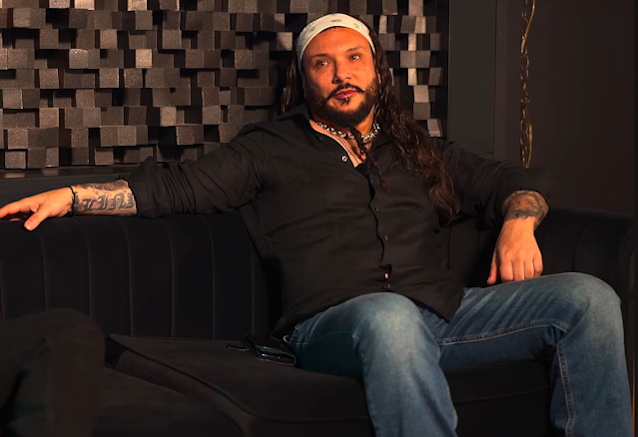
MAYHEM Drummer JAN AXEL 'HELLHAMMER' BLOMBERG Reflects On Genre-Shaping Career And Pioneering Blast Beat Innovations
November 29, 2026MAYHEM drummer Jan Axel "Hellhammer" Blomberg has offered an in-depth look at how necessity, mechanical experimentation, and pure instinct shaped his legendary drumming style — including his early development of alternating two-foot blast beats, non-crossover kit ergonomics, and high-tempo double-stroke kick techniques.
Speaking in an extensive sit-down interview with Zed Amarin, artist relations manager at AXiS Percussion and founder and CEO of Amarin Productions, the 57-year-old Norwegian percussionist reflected on four decades behind the kit and how his refusal to follow convention helped define extreme metal drumming.
Asked about the weight of knowing his recordings — from MAYHEM's foundational 1994 full-length "De Mysteriis Dom Sathanas" to landmark releases with ARCTURUS, DIMMU BORGIR and THE KOVENANT — helped shape an entire genre, Hellhammer insisted he never set out with historical ambition in mind. Instead, his career has been guided strictly by following his own creative instincts.
"Of course, that wasn't in my mind at all when I started," Hellhammer said. "I just wanted to do what I wanted to do. I had no plans or aspirations of being like this or that. To this day, I never do things that I don't wanna do, because if you do things that you don't wanna do, you never succeed doing anything good. But if you do things that you want to do and are passionate about and interested in, then that's the only way of getting real good."
When pushed outside his comfort zone by faster, more demanding compositions, Hellhammer repeatedly engineered new physical techniques and kit configurations rather than accepting the limits of standard hardware.
In the early 1990s — before extreme metal drumming terminology was standardized or modern direct-drive pedals were widely available — Hellhammer found that his hands could sustain blast-beat speeds his single-foot technique could not yet match on older pedals. His solution was to split the kick workload between both feet while placing the snare in between.
"I could work up a pretty good speed on my hands, but for my foot to follow that was [difficult]," Hellhammer explained. "And then I got a genius idea about alternating left and right — I mean, we're talking very early '90s here. It wasn't even called blast beats back then… So I was, like, 'Hmm, what if I alternate left bass drum, right bass drum with a snare in the middle?' Like a two-foot blast we call it today, but back then nobody was doing it."
To maximize speed and eliminate the awkwardness of crossing his arms over the snare at extreme tempos, Hellhammer also redesigned his ergonomics — adding an auxiliary X-hat on his right side and even positioning a shallower secondary snare to the left of his main hi-hat during his earlier years.
Hellhammer also traced how his hand and foot mechanics evolved across different eras of extreme metal. Studying traditional triplet-based Moeller stick motions, Hellhammer modified the rebound cycle into duple-time patterns, training his hand to use the upward recovery motion to trigger an immediate second stroke — predating what modern drummers now call push-pull or gravity blasts.
Around 2005–2007, while tracking DIMMU BORGIR's "In Sorte Diaboli" ("The Serpentine Offering"),Hellhammer was challenged to execute blistering 32nd-note double bass passages rather than triplets. Pairing AXiS longboard pedals with drum triggers, he mastered heel-toe/double-stroke kick execution to hit 290 to 300 BPM without burning out his muscles.
"I can also play today 300 with single strokes, but not for extended periods of time because then you strain your muscles in a way," he noted. "Using double strokes for the kicks, if you want to conserve energy and play efficient, makes total sense to me. Some people call it cheating. Some people called two-foot blast cheating. Some people call everything cheating. They're usually the guys that cannot do shit themselves. To hell with them."
Hellhammer's reflections arrive amid a major milestone period for MAYHEM. Following the band's 40th-anniversary celebration, the Norwegian black metal pioneers released their seventh studio album, "Liturgy Of Death", on February 6, 2026, via Century Media Records.
Recorded across NBS Studio in Sweden alongside SMB Studio and Chamber Studio, the eight-track, 49-minute opus reunites the band's longtime lineup of vocalist Attila Csihar, guitarists Teloch and Ghul, bassist Necrobutcher and Hellhammer, and features a guest vocal appearance from ULVER's Kristoffer "Garm" Rygg on opening track "Ephemeral Eternity". MAYHEM supported the release throughout February 2026 on their "Death Over Europe" headlining tour alongside MARDUK and IMMOLATION.


 Prev
