


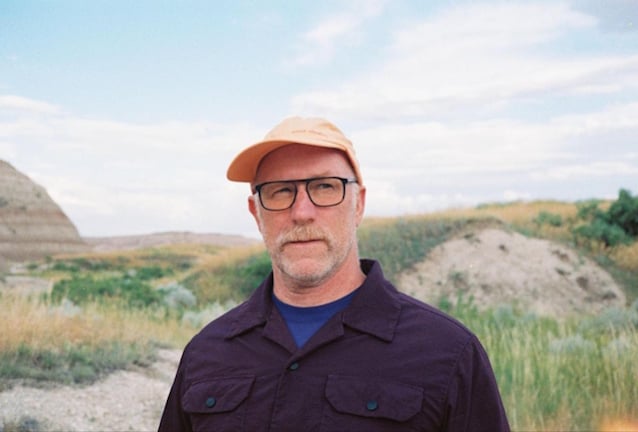
RODDY BOTTUM Reflects On FAITH NO MORE's 1992 Tour With GUNS N' ROSES: 'Misogyny, Male Aggression, Toxic Masculinity Was All Just Part Of The Equation'
January 1, 2026During an appearance on the "60 Minutes Or Less" podcast from Birthday Cake For Breakfast, FAITH NO MORE co-founder, musical trailblazer and queer icon Roddy Bottum — who has been promoting his recently released memoir "The Royal We" — reflected on his band's 1992 run of shows as the opening act for GUNS N' ROSES during the Axl Rose-fronted act's co-headlining tour alongside METALLICA. The tour took place in the middle of GUNS N' ROSES' "Use Your Illusion" tour, promoting the latter band's "Use Your Illusion I" and "II" albums, and between METALLICA's "Wherever We May Roam" tour and "Nowhere Else To Roam", promoting the heavy metal giants' eponymous fifth album "Metallica". Regarding what it was like being part of what is considered one of rock's most raucous and excessive tours ever, Roddy said (as transcribed by BLABBERMOUTH.NET): "I think it was a challenge, but, honestly, only for me. I think it was very much the rock and roll norm at that point. Misogyny, male aggression, toxic masculinity was all just part of the equation in that time, and everyone was on board for it. I don't know anyone that wasn't, honestly. I mean, our guitar player at the time — we had a very rock guitar player; he played a flying V guitar and he had long black, curly hair and he was very rocker sort of vibe, which is what we loved about him. He played guitar like that, kind of like METALLICA played, and he was best buddies with METALLICA. He was very much of that type of person. But the rest of us were all sort of leftist-leaning, progressive, weird artists, liberal minded. Billy [Gould], who I grew up with, who played bass for FAITH NO MORE and Mike [Bordin], the drummer, and Mike [Patton], the singer, we were all, like. 'Oh, my,' kind of blown away by the audacity of that environment. We couldn't believe what we were seeing, but we were very much alone in that mindset. Everyone on that tour, the GUNS N' ROSES people, their crew, the METALLICA people, their crew, Jim [Martin], our guitar player, probably a lot of our crew, they were down with the hedonism. They were okay with it, and it was just an era in which people got on board. Me being the gay man who sort of — I grew up with three sisters, basically — that was just offensive and wild and 'what the fuck?' to me, more than anyone else, for sure. And in the book — all you listeners out there, this is a spoiler — but it reaches a point in my life where recognizing that and seeing the potential association of us as a band and me in that band being sort of regarded as that was like, 'no, no, no, no, no, no.' So after that point, I hadn't really been open about my sexuality in the press, so it kind of did stir me on to making that declaration in the press and like talking about being gay. And that's sort of when my story turns in the book."
Bottum went on to say that he was a fan of GUNS N' ROSES' music when he was first exposed to it. "GUNS N' ROSES, when that first record ['Appetite For Destruction'] came out, I bought it," he said. "As pop songs, they were so good. It was so dynamic and it worked so well. And even though there was this thing, like an insert, that came in the first GUNS N' ROSES record, and it was kind of like a cartoon sort of drawing, and there was graffitied wall. It was a cartoon, and there was a girl — she's an underage girl in a schoolgirl outfit, and her underwear are down to her ankles. And the vibe is she's been raped. I'm just gonna say that. And I'm sorry to trigger anyone with this sort of talk and how that might affect someone. Apologies. And even looking at that, when I bought the record and opened it, I was, like, in. It's hard to think about ourselves in those terms back then and how much more lenient sort of I was and I was okay with things. That's not cool. Especially today, if we were to look at that, see that as a sort of an addendum in someone's artwork to include something like that, you would just be, like, 'What the fuck? No.' But for whatever reason, we as a people, we embraced GUNS N' ROSES. Even progressive and liberal people embraced GUNS N' ROSES. It was a viable thing, and they were exciting and dynamic and they were a loud, disrespectful rock band, and it was cool… So it took a long time for the sort of the distaste of what they were to sort of settle in. It took a long time for me to [be], like, 'Oh, wait, hold on.'"
Two months ago, Roddy spoke about what it was like to come out gay in the 1990s with no role models to look up to. He told Australia's Wall Of Sound in part: "Yeah. It was a difficult time. Looking back on it and what that attitude was about, it's kind of hard to imagine, that people were that phobic back then about gay people, but the world was really like that. And a lot of the book is about that, about the judgment of great culture on gay men and the reaction from gay men, and how do we deal with that? And particularly my generation, yeah, like you said, there weren't a lot of role models for me, and it was a clunky time as a kid to not have that. And what I was talking before about secrets, there's no other option from my generation, speaking from where I was coming from, there wasn't any other option but to be secretive and hide things, because, yeah, like you were saying, and I've said in my book a lot, there weren't a lot of role models. There was no one I could look up to, especially in the world of music. When I started coming out back in the '90s, there was really no one in my world that had a gay voice. The only person that I kind of knew, while we got to become really close, and she's one of my best friends [now], was Patty Schemel from HOLE. Besides Patty, I really didn't know queer people in rock; there just wasn't that in my world. When I was super young, I remember even — Elton John I was a big fan of, and I remember listening to him on the radio at one point and he was talking about getting married and stuff. It was that phase when he was really hiding his sexuality. And as a kid, as a young kid, I knew he was gay, but then seeing him sort of hide that or having that prospect of, like, 'Oh, here's an icon that I can latch on to,' taken away from me in that way and him shutting down and sort of doubling down and saying, 'No, I'm straight. I'm getting married to a woman' was, like, 'Oh my God.' It was such a slap in the face for me as a young kid. All I wanted was a direction and a person that would say, 'Yeah, this is okay. You can be this way.' But there just wasn't that. Even QUEEN, I talk about in my book, too — I remember QUEEN, they wouldn't come out and talk about being gay. I remember there was a reference at one point, I remember reading somewhere, and it was, like, 'Our band is called QUEEN and we basically sing opera music. So you do the math.' Okay, they were saying they were gay, but they weren't saying it. Everything that was even said in those regards was sort of guarded and cloaked and sort of fed in such a shameful way. It was hard to get on board with that. Even THE VILLAGE PEOPLE, I remember them speaking. As a kid, oh, clearly, oh, here's a gay representation, but I remember them saying, 'Well, we don't really wanna say if we're gay or we're straight 'cause we don't wanna lose any of our audience.' And what does that say to a young kid? That means, like, okay, say you're gay and people are gonna not like you. That's the exact statement it was. So coming from that world, it was definitely a hard place. Then even as I got older too, like I always say, [R.E.M. frontman] Michael Stipe was not gay when I was coming out of the closet. That wasn't a direction I could look. Even Bob Mould, who's very outwardly gay now, was, like, that wasn't sort of… Those two voices, which are pretty strong in queer right now, those weren't options for me. So it felt very alone to come out in that environment, in that crew of people when there weren't voices like that."
Roddy went on to say that the perception of HIV as a "gay disease" fueled the fire of homophobia, violence and intolerance in the 1980s. "For sure — [there were] a lot of levels in which it was difficult," he noted. "And that was for sure a whole tableau of humiliation and shame, was HIV and AIDS. At that point, it reinforced the notion that gay is bad. Not only is gay bad, it's toxic. It's not only toxic, it's poisonous, it's deadly. And if you're gay, you're gonna die. So, yeah, it was a lot as a young kid to deal with. But at the same time, that said, I don't mean to be sort of 'boohoo' about it. It created a really specific kind of person that I am, and I'm kind of thankful for that. It was hard to go through that generational weirdness, but at the same time it's a strength that I have that a lot of gay people who weren't in my generation don't necessarily tap in to."
Asked if his sexuality was an issue within FAITH NO MORE and whether that was what kept him from coming out sooner, Roddy said: "I don't think [so]. I think it was just an inherent thing. If you had asked me or asked any of the members of the band, like, 'Is it a deal at all that Roddy is gay?', it was so not a deal. We lived in San Francisco. All of the people in the band were so open-minded, they were all encouraging, but in my head it was something different and I just wasn't willing to go there. And that's on me. I talk that about that a lot in the book. Billy [Gould, FAITH NO MORE bassist] and I were best friends since the time we were very young, really young kids. Billy's the bass player of FAITH NO MORE. And, yeah, the fact that I wasn't able to be open with him about my sexuality, it still is something that's kind of a weird rub for me. It's not cool. I wish I would've had the wherewithal to be open. I mean, he was one of my best friends. So, amongst the band, it wasn't on them, it was on me. I just wasn't willing to go there with them based on the childhood that I had and the culture that we lived in. It was really difficult. But definitely they've only been supportive and understanding in that plight of mine."
Released on November 4, 2025 via Akashic Books, "The Royal We" documents Bottum's travels from Los Angeles to San Francisco, where he formed FAITH NO MORE and went on to tour the world relentlessly, surviving heroin addiction and the plight of AIDS, to become a queer icon. A deeply personal work of humor, commentary, and reflection, "The Royal We" is much more than a musician's tell-all. There are personal tales of historical pinnacles like Kurt Cobain and Courtney Love, GUNS N' ROSES, and recaps of gold records and arena rock — but it's the testimonies of tragedy, addiction, and a deeply loving recollection of a remarkable scene that make this work so unique and intriguing. Writing about his harrowing past in a clear-eyed voice devoid of self-pity, Bottum's emboldened and confident pronouncements of achievement and unorthodox heroism flow in an unstoppable train that's both captivating and inspirational.
Photo credit: Joey Holman


 Prev
Prev 