


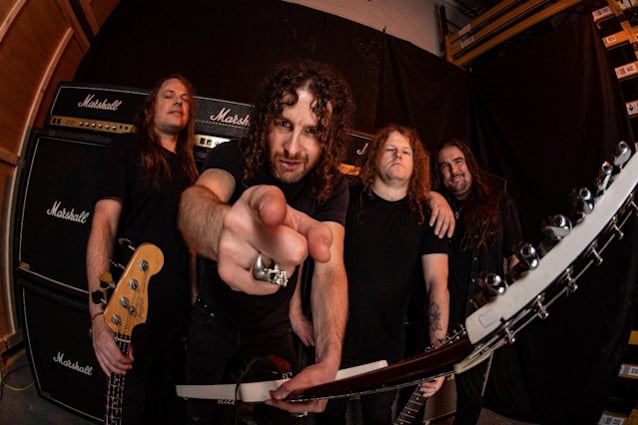
AIRBOURNE Goes To The School Of MUTT LANGE On New Self-Titled Album: 'He's A Sonic Magician'
September 1, 2026By David E. Gehlke
In their 25 years as a band, AIRBOURNE had yet to do something as daunting as submitting two songs to elusive South African megaproducer Robert John "Mutt" Lange and Canadian singer/songwriter Bryan Adams. Adams's track record notwithstanding (lest we forget he penned KISS's "War Machine"),Lange's stamp on hard rock music is permanent thanks to his knob-twiddling on AC/DC's "Highway To Hell" and "Black In Black", as well as DEF LEPPARD's "Pyromania" and "Hysteria". He also made a huge impression on the AIRBOURNE brothers O'Keefe (Joel and Ryan),who, as youngsters growing up in Australia, worshipped at the altar of Lange's production jobs and dreamed of working with him. That day finally arrived for two cuts off the band's new self-titled studio album, "Here She Comes" and "Who Put The Rhythm In You", the former, a preening, radio-friendly shot of classic DEF LEPPARD that marks a semi-detour for a band who has long been known as the second coming of AC/DC.
Operating with the goal of making an "iconic record," AIRBOURNE set up shop at Music Farm Studio situated in a jungle near the coastal town of Byron Bay. Along the way, the band encountered the type of deadly spiders and snakes that only Steve Irwin could love, as well as weather conditions that threw their guitars out of tune and powered their gear down at a moment's notice. Furthermore, AIRBOURNE tracked the entire lot of songs on tape — a true throwback if there ever was one. With that said, AIRBOURNE remains a chip off the old block with a knack for punchy, fun, no-frills hard-rocking tunes, which, as Joel O'Keefe would tell BLABBERMOUTH.NET, is why they sought the services of Lange and friends.
Blabbermouth: What was the thought process behind going the self-titled route for the new record? That's a title usually reserved for when a band thinks they've made something particularly special.
Joel: "Yeah, mate. There's that. We also couldn't pick a song that we wanted to drive anyone or a listener to. Every time we put it on, we said, 'It's an album. We set out to make an album. We've made a record; it's an album. You can either choose to listen to it from start to finish or not.' But we didn't want to put a title on it that would do it. All of the songs stand together. We couldn't write 12 titles on the front either!"
Blabbermouth: In your defense, it's gotten harder to come up with a title these days.
Joel: "It's tough! You want to outdo the other bands. You could say, 'This album is fucking rock and roll!' You can do that; it's got to be something else. 'This album is called 'Kick Ass!' You can't call it that either."
Blabbermouth: To steal a term from DEF LEPPARD, was there any sort of "stage fright" when giving a song to Mutt Lange? Did you get nervous?
Joel: "Maybe DEF LEPPARD wrote that song for the same reason! [Laughs] You do. I'm incredibly nervous about Mutt Lange and getting his ears on something. This is someone who made the best records on the planet; the most influential records on the planet, this guy has been involved in. If there were no Mutt Lange on the planet, if he were never born or existed or never decided one day to get into the music industry and do what he does with production, songwriting and everything, there would be no 'Back In Black' or 'Highway To Hell'. There would be no 'Hysteria' or 'Pyromania'. No FOREIGNER '4'. 'Jukebox Hero'. AC/DC, most likely, would have never gotten past 'Powerage'. Everyone loves 'Powerage' if you love AC/DC, but the album didn't move the needle anywhere on the planet. They could have been a cult band until the absolute worldwide smash of 'Black In Black', and the lead-up was 'Highway to Hell', which cracked them in America and got them on the radio. The sound changed. Everything was different. The sound of music changed when Mutt Lange touched the knobs and started doing things and pushing faders and producing the bands that he did. No one had ever gotten drum sounds like that in their lives. No one had captured the clarity of the guitars and the vocals — there's so much tension in the vocals that you walked away with everything that Bon [Scott] or Brian [Johnson] sang. Every producer after him listens to those records and goes, 'Wow! How do we do that? How do we do this? It's amazing'. The whole sound of music changed. There is only that. He is the master of all masters. Of course, you're going to be shitting your pants when you send him your demo! [Laughs] Yeah, it was such a great and exhilarating experience to do that. You know, with Bryan Adams, another one. The two of 'em together: it's just mind-blowing when you're sending demos to Bryan Adams and Mutt Lange, and they were actively working on the songs to make your little rock and roll band have some of the magic and some of the advice that they have crafted and built and designed for many, many years of their career. It's the learning experience. I couldn't focus in school whatsoever. All of my report cards said, 'Joel doesn't pay attention. Joel will not pay attention. And Joel doesn't do his homework. Joel doesn't do anything in class pertaining to his lessons.' However, when it's Mutt Lange and Bryan Adams, I was all ears. I listened to every little thing. That's the school I want to go to. It was great to finally be able to go back to school, to the one I wanted."
Blabbermouth: You've had plenty of songs with big singalong choruses before, but maybe not as bold as "Here She Comes". Was it fun to lean into that side a bit more?
Joel: "Absolutely. Since we started our band, we've always loved those big choruses. For example, METALLICA. This is the reason why we had the Canadian sound in there as well, because it's that Little Mountain Sound [referring to the Vancouver, BC studio where METALLICA tracked parts of the 'Black Album'.] Those albums they did — Bob Rock and Bruce Fairbairn and BON JOVI and METALLICA. 'Enter Sandman' is a nasty chorus. It's a massive chorus. Everyone in the stadium sings it. It's nothing something before than that you would associate METALLICA with to that point. They always had really good choruses, but the massiveness of that, the tempo, everything about that particular album, the 'Black Album', is just massive choruses here and there. You just want to sing. Their anthems, and that's the whole point, is that you got this big feeling inside that's a rock and roll song. It always comes out in the guitars, but to get it there vocally, that's where the magic kicks in. You go, 'You know what? We need help here. We need some Mutt Lange and Bryan Adams.' We plugged into their systems and bang, there you go. Of course, Mike Fraser and Brian Howes are the other Canadians who produced the record, loved a massive chorus and came up in that school of the Little Mountain Sound. It's where it is. Everyone wants to sing. You're not playing to a crowd of guitar players. Our first producer told me that back in the day, his name was Bob Marlette. It's not a crowd of guitar players. They got to see something; give me something to hang my hat on. It's a fun chorus to sing."
Blabbermouth: It took your brother three months to track drums. Would you ever have the patience to record like that?
Joel: "Absolutely. If Mutt Lange says do it, I'll do it. There's one thing I learned from our journey: You don't know everything. There is a reason why these people asked you to do certain things. Sometimes you can push back. Mutt, he's a magician. He's a sonic magician. If he says, 'Sing the thing 198 times' and you do it, and he says, 'Now, that's the right-hand side of the stereo spectrum; now I need another 198 times to get the other side of the left-hand.' And you're like, 'Wow, I guess we're going to get back in there and do it.' When you hear the result, it's massive. We didn't employ that technique because the tuning, the guitar tuning, was so fucked in 'the jungle'; we had this humidity. It constantly knocked the strings out. We had storms that would arrive quite often, and they would knock out the power, so you had to get the takes when the weather permitted. We were always on a knife's edge. We didn't have the time to do the one string at a time thing."
Blabbermouth: Weather-related delays in guitar tracking don't happen too often these days.
Joel: "It made it like a live gig. [Laughs] You only had a certain amount of time, so you played like your life depended on it: 'There's a storm coming. We've got about 45 minutes. Play like you fucking mean it because we're going to lose power for the next three days. In those three days, we're going to work on writing the lyrics, so get the fucking take. Everyone on, let's go. Hit record. Play like you mean it.' It did level up the intensity at times, which was good because it made you get the energy into the take. Having that threat looming was probably a bit different than someone standing there with a gun. [Laughs] But it did feel a bit like that sometimes, because you're like, 'We're running out of time in this jungle. We haven't got this record done yet, and we can only track a certain period of time, not to mention we're surrounded by spiders, snakes and cane toads and all of this wildlife that can kill you.' It was a good, intense experience, but we had a lot of fun. It was a lot of fun."
Blabbermouth: You don't hear these kinds of stories anymore. Album making has become largely uneventful.
Joel: "When we grew up as kids, we always had this obsession, funnily enough, with Mutt Lange. We made a chart called the Mutt Nations; it was all the things he would do in a song, through history. I would find a little production move he would do in an AC/DC song; I'd find it again in a DEF LEPPARD song, or he'd have the same move in a Shania Twain song and even THE COORS. It was the same thing that would run through, then I'd go back and listen to as many as I could; I didn't find them all. The story of 'Back In Black' was in the Bahamas. They had baseball bats in their rooms because people were going to rob them, and they had these storms; the studio was falling apart. It was kind of similar to where we were. We didn't have people breaking in, but we did have spiders and snakes. We went back to that mindset of like, 'There are bands that we love that we are influenced by and we love them, but the producers that made those bands, somewhere along our way, have not given them enough attention to why we love them.'
"We went back to that experience of making a record. When you look at those producers, the experience of making a 'Black In Black' or the experience — there's the doc with Bob Rock, 'A Year And A Half In The Life Of …'. You see them in the studio, slaving over the songs, then having arguments with Bob Rock. You can see no one's showered from the day before, and everyone is strung out from the record, and Kirk [Hammett] is not getting the solo, and Lars [Ulrich] is showing up late in his Porsche, and James [Hetfield] is getting upset, like, 'Are we ever going to get this fucking thing done?' But they came together. They're all on the same goal, and they're all pushing for this great. It's one more take, and then it's attainable. Every time you do that next take, it's one more take again; it keeps getting away from you until you finally get it. Lars's drums, like this legendary thing that they're all chopped up — whatever it takes to get it done. They made one of the greatest heavy metal albums of all time in 1990. There's a massive story behind that. It's like, 'Why don't we do that?' We've always said no to doing it on the laptop or using guitar plugins. We've always said that. We thought, 'Let's go to the fucking jungle where we're going to be way out of our element and comfort zone. And we're going to fly three Canadians to this Aussie jungle and do it this way and without even trying to make it a story, but make it this adventure, so we go away to make this record, and we're either going to fail, or we're going to succeed. There's really no way to come back from this at all. If we fuck this up, it's going to be bad. [Laughs] We made this thing, and it's a part of our lives. If you put a part of your life into your record, then put it out there to the world. Some people will listen to this record, like it and listen to it more than once, and it might become a memory for them as they grow up. For me, AC/DC's 'The Razor's Edge' is a memory for me because I found it when I was a kid. When I listen to it now, I'm transported back to that place. You want to put it all in."
Blabbermouth: What inspired "Christmas Bonus"? Are you thinking the rock scene needs more songs about the holidays?
Joel: "Funnily enough, we recorded it in July. So it was like Christmas in July. We're laughing because in Australia, it's winter in July. So, it was like the American version of Christmas or the Canadian version of Christmas or, you know, the other hemisphere, the Northern Hemisphere. In all the movies, 'Home Alone' and all that shit that we grew up with, Christmas is always in winter. But in Australia, it literally is a 40-degree day, and you've got the BBQ, and you're outside, grilling up brawns and stuff. And so, the other reason was that we wanted to make a rock'n'roll Christmas song because Christmas always has the carols and stuff like that, and there aren't too many rock 'n' roll songs out there. And back to 'The Razor's Edge', there's a song on that called 'Mistress For Christmas'. So, we were like, 'Look, we're six albums in here. I think we can do a Christmas song.' We had a crack at it."
Blabbermouth: How long do you think you'll keep climbing scaffolding at shows?
Joel: "I don't know. [Laughs] I mean, every show is different. And you look at the truss before you climb up the thing and you think, 'Can I get up that thing?' I'm a bit older now. And you're rocking along, and you go, 'Look, the crowd's into it. I'm into it. Let's just fucking give it a go and get rocking.' We've been going out to the crowd a lot more now on the shoulders and stuff, which has been great to get out there and rock with everyone because you're right there at face value, and there are so many faces. When you're playing the show, there's that barrier and stuff, and you're on the stage. There's this kind of distance between you and the crowd, but when you actually go out amongst them, you're really in it. Like, it's so much fun, and the energy out there is something else. It really moves you, especially when we end up randomly, we mistakenly walk into a circle pit, and we're like, 'Oh, shit. How are we going to get out of this?' So, it's a lot of fun to be able to do that too. They're two party tricks we got. We'll keep doing them as long as we can."
Photo credit: John McMurtrie


 Prev
Prev 