


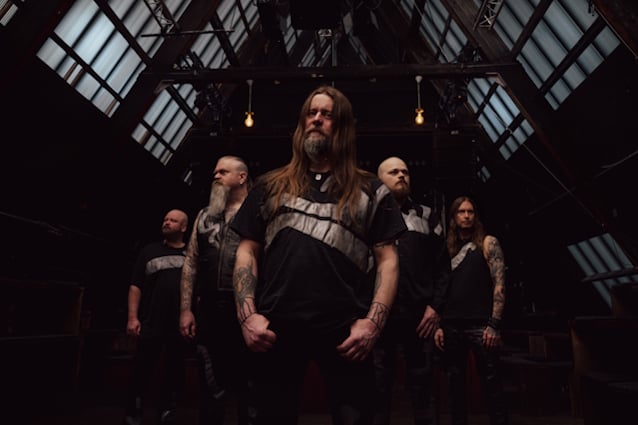
ENSLAVED Remains One Of Progressive Metal's Most Restless Bands: 'We're Still Looking For New Paths'
November 3, 2026By David E. Gehlke
ENSLAVED co-founding member, guitarist and primary songwriter Ivar Bjørnson decided to throw caution to the proverbial wind after deciding his demos for what would become "Mið" weren't up to snuff. Instead of relying on standardized, if not predictable, ways of working, Bjørnson suggested the band book a studio with no material prepared. His bandmates took him up on the offer. The quartet then sequestered themselves in a studio and, through trust and their usual songwriting ingenuity, managed to assemble eight cuts that met everyone's standards — and beyond — highlighted by lead single "Solar Will", the spacy "Mountain" and "Spirit Helper", a number that features Kevin Kicking Woman, a Blackfoot Elder. It is another testament to ENSLAVED's unwillingness to be boxed in, a feat all the more remarkable considering it's the band's 17th studio offering.
There really isn't much ENSLAVED hasn't tried since Bjørnson and Grutle Kjellson (bass/vocals) got together in 1991. It's almost easy to forget that ENSLAVED's first era was closely aligned with Viking metal before they ventured into progressive realms in time for 2003's "Below The Lights". From there, there are few, if any, blemishes to the ENSLAVED discography, and it's easy to think that Bjørnson's aforementioned throwaway material is another band's best. The Norwegians keep finding new ways to deliver and expand their universe, which is why BLABBERMOUTH.NET snagged Bjørnson for a friendly conversation.
Blabbermouth: "Mið" was recorded even though you didn't have any material ready before hitting the studio. Had the creative process grown stale for you?
Ivar: "No, not at all. We started working on the album concept with Grutle, as usual. We gravitated toward — there's been a bit of an evolution. The classic first album was where you write the songs to go into the studio, but then, 'Oh, shit! We need lyrics.' I know some bands still do that. The lyrical process can be good to be sort of doing it at gunpoint. One of the most famous saga stories is called 'Höfuðlausn', which translates to 'Missing your head.' It's a story about this bard who was so eloquent that, at some point, he did something to piss off a king. As they put his head on the block and raised the axe to rid him of his head, he started reciting a poem. He improvised it. The king couldn't get enough of it, and he ended up getting out of it since he made up this fantastic song. It's nothing entirely wrong, that sort of thing. What happened is, the concept of 'Mið'. What is the album about? I think it's about subjective experience, 'existence,' if you want to boil it down. What is the common denominator? We are storytelling creatures. That's what science is telling us: Our strand of humanoids succeeded because we're good at telling stories. As a function of gathering and common goals, loyalty, we won because we like to be in groups and all that stuff. That also gave us the desperate need to understand or seek connections and explanations. So the cameraman looks outside, and a meteorite is falling. It's not just a burning rock falling from the sky. All of a sudden, fallen angels are being cast out of heaven. In Norse mythology, Thor is a major god in the clouds. In Japan, you have a thunder god also having a hammer but wielded by a dragon. What's fascinating about these stories is that they give insight into how we are constructed on the inside and how we work mentally. That gives you more control of your destiny if you know why you react. It's basically looking at the landscape around you, do you want information about how we are and how you are? So, in this concept, all of a sudden, as a songwriter, I'm like, 'Shouldn't the music be a bit like that?' Not just riffing, jamming, which I love doing. That's been my more normal modus operandi, just sitting in my studio or my family's annoyance at times, having my guitar and jamming in the living room. All of a sudden: 'Hey, there's a riff.' And you build on that. This time, turn it around and wait for the music to come to me. What does it sound like when I look at the mountains or forestry or snow and ice? It inspires me, sure. Like, how close to that source can I get? That's when I started deleting folders in my studio."
Blabbermouth: You had mentioned you had some material that you weren't thrilled about. Then you found this new way of doing things. It sounds risky.
Ivar: "I felt like a lunatic when I presented it to the guys: 'We're going to book the studio.' 'Oh, yeah? You have the songs. Normally you have the songs when you write them. Do you have them ready?' 'Not exactly. Most of it is not ready. We're going to record it as we come up with it.' They said, 'Yeah, sure. Sounds great.'"
Blabbermouth: Everyone was cool with it?
Ivar: "Totally! It was really something special for us because it brought out a lot of heads-on-the-chopping block, coming up with good ideas, things that really felt good as a group, working together. There was also the concept of, 'Hey, we're a 35-year-old band. It's not like we have to do this on the next album.' Or, 'Next time we're going to write the songs as we parachute out of a plane.' It's not that. It's more like the whole concept of it doesn't matter how long you've been around, but if you're open to challenging yourself and sometimes being inspired, whether you're 15, as we were doing our first album, don't think too much about stuff. Just be a metal band, and it's going to work out."
Blabbermouth: When did you realize things were going well? Was it when something like "Solar Will" emerged?
Ivar: "Yes, 'Solar Will'. 'Spirit Helper' had a parallel path. 'I Am Ice' is the one song that was with me all the way. I started it after the 'Heimdal' album. I finished it in the first days of 2024. It was there when I kept writing these bits and bits. I finished that before the studio album. 'Spirit Helper' was a different way of doing things. That's another way of writing songs that I haven't done before. We recorded the vocals in October 2025 in New York at a ceremony with Kevin Kicking Woman, a Blackfoot Elder. I contacted him after Fire In The Mountains 2025 and simply asked, 'We'd love these collaborations.' We'd like to talk and work with you. We're a band that's always searching for the roots, and we feel like we're touching them now. They represent the living tradition that's been kept alive. The songs that Kevin is singing are thousands of years old, some of them, which is insane. His answer was simply, 'Yes, let's do this. I have a song that I would like to give to you.' We met in New York and recorded the song on my phone at the ceremony. I said, 'Are there any sort of rules to how you would let someone work with a song like that?' He said, classic Kevin, 'You know what to do with it. You'll do the right thing. [Laughs] You'll figure it out.' So I went home, and I listened to it for a long time, just his vocals. The vocals you hear on the album, that's the phone recording, exactly. There was no editing whatsoever. There's a little bit of refinement on frequencies and stuff to make it fit in the mix, but there's no cutting, no pitching, anything like that. The first weird thing is that it's a 20-year-old song that he made. He hadn't heard any ENSLAVED before we met, and we have this tuning, which is a drop D sharp, which is definitely not the most used tuning. It turns out his song is in total pitch-perfect drop D sharp, like open-string ENSLAVED. I was like, 'How is that possible?' And then, of course, another typical answer from Kevin would be like, 'Well, that's how the universe works.'
Blabbermouth: Ice Dale has a couple of incredible solos on the new album, especially on "Solar Will". Can you go into what an asset he's become for ENSLAVED?
Ivar: "He's not only one of my favorite people because he's one of my best friends, but he's one of my favorite guitarists. The thing is, he knows how to shred. I've seen him do it. He can do all this stuff. His technical level is just mind-blowing, but he's got this musicality. What I love so much is that he's got that sort of [David] Gilmour [PINK FLOYD] kind of thing. Sure, sometimes he'll do a run, and he does that on 'Solar Will'. You can see it in the video. He'll play this run, and then he'll stop at one note. And that note gets all the attention. There'll be some bending, some vibrato, and it's just done perfectly. That's the magic, I would say. I think all of us in the band, maybe except Ice Dale himself, the four of us anyway, would say that's one of our favorite parts of making an album: when Ice Dale starts sending over his solo demos. By that point, I'll have written the riffs, and Iver [Sanday, drums] and I will have worked out the song structure. Then the singers get involved, and eventually we'll tell Ice Dale, 'I'm imagining maybe a solo around this section. Would something like that work for you?' Sometimes the singers will say, 'We were thinking about doing something there vocally. Maybe that lead could turn into a vocal melody instead.' Eventually we arrive at something, and Ice will say, 'Okay, I'll try something.' Then he'll send an email with a demo attached, asking, 'Do you guys think this could go anywhere?' We listen to it and just go, 'What the fuck, dude? This is amazing.' And he'll be like, 'Oh, glad you liked it.' Then he'll say, 'Okay, now I'll record it for real.' And we're like, 'What do you mean? For real? [Laughs] So yeah, that's one of the really fun things about being in this band. It happens live, too. I'll look over to my left and think, 'What is he doing? How does he do that?' It's just amazing."
Blabbermouth: Speaking of being around a great group of people, you've since become involved with the Fire In the Mountains festival. What have you gotten out of your involvement with the festival? It's a pretty unique thing that you've become so connected with something here in the States while you reside in Norway.
Ivar: "The short version is that in 2019, I went to Denver, Colorado for live production, which was my day job before I did only ENSLAVED. WALDRUNA was going over there to do a show at Red Rocks, so I got to do that. Through that connection, I was introduced to Shane [McCarthy], who was one of the booking guys then and still is, I think, for Fire In The Mountains. At that point, I actually hadn't heard about the festival yet. He reached out to ask if ENSLAVED would come and play, and they also wanted me to co-curate one of the days at the festival. Back then it was still held in Jackson Hole, Wyoming, so I was like, 'Yeah, sure, absolutely.' We started working on it, and then the pandemic hit. So nothing really happened until 2022. But when it finally did, it was totally awesome. One of the bands I really wanted to bring in as part of the curation was Steve Von Till's solo project. Not only because I'm a huge NEUROSIS fan, of course, but because what he does on his own is so powerful in its own right. His solo work has this atmosphere and depth that felt like a perfect fit for that setting and for what the festival was trying to create. It was a total fanboy move, really. Meeting Steve, getting to book him so he'd have to come out and hang around at the festival. But it turned into a great friendship. He also developed a really strong connection to the festival itself. These days he's one of the key people behind the Firekeeper Alliance and the work they're doing there. At some point, it went beyond a professional connection and became a close personal friendship. As you said, it's a long way, but that's one of the wonderful things about this scene. You travel all over the world, and then you meet people who share the same ideas, and you really connect. And then, somehow, despite the distances involved, you get the opportunity to keep meeting, keep working together, and keep building those friendships. That's one of the things I love most about it. Even when people are far away geographically, it doesn't necessarily feel that way once you've made that connection."
Blabbermouth: American schools teach the Vikings. In Norway, do they teach the Native Americans?
Ivar: "Yeah, a little bit. The problem is that, even with our own indigenous people of Norway, they've always been overshadowed by the influence of how the Vikings were sort of popped out of the ground with their mythology and esoteric knowledge. The truth is that they were doing what Indigenous peoples seem to have always done. When new people arrived, they were open, welcoming, and willing to share. Sadly, in most cases, that didn't work out very well for them, because the newcomers were really after the resources. But with the Vikings, it was a little different. There wasn't really any kind of conflict there. Quite the contrary. They were welcomed in and given a great deal of knowledge. Many of the things we associate with Norse culture, even elements of runes and mythology, can be traced back to Sámi culture. We've known that for quite a long time. For us, it started as a search for our own roots, but these days it's become more of a search for the roots of those roots. We're moving further back, toward a point where all these peoples were connected, sharing the same regions before eventually spreading out. The ancestors of Native American peoples moved eastward across the Bering Strait to Turtle Island, the American continent, while others remained in northern Europe. So we've always had that interest. But in school, as with Viking history, these subjects were never really presented in much depth. They were often portrayed as something a little simplistic, almost childish. It wasn't until I met my friends in the Blackfoot Nation and they started sharing proper literature with me that I began to understand the true scale and sophistication of the civilizations that existed here — hundreds of independent nations and more than 50 language families alone. Growing up, the impression we were given was much simpler than that. It was almost a caricature: Some guys without shirts, riding horses, living in the wilderness, and occasionally coming into conflict with religious refugees and settlers from Europe. The reality, it turns out, was very, very different."
Blabbermouth: Going back to the new album, do you see it as a new chapter for the band based on the way it was written and recorded?
Ivar: "It might be, you know, the fun thing is that might be a return to form. The next album might be back in the good old couch with a mini amplifier rocking out. [Laughs] Or maybe we talked about, we had such a good time in the studio now with these directions, maybe working more in the rehearsal room with songs, you know, getting a little bit away from the cleanliness of the writing studio and being more of an environment where you have feedback from the amp. Sometimes you have to yell, 'Hey, shut up, man, stop playing, because we're trying to figure out the pattern.' [Laughs]"
Blabbermouth: Hate to end on a bummer note, but Cronos recently passed away. ENSLAVED is very closely linked with the second wave of black metal that took inspiration from VENOM. How much of an impact did he have on your career?
Ivar: "It meant a great deal, I have to say. In terms of my own musical development, they were one of the key things in my life. Before that, I had gotten into KISS. Grutle and I had pretty much the same experience, because we both grew up out in the countryside in Norway. There was this children's TV show on Saturdays, and they did a segment about a teenage girl who was a huge KISS fan. Of course, they showed a KISS album cover and played a song, and we both thought Gene Simmons was the coolest thing imaginable: the 'Demon' look, all of that. I have to admit, though, I was a little disappointed when I actually heard the music. It was a bit too disco-y and flashy for what I had imagined. Looking at the cover, I thought it would sound much heavier. Then something happened completely by accident. My dad was on a business trip to London, and he saw a video with these long-haired guys in leather. He thought, 'Well, that's probably something my son would like.' So he brought home 'Seven Dates of Hell' by VENOM. I was nine years old. He didn't flip it around to see the backside with the inverted crosses and the skulls and everything. I kept watching that at night, and it was the biggest thing ever. We played a show with VENOM last year in Helsinki. We've been at a few festivals together, and it's always been awe-inspiring. He was a larger-than-life character. It's a sad day, but it reminds us that time moves relentlessly in one direction. He was 63, right?"
Blabbermouth: Right. He wasn't too old if you think about it.
Ivar: "At the festival in Helsinki, I think we arrived at around two in the morning or something like that. And there he was, just carrying his own backline. Not because he had to, but because he wanted to get to his room as quickly as possible. Just hauling the gear on his own, in his arms. The thing is, he didn't just look like a strong guy. He was a genuinely strong guy. So the rest of us were basically just standing there, stepping aside and instantly turning back into 15-year-olds again, going, 'Wow, man...' It was almost like watching the thunder roll past as he stormed through the hotel lobby, grabbed his room key, told everyone to 'Fuck off,' and headed straight to bed. What a guy. Then he got up and played a great show the next day."
Photo credit: Chantik Photography


 Prev
