


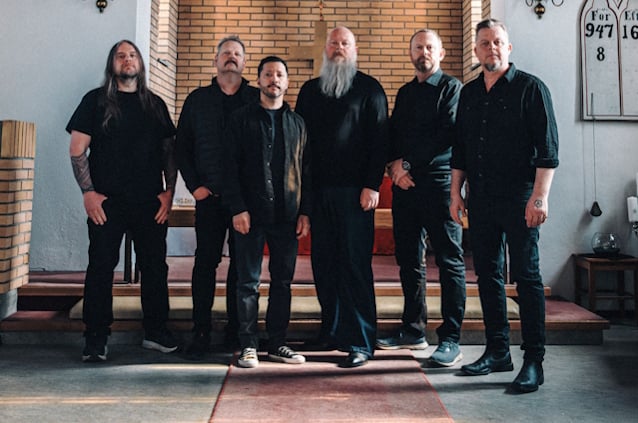
KJETIL NORDHUS Ponders GREEN CARNATION's Future After Masterful 'A Dark Poem' Trilogy: 'This Might Be The Last Thing People Hear From Us'
November 9, 2026By David E. Gehlke
Norway's GREEN CARNATION are no strangers to ambitious, multi-tiered, emotionally fraught concept albums. Their 2001 "Light Of Day, Day Of Darkness" was a single-song epic clocking in at over an hour, detailing founding member and bassist Tchort's journey after his daughter's death and his son's birth. The LP garnered instant critical praise for its melancholy and progressive metal tinges, but instead of doubling down on "Light Of Day…", GREEN CARNATION ventured into more 1970s rock avenues with 2003's "A Blessing In Disguise" and 2005's vastly underrated "The Quiet Offspring". After a calamitous 2007 North American tour that wreaked havoc upon their finances, GREEN CARNATION went into hibernation until 2014.
The sextet returned to studio action with 2020's "Leaves Of Yesteryear", but now presents the three-part "A Dark Poem", which will likely invite opinions that they've topped "Light Of Day…". Part I ("The Shores Of Melancholia") arrived in 2025; Parts II and III ("Sanguis" and "The Messiah Complex") dropped this year and culminate the intensive writing sessions between bassist Stein Roger Sordal and vocalist Kjetil Nordhus. The trilogy draws its concept from Arthur Rimbaud's poem "Ophelia" and weaves in Sordal's intensely personal experiences, which can be jarring to listen to. Yet, behind the silky-smooth clean vocals of Nordhus (an unsung singer in Scandinavian metal circles if there ever was one) and an unbeatable assortment of doom, progressive rock and orchestral maneuverings, GREEN CARNATION may have reached their creative zenith. As it turns out, that was the sentiment Nordhus shared with BLABBERMOUTH.NET now that the trilogy is complete and out in the world for consumption.
Blabbermouth: What was your first thought when the band decided, "Okay, we're doing a trilogy"?
Kjetil: "Obviously, as you know, that idea had been in the band for years. I don't think it's for any specific reason it's a trilogy. That idea came after 'Light Of Day, Day Of Darkness'; we were pondering our next moves. Obviously, we chose a totally different direction back then. Looking back now, I'm glad it didn't happen in 2002 because I'm not sure we could've done it, honestly. There's been so much thinking and planning behind this, and I do not think we had that in us back in the early days. [Laughs] Obviously, when you're less used to everything, when you know less, sometimes that can be a good thing. You just do what feels right. Having seen how much work this needed, I don't think we would have been able to, for example, leave anything until it was 100 percent of our capacity. That's something I learned a few years ago, how big the difference is between 95 and 100 percent and how much longer time that last five percent takes. Stein Roger and I agreed on that before we started writing the material. We had to remind each other sometimes that. Sometimes you want to get on with stuff when it's only 92 or 95 percent, but this time we agreed that it wasn't going to happen. That's maybe what I'm most proud of.
"It's easy to say now, but I honestly think we weren't ready back then. We had emptied ourselves. Tchort had emptied himself creatively by doing 'Light Of Day, Day Of Darkness'. When I say the last bit of composing for this was actually the classical piece, which was in early 2024, obviously, we haven't been able to do other things since releasing six singles and three albums and four or five music videos. It's been incredibly busy. But, luckily, all of the work, all of the creative work, was done from 2018 through 2024."
Blabbermouth: I read you went up into the mountains to write the albums. What was that like working with no one else around?
Kjetil: "Covid was an opportunity and a roadblock for us, to be honest, because Stein Roger was really creative in that period because he wouldn't play as many gigs as he normally does. It kind of let him concentrate even more on writing GREEN CARNATION material. I wouldn't say there were 'roadblocks,' but we worked on some songs for a very long time and had to put them away. We had to take them back in. We had to skip some parts, and sometimes we had 30 versions of each demo. [Laughs] That's not unusual on this project, which it isn't, since the song doesn't necessarily sound completely different from version to version, but there were always things to make better. To be able to be up in the mountains with so little distractions, I think that's also been something that was extremely important for this: because when we were at home, even in his home studio in the basement, there would always be people coming to the house and stuff like that. And of course, we're closer to the city. Sometimes, it felt like maybe we should rather go out and have a beer if we were struggling, but being up there you couldn't really do anything else. You just had to stay with your struggles and try to solve them instead."
Blabbermouth: There's some nice vocal variety across the three albums. You've long developed your style, but was it a challenge to mix it up so much, especially with some heavier growls?
Kjetil: "Oh, absolutely. But I did want it to be like that. And releasing three albums that belong together and having a one-dimensional vocal strategy probably wouldn't work, so I knew from the day we started recording that I needed to challenge myself and my voice like I'd never done before, and also have the songs decide what kind of vocals they needed. That's why we ended up with Grutle [Kjellson, ENSLAVED] being the guest on the first album. I actually did the growls in the studio first."
Blabbermouth: You're saying you did some death metal vocals in the studio? It would be cool to hear you do something like that.
Kjetil: "Yeah, I did, but we needed to do a lot in the mix for it to sound really cool. And again, we didn't want to make any compromises on this trilogy, so the rest of the guys thought it sounded good, like really good. And I guess it did, but I would never be able to recreate that live. Rather than me kind of doing something that's not really good but kind of sounds good, I'd rather use a world-class singer on that, so luckily, he wanted to do it. I think that also gives the first album a great vocal expression variation. I think many people were quite surprised by the choice. But that was the song ['The Slave That You Are'] actually needing that kind of vocals. It started with clean vocals on the verses, then we made the start a little more extreme, and then we figured out that, 'Oh, we cannot let go of the intensity at the start.' So we started playing with the idea of doing something extreme for the first time in the band's history in many, many years."
Blabbermouth: Some of the topics across the trilogy are pretty hard to digest. There's a lot of emotional stuff happening, especially with Stein Roger's relationship with his father.
Kjetil: "Yeah, it is. Especially after having maybe one of the heaviest lyrics in the trilogy is the song called 'Sanguis'."
Blabbermouth: That's the one I was referring to. It's a hard one.
Kjetil: "Yeah, it's a real hard one. After we recorded it, Stein Roger's father died suddenly. They just started finding their way back together and developing a new relationship, then he suddenly died. I had to talk to Stein about that: 'Can we still do this song like it is?' He said, 'This is my experience; that's how it was.' It's also a song where he writes that now he understands why things were like that, which is something nice. It's just very sad. I don't think I could have worked my way through these lyrics with anybody else but Stein. We've been extremely close for 30 years now. Having spent so much time together composing and writing this, I know when he comes with lyrics; I can tell, just by reading the first two sentences, exactly what the whole piece is about, because I know it from before. I have lived his struggles together with him in many ways, like when it comes to his wife's brain tumor. That was a successful operation, and she's still on this Earth, but it opens up so many more worries, which I think is basically what this trilogy is about. It's about our worries for many different things. And it's not very uplifting, and we don't give any extremely uplifting conclusions in the end either. I also know that for him, it's been a way of trying to 'write himself out of something,' as many people say. For me, since he was discussing all the lyrics a lot, I kind of feel that the lyrics are mine as well, which doesn't really make it easier, but at least it makes it possible."
Blabbermouth: The third part of the trilogy has the orchestral suite. What brought about that idea? I like how it ties everything together.
Kjetil: "I think we thought of it in different ways. I think it's a quite dark piece as well, the orchestral suite, but there are some glimmers of not maybe hope, but at least some light. Musically, having that piece finish or close the trilogy made a lot of sense for us. Also, that symphony has a lot of musical references to melodies and themes from the first two and a half albums. Not only lead melodies, but I'm sure people will, when they get to know all three albums even better, find some melodies that aren't necessarily the lead in the orchestra, but you could find that somewhere in some other instrument, like, 'Oh, there's that melody again.' I think it's written quite cleverly to be such a big closing element for this entire thing, and that's why we chose to put it at the end. At the show we did in Kristiansand a couple of weeks ago, we decided to open with that song. Opening with a conclusion and then showing how you got there is also kind of a good way of doing it. Like many TV series do today, you get the last scene first, and then they show you the way up to it."
Blabbermouth: What was the feeling among the band when you turned in the masters for the third album?
Kjetil: "I remember when we had recorded the last tone, the last notes from the orchestra. I turned to Stein and said, 'We did it now. We've done it now.' Because we had already finished all the band recordings many months before that, a year before that, there was another feeling like that when we released the first album. We knew that we had three strong albums. And we discussed, of course, everybody's not going to like what we do. And that's okay, of course. I'm looking forward to seeing what they criticize. Because again, we've done this 100 percent of our capacity together, and also with the help of, of course, the rest of the band doing an incredible job in the studio and the producer, the mixer. The mastering guy in Sweden, the cover art. There's nothing that's not 100 percent of our capacity, so I was kind of eager to see what people didn't like. I had to ask Will [Yarbrough] of Season Of Mist about this. But I asked him, 'Has it changed? Is it now that reviewers don't review things they don't like anymore?' Because I think the worst review I've seen is maybe, like a proper review, is maybe four out of six or something like that."
Blabbermouth: That's pretty good!
Kjetil: "Yeah, it is still a good review. And then, after releasing the first album and seeing the reaction to it, I was a little bit worried about the second album because that was quite different again. It's maybe doomier, but it's more naked. There are a couple of quiet songs there. Then the reviews were even better for that one. Then, of course, we knew that we were challenging everybody, including ourselves, especially with the orchestral suite. But when we listened to the final mix, Stein and I were really surprised by how good the other three songs were on that one, too. For me, I always thought it would be the moment we went offstage at our big hometown show the day after the release, because that was the climax. People from 21 different countries came to Kristiansand, a small town in Norway, just to see us play live. I'm not going to do that again, I think, because that was just too much. [Laughs] Of course, it went incredibly well, so I'm extremely proud of that. But there was so much work around it, rehearsing everything, but also organizing everything and planning side activities for all the people who had come from the other side of the world to see us. Then, after eight hours of work and six hours of rehearsal the day before the show, being there with them wasn't really what I wanted. I did a Q&A there with 100 people from all over the world asking us questions, and that was at like 11 p.m. We'd been working since seven thirty in the morning on everything. But again, it's about trying to do something 100 percent. I'm glad we did it. It's one of the things we wouldn't have thought about when we were 20."
Blabbermouth: "Light Of Day…" is the entry point for many with GREEN CARNATION and is considered your best work. However, it's not a stretch to think you've topped it with the trilogy. Do you feel that way?
Kjetil: "I see several people saying that. For us, I think the most important thing would always be the newer stuff. Everybody thinks they'll release their best album when releasing an album. They're not saying anything else. We know how much 'Light Of Day, Day Of Darkness' means to people, and it means a lot to us as well. I think it's just two extremely different things in two very different ways in our career, with extremely different challenges. I don't need to compare. People need to compare stuff all the time. I'm like that too when it comes to other things, but we don't have to compare those, although I see many people are actually saying the same thing you did. We appreciate that. It makes us even more proud."
Blabbermouth: Would you ever do a record of just songs again?
Kjetil: "It depends on who you ask. I'm sure if Stein was here, he would probably say yes. I think we've developed our way of making music quite a lot, so I wouldn't feel it was natural to force the creativity in another direction just for the sake of it. But of course, we have that in us if we wanted to do it like that. Right now, we don't have any plans with the band except for playing live. And we don't have a record deal anymore, because this was our last album with Season Of Mist. It could also be that, if we don't find a great idea, we need something. We need an idea, and then we can start talking about whether we want to do this again and everything. But right now, there is nothing. This might be the last thing people hear from GREEN CARNATION, to be honest with you."
Blabbermouth: Do you feel like you're creatively exhausted?
Kjetil: "Yeah, I think we are. Maybe especially him [Stein Roger]. But I do think that if he and I went up to that cabin in the mountains again for a couple of days just to talk about stuff, I'm not sure, but we could come back with some kind of idea. We've started talking a little bit about it, but we need to be on the same page and agree. I don't think we have talked about it enough yet."
Photo by Lars Gunnar Liestøl


 Prev
