


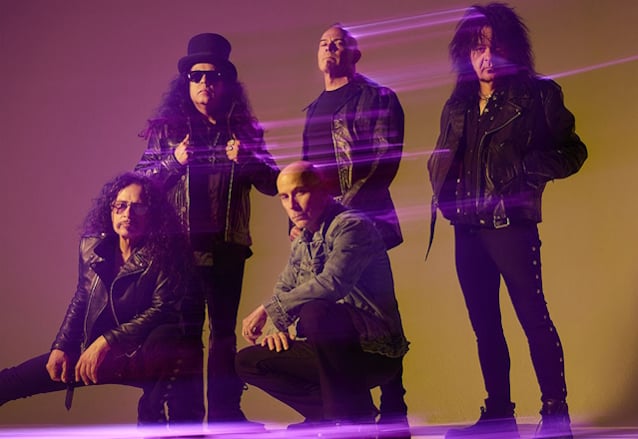
ARMORED SAINT Is The Classic Metal Band That Doesn't Sound Like Classic Metal: 'We're A Band You Can't Pigeonhole'
May 27, 2026By David E. Gehlke
Logic would dictate that ARMORED SAINT's 1982 formation and subsequent first offerings of straight, no-frills, hard-edged, rough-and-ready, while clad-in-actual-armor metal would be something for them to rely upon as they release their ninth studio album, "Emotion Factory Reset". After all, it has been difficult for bands from metal's golden era to finagle any upward mobility without straying too far from their core sound, since the alternative is a shrinking fanbase and even ridicule. For ARMORED SAINT, it's been the opposite. Since the quintet reemerged in 2000 with "Revelation" or even going back to their now-classic 1991 LP "Symbol Of Salvation", they have worked in blues, Southern rock and even R&B, all the while assertively not sounding like a classic metal band. As a credit to the quality of their studio output, ARMORED SAINT has kept a firm hold on their fanbase, who have been happy to go wherever the band takes them, something likely to continue with "Emotion Factory Reset".
Bassist Joey Vera was unexpectedly handed the musical controls of ARMORED SAINT after the devastating passing of founding guitarist and fellow co-songwriter Dave Prichard in 1990 after a short bout with Leukemia. As Vera, along with lead singer John Bush, guitarists Jeff Duncan and Phil Sandoval and drummer Gonzo Sandoval have shown, ARMORED SAINT doesn't play any brand of metal but their own, which was among the many topics when the bassist and producer sat down with BLABBERMOUTH.NET.
Blabbermouth: When Dave passed away, were you ready to step into the role as main songwriter in ARMORED SAINT?
Joey: "I think I was already being internally groomed not just for that, because, had Dave not passed away, he probably would have taken the role I have now. Dave and I were co-songwriters from pretty much the beginning. We wrote a lot of songs together and separately as well up until that point. I was already a songwriter, but I wasn't the main songwriter. Dave was. We were both on this trajectory, interested in the recording process as well as the creative side. We were both interested in production, had a lot in common and were good at it. Yeah, it would be interesting if Dave hadn't passed if he had continued that, like what his role in ARMORED SAINT and maybe even out of ARMORED SAINT would have been. At the time, when 'Symbol' came around, as you can imagine, we were devastated. The band broke up for three months. We were going, 'How do we recover from this?' It was a huge blow. Once we started picking ourselves back up, Brian Slagel [Metal Blade Records] basically said, 'You have to make another record. Don't let all this music you wrote with Dave go to waste.' He convinced us to do that. Jeff and Phil, mind you, they weren't in the band yet. I was the logical guy to start putting things together musically and internally as well. I slowly became that guy. Of course, the band broke up a year later when John joined ANTHRAX. [Laughs] It was the role that I took, and I think since then, my experiences and the records we've put out since 1999 until now, I think I've gotten pretty good at it. I have good organizational skills, a strong creative mind and I am good at getting things done. I'm good at troubleshooting. I'm probably a better producer than I am an engineer, but I think I have a good ability to be objective. It's hard to do that when you're in a band, and especially when you're so emotionally attached to it. I'm pretty good at stepping back and looking at it from a distance, and not everyone can do it."
Blabbermouth: You had a quote from a few years ago that amounted to "ARMORED SAINT doesn't have one guy steering the ship." What happens when a big decision needs to be made? Who gets final say?
Joey: "At this point, we've had so much time to sus out where we stand creatively, the way we communicate and function. [Laughs] It's been a lot of trial and tribulations. As you can imagine, we've had plenty of arguments about the dumbest things. Some of them have been important things, too. It comes down to a couple of things: There aren't that many bands where it's an absolute democracy. They do exist, but there are very few of them. It's rare. It usually comes down to one or two people, maybe more, but a couple of people are just going to be able to have the, I don't know the right word, there are the ones who are going to say, 'Make the decision. We're going to turn left now.' The way that it works with us is that John and I have just settled into this songwriting team. We've been working this way pretty much since 2000, when we got back for 'Revelation'. It's a method that has kind of proved itself to be practically effective. It's not something we forced down everyone's throats; it's none of that. It's really more about it being a 'proof is in the pudding' kind of thing. We made it clear, though, that we are going to function this way, but on the same sense and the same breath, everyone has an equal say. Everyone has a voice. Everyone can contribute. We are constantly asking for contributions. We're constantly making everyone be involved. This is a band. It's not a solo project, so that's very clear with everyone. But, at the same time, and this is a testament to the others, it takes a grown-up person to be able to recognize how the team functions. This is a team. Everyone has their role on the team. Not everyone can be the starting guard. There has to be a hierarchy, there has to be. This is pretty much understood within the band, but we discuss everything. Nothing gets done without full disclosure on everything. I'm not saying it's easy because these things are never easy. [Laughs] You're dealing with five personalities. There's going to be ripples in the road or ripples in the water. It's going to happen, but we'll work it out. We're a team; we're a family. We figure it out."
Blabbermouth: Flipping over to "Emotion Factory Reset". When we take into account the last few albums and the fact that you are writing most of the riffs and are a bass player, why do your riffs have such a unique feel to them? Do you think differently as a function of being a bass player?
Joey: "Probably. The background of my trajectory is that I started on the guitar when I was 13 years old. Then, I switched to bass when I was 15. I'd been playing guitar for two years. How good was I going to get in two years? Not very, although back then, there was no YouTube. Your growth spurts are really short. [Laughs] Then, I switched to bass, and I put the guitar in the background. I didn't play it as much as I played the bass, but I've played guitar ever since. All the stuff I wrote with ARMORED SAINT was written on the guitar. I almost never write on the bass. But I think that I'm only so good. I'm a pretty damn good rhythm guitar player, and I'm not a very good lead guitar player. My abilities are somewhat limited in that sense. I don't have much dexterity; my fingers are fat. [Laughs] They don't sit on the fretboard as comfortably as I wish they would. As a result, some of the riffs and things that come out of me are slightly awkward, let's say. But, on the other side of the coin, this is what makes them not feel or sound normal or things you've heard a million times before. It's some bass player with fat fingers doing it! [Laughs]
"It's funny we're talking about this. A lot of times, I'll write the songs or a riff, and when it comes time, I always have Jeff or Phil replay it for the record. Again, it's a band. It's not a solo project. Don't get me wrong, I do play some guitar on the records, but predominantly those guys are doing it. When it comes time to teach them, 'This is how the riff goes.' They have a hard time getting the nuances that I have. They are like, 'Why are you holding your pick like that?' 'I don't know! It's how I hold it! Did you ever see Marty Friedman [ex-MEGADETH] pick?' He's an amazing player. You can't fault him for how he holds his pick. By no means am I comparing myself to him. It dawned on me over the last ten years, 'Maybe the way I'm writing is idiosyncratic to me because these other guys who are great guitar players, they're not quite able to cop the subtlety or the feel that I have. Why is that?' It comes down to what we're talking about: It's a bass player's point of view. I love the guitar. I wish that I played it more in other situations."
Blabbermouth: A song like "Bottom Feeder" is a good example of that. It has that lurching riff that is almost odd in a way. But then, when you think about ARMORED SAINT circa 2026, it makes sense.
Joey: "We were worried about that one. It's a bit left-field for us. 'Left-field' doesn't always mean good. [Laughs] I'm saying this because you're not the first person who's mentioned that song. For me, it's a little bit of an odd duck on the record, but I'm close to it. I have a different viewpoint, so don't listen to what I'm saying. [Laughs] I felt like that one was taking a chance, going outside of our box a little into outside of our comfort zone, but I thought we should go with it, do it to the helm, make it down and dirty, dredgy, then go full-bore on it and don't lighten up. Make it as bombastic as we can. That's what we did. Again, I wasn't sure we succeeded with it, but I'm guessing we did."
Blabbermouth: "Ladders And Slides" and "Buckeye" should be thrown in there as well.
Joey: "Those two songs are also outside of our box. They're a little bit risk-taking. 'Ladders And Slides' and 'Buckeye' are very bluesy and very swampy, almost LED ZEPPELIN, a little Southern rock as well. That's my wheelhouse. When I'm home on the weekends, I don't listen to anything past 1978. Everything I listen to is classic rock and Southern rock. I'm a huge THE ALLMAN BROTHERS and LYNYRD SKYNYRD fan from back in the day. That's all I listen to. This was a chance for us to be, 'You know what? I'm going to go down this rabbit hole. Let's see if it works.' As long as it comes across as sincere and honest, not gimmicky, we succeeded. John knocked it out of the park with 'Buckeye.'"
Blabbermouth: This brings up a broader point: ARMORED SAINT started in 1982, which makes you, technically, a classic metal band. However, since you came back with "Revelation", you haven't sounded like a classic metal band. What do you make of that?
Joey: "I think it started before that. For us, our trajectory took off in a different direction with 'Symbol Of Salvation'. At that point, we weren't remaking 'March Of The Saint', 'Delirious Nomad' or 'Raising Fear'. It was something completely different from those three records, to the trained ear, maybe not to the untrained ear. [Laughs] We weren't reinventing the wheel. It took us to this place where we're starting to feel comfortable allowing all of our influences to come into the music that we wrote and not be concerned about where we fit, who we fit in with. Are we going to alienate our fanbase? We're the kind of band you can't pigeonhole; we're a little bit all over the place, for better or worse. When it came to 'La Raza', I started to realize this and think, 'You know, we're sort of on our own island.' We spent so much energy worrying about where we fit in, and we were overly concerned about where our peers were during the 1980s. We freely admit that. How could you blame us? We were a traditional metal band, but we were from L.A., and we didn't sound like those bands either."
Blabbermouth: Correct. You weren't thrash, and you certainly weren't glam. Where could you put ARMORED SAINT?
Joey: "We had an identity crisis. By the time we made 'Raising Fear', it was, 'Who are we?' As I said, around 2010, when we were writing 'La Raza', I said, 'We should embrace this. This is who we are. We're a band that can do whatever we want to do.' I'm not saying we'll succeed, but this is where our hearts are, this is where the honesty is, our sincerity, so this is where we should be. Let's keep doing this. As a result, you get music that draws on as much inspiration as I have, like the song 'Close To The Bone'; subconsciously, it's a British heavy metal song. I listen back to it, I go, 'This is something like SAXON or [JUDAS] PRIEST would have put it out in '82.' But does it sound like them? I'm not going to cop them to the point where it's like, 'Gee…' but if I can write it in a way where it sounds like ARMORED SAINT, I think I succeeded. I'll readily admit that's a New Wave Of British Heavy Metal song, but it's part of our lineage. Let's go with it. Part of the same token, I'm copping stuff from THE POLICE, FOO FIGHTERS, CHICAGO, THREE DOG NIGHT. I'm listening to stuff that's so outside of our wheelhouse, but I appreciate and love all of this music. I find ways to incorporate it into what we're doing today. As long as we're being honest and sincere, I think that's what separates us from a band that's just churning out the same record over and over again, and not bending."
Blabbermouth: We know what sometimes happens when bands venture away from their core sound: they lose fans. That hasn't happened with ARMORED SAINT. Even "Symbol" songs like "Dropping Like Flies" and "Tainted Past" had no resemblance to what was happening in 1991. They're just ARMORED SAINT songs.
Joey: "People ask me all the time, what's the most important record in your opinion? I often cite 'Symbol' for that reason. I don't think we made a flawless record by means. It was an important record for our trajectory. It helped us psychologically and emotionally get to a place to make the kind of music we wanted to make."
Blabbermouth: Thinking back to 2000: You're in FATES WARNING, John is still in ANTHRAX, and you come back with "Revelation". Were there any expectations there?
Joey: "Not really. It's a funny thing about expectations. Since 'Symbol', we had so many expectations for that record, and we were sadly disappointed. It wasn't anyone's fault, it didn't work out. We had too high expectations. It was like, 'What were we thinking?' Were we going to conquer the world? We were on our fourth record after being dropped. We had high expectations that weren't met. Since then, I haven't had any expectations. I try not to. I want people to like our music, but I'm not going to go out of my way to make everyone happy. It's not what we're doing anymore. When 'Revelation' came out, we officially weren't a band yet. We had a handshake agreement with everyone and said, 'John is still in ANTHRAX, I'm still in FATES WARNING. We're going to do this record because John has downtime because ANTHRAX is taking a break to do S.O.D. ' And I was off tour for six months, so we put together 'Revelation'. We said, 'Let's do this for fun. Everyone, leave your expectations at the door. We're not going to buy Maseratis or houses from this. This is strictly for fun. We're going to do this; Brian Slagel is on board.' He said, 'You want to make a record? I'll put it out. Let's do it.' The attitude and the feeling were really light because of that. It was very much there; there was no heaviness of, 'Oh, what's the first single going to be? Who is going to be on the radio?' There was none of that. It doesn't matter. None of this matters. What matters is that we're here for the music and we have the opportunity to make a record. Some things came out of it. We got to tour Europe that year, which was our very first proper tour there. Believe it or not, it took us that long to tour Europe. It's crazy. And then we did a tour here in support of DIO, which was awesome. Heck, this was a side project, and we're doing it for fun, and we're opening for DIO! What the fuck! This is great. Since then, we've left expectations at the door. It was cool to be back at that place for 'Revelation'. It was a one-off. We didn't make another record for ten years. John had to finish with ANTHRAX, and I continued with FATES until after 2010. But when John officially left ANTHRAX, I was like, 'Okay…' Then we had a different conversation: 'Let's officially get back together and let's see what happens.' And here we are."
Photo by Travis Shinn


 Prev
Prev 