


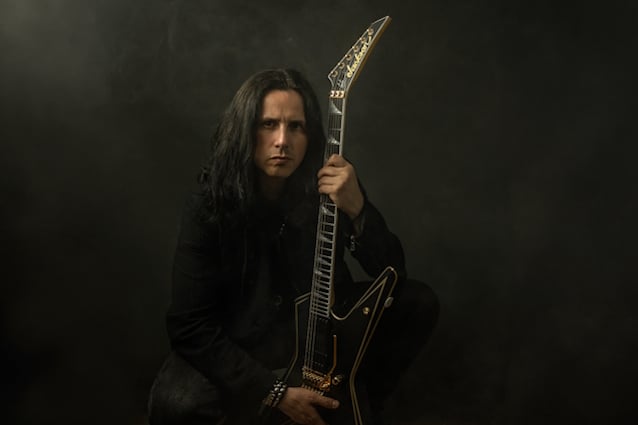
GUS G May Be One Of The Last True Guitar Heroes Standing
May 19, 2026By David E. Gehlke
Greek guitar virtuoso Gus G (real name: Konstantinos Karamitroudis) started releasing albums at the turn of the century, a veritable lifetime in the music industry where turnover is regular, and longevity is a hard-fought commodity. Gus found several ways to break in, whether via his own melodic metal outfit FIREWIND, the Swedish tongue-in-cheek fantasy metal outfit DREAM EVIL, the straight-ahead German power metal unit MYSTIC PROPHECY and even the Greek melodic death metal front NIGHTRAGE. Gus eventually shed every act but FIREWIND, and in the process established himself as a bona fide international guitar hero thanks to his blend of neo-classical stylings and penchant for speed. This, of course, also helped him hold down the ultra-coveted slot in Ozzy Osbourne's band from 2009 to 2017, ad providing him with the kind of notoriety most players in his field could only dream of.
Gus recently released his sixth solo studio album, "Steel Burner". Featuring an impressive list of guest vocalists from Doro Pesch, Matthew Barlow (ASHES OF ARES, ex-ICED EARTH),Ronnie Romero (ex-RAINBOW) and Dino Jelusić (TRANS-SIBERIAN ORCHESTRA),"Steel Burner" is an expert blend of Gus's exotic shred and melodic phrasing capabilities, coupled with some accessible, chorus-dominated melodic metal that can suit just about anyone. As he would tell BLABBERMOUTH.NET, Gus is enjoying the added responsibility of parenthood while remaining thoroughly committed to his craft, a trait that continues to keep him in business.
Blabbermouth: You became a father last year. How has it changed your life?
Gus: "In so many ways, it's the biggest change I've ever had in my life. It's amazing; it's a lot of work. [Laughs] But it's an amazing thing to experience parenthood. It teaches you a lot about yourself and kind of unlocks a different kind of love you didn't know you had. I don't know how else to say it. Of course, it will not make it any easier for me to leave home. It was already hard leaving home before going on tours and things like that, but it's definitely going to get much harder. At the same time, I've come to terms with it. This is what I do. It's not going to be like where I'm going to change jobs all of a sudden when I'm 45, 46, almost. I'm not going to stop doing what I do. I love what I'm doing. I love my job. I don't even look at it as a job, but I make a living from it. A lot of people are asking, 'Are you going to stop touring or scale it back?' There are no plans for that right now, but it's not going to be like adding more dates. Let's see. [Laughs] I'm playing it like, 'Let's see what comes my way, and we'll see.' Maybe we'll get to pick and choose some gigs, but we'll still need to do other things for the record cycle. I still love touring and traveling the world and playing for the fans. That will never change. When the kid is a bit older, he can join me on the road. [Laughs]"
Blabbermouth: Switching over to "Steel Burner". You did the all-instrumental "Quantum Leap" solo album five years ago. Has this led you to decide that FIREWIND is going to maintain the full-on metal style you've had for a while, and you'll lean more into melodic rock territory for your solo output?
Gus: "In a way, yes. The stuff that will not be so heavy will end up on my solo records, not to say my solo records aren't within the heavy metal realm, listen to the song 'Nothing Can Break Me' with Doro. That could have been a FIREWIND song, without a doubt. But, you mention 'Quantum Leap', when I did that, it was a new path that I kind of regretted that it took me so long to make an instrumental record. I don't know why, I wasn't confident enough to do it in the past. I don't know if it sounds silly, but that's the truth. That was my, what do you call it? My 'lockdown' record. It was like, 'Well, I can't go out and meet anybody. I might as well sit here and do it all myself.' I said, 'I'll just put it out if nobody listens to it, whatever. Nobody is doing anything at this time.' It became probably my most successful record. [Laughs] At the same time, it gave me a new joy. I like to explore instrumental guitar music. It took me on a different path, and then it made it clear for me: 'Well, I'll keep the instrumental stuff for my solo thing.' Now, I have a mission. If I want to do something like that, I have a reason to put it out. Then again, I like to do collaborations. I like to work with other great singers when I get the opportunity. This is what happened this time around. I didn't want to give up on the instrumental thing because I know a lot of people enjoy it. A lot of people who don't even play guitar, apparently, like my instrumental record. ['Steel Burner'] became a 50/50 record. There are five instrumental and five vocal songs. I wanted to do these collaborations if they're the right thing to do, like if it's the right person and the right collab."
Blabbermouth: How long has a guy like Matthew Barlow been on your list?
Gus: "Matt has been visiting Greece for the last few years with ASHES OF ARES. They've been doing stuff here in Greece; ICED EARTH was probably their biggest market, if not in their top three. Anyway, Matt and I met at a mutual friend's house. It was three years ago. Or two years ago. It was one of those things where we kept in touch. Whenever he was back here, we would meet up, and it was like, 'Maybe we could write a song someday.' I said, 'I'd love to.' Then he went back home, and I was looking through riffs, my folder of stuff that I haven't used. Then I came across this riff that I hadn't used. Then it clicked. It's not like I wrote it for him, but that kind of song I knew instantly, 'Well, this is going to fit Matt Barlow like a glove. This is for him.' It has this aggression and also this melancholy. It will remind you of '90s ICED EARTH for sure if you listen. That's how it came about. I didn't think twice about it. To be honest, I originally wrote that song ['Dancing With Death'] thinking it would be on a FIREWIND record. We tried it out for [2024's] 'Stand United', and it didn't click. We couldn't get the right melodies, and I thought, 'Let's save it for a rainy day.' The thing with Matt is that if you hear him sing one note, you recognize it's him. That's Matt Barlow."
Blabbermouth: Ronnie Romero pops up on one of the better songs on the record, "Frenemy". The two of you seem like an ideal fit, you're close to the same age.
Gus: "The whole thing with Ronnie, I've known him for ten years. We used to do covers together in Sweden. We kept in touch on and off, then two years ago, he reached out, and he asked me if I wanted to do a few acoustic gigs in Romania. He lives in Romania, which borders Greece. We live very close by. I said, 'Yeah, man. Let's hook up again and do something.' We did a short tour in Romania, then I invited him to Greece to play a few shows with my band, like electric shows. One thing led to another. The agent saw that: 'Ah, how about I offer you guys for some festivals?' We were like, 'Yeah, sure. If you get anything, let us know.' Then, all of a sudden, last summer, we had all of these festivals in Europe. Then there were offers to do a full tour, which we did, and it did really well. It started as a fun side thing and has since snowballed. The gigs started to do well, and I said to him, 'Hey, man. We should write something. We should have a mutual song, something we write together so we can play it on the tour.' That's how we did the first track, 'My Premonition'. I put it out as a single last summer. Then, I reached out to him as I was completing this record and said, 'We're going to do it again in 2026. We should have another song.' [Laughs] He's like, 'Yeah, bro.' I told him that I had this really cool riff that was right up his alley, which became 'Frenemy'. I like it too. It goes down the hard rock path more. It's very bluesy, like blues-metal riffing. Ronnie, geez, he's such a great performer, the way he sings every note. I love it. He's great. He's so easy to work with as well. He's one of those guys who go into the studio and call you 20 minutes later, 'Okay, I did it.'"
Blabbermouth: How about a guy like Dino Jelusić? You could probably put him in the same bucket as you and Ronnie as the "younger" guys of the scene who are going to need to carry it forward.
Gus: "Dino and Ronnie, especially in the European scene, those two guys are the voices of the generation, if you ask me. Dino is one generation younger than us, maybe two! [Laughs] Dino is what? Thirty-two or thirty-three? I first met him in 2018. We've known each other and bumped into each other at a couple of festivals in Switzerland. I think we even did a thing together at a festival in France a couple of years ago. He's a brother. He's a really good friend, and I know his band and his father, who's managing him, really well. I called him up, 'I know you're super busy, but we have a window to do something now, putting this solo record together. I got a song for you. If you can make it happen, I'd love to have you.' And we did it. I wanted to give him a song like that specifically because it's not even a heavy metal track. It's got this GUNS N' ROSES vibe. [Laughs] I knew he would kill it. He's got such a bluesy vibe, and I knew he was going to perform great, and he did it."
Blabbermouth: You brought up the current generation of vocalists. How happy are you that you got in before all of the YouTube guitar players started getting popular?
Gus: "It's kind of funny because when I got into the music business and started making records, I was thinking I was late! [Laughs] It was right in the transitional period where you saw all the first big sales drop because of piracy, and before streaming came along. That's when I started making records. It had already started to affect the music industry, and I remember being bummed out because we only sold 50,000 copies of the first DREAM EVIL [2002's 'Dragonslayer']. [Laughs] I was so bummed out. I was like, 'This is a flop!' Everybody at Century Media was like, 'What are you talking about? This is a fucking great success. You're one of the best sellers.' I was like, 'I don't know, is it supposed to be like this?' Growing up, you saw MTV, and if you didn't sell at least half a million records, you're a flop, and the record label would drop you. I didn't know anything; I was green to the whole thing and was a kid! I experienced that. Then, as the years went by, even as my fame grew, the shows were more successful, and I was getting more work, sales were declining. Then I was told, 'That's what's happening to everyone now.' On one hand, of course, yeah, I'm happy I got in when I did to make a name in the scene and have work today because of my name and my past and the catalog that I've built. I'm able to travel around the world and do this. Then again, who knows how I would be if today I were 20?"
Blabbermouth: That's the point!
Gus: "When people ask me, 'What do you suggest to someone [about having a career in music]?' I said, 'It's very different.' When I started, we made demos in the studio. We paid for the studio, put it in an envelope, and sent it to a label, hoping someone would call back. Now, it's not like that. You don't even need a label. You have so many amazing tools, like YouTube. You can reach everyone through that. You can reach everyone through your socials, your Instagram, your TikToks. It's the other way around: A label will approach you when you already have your own global fanbase, and you're already generating online buzz. A lot of those guitar players, I'm watching the YouTubers, they're not really concerned about the live industry. Some of those guys don't even have to go out and play. They don't know what it is; maybe they don't have to worry about it because they make their money from views or sponsorships. It's a different landscape. That's how I see it. The whole thing has changed and shifted. I like that I come from a bit more of an old-school, traditional way, where I still believe in hitting every town, hitting the local venue and playing for the people who want to come. I'm a firm believer in that."
Blabbermouth: When you emerged, it was a cool thing because you were this young, Greek guitar hero. Now, it's hard to say whether people get excited for "guitar heroes" anymore, don't you think?
Gus: "It doesn't have the same 'hype' or the same enthusiasm or the same power as it did before. Anybody from any corner of the world can upload anything. They should. There are incredible players out there. Yeah, that's the globalization of the internet. I'm grateful that I experienced some of that magic, if you like. There was a time when I was the young kid on the block, and I was from a small country that people probably only know for feta cheese. [Laughs] There I am, making waves and playing out there and making heavy metal records. Maybe that was exotic back then!"
Blabbermouth: You have stood the test of time, Gus.
Gus: "That's one thing I'm very proud of. If 'proud' is a word I can use. I've seen a lot in these 25 years. So many people at the labels come and go, even the record labels come and go. Our last label, [AFM Records], is out of business. Bands come and go, and people quit for whatever reason. It's not easy. Just keeping a band together for a decade is tough. THE BEATLES couldn't last for more than ten years, and they're the biggest band ever. [Laughs] The industry is changing so drastically now. Yeah, I'm proud that I can still be here and keep doing this. Of course, I'm so grateful there are enough people who care and want to listen to the music I make. I found out, it's my philosophy, I don't think there's a secret to this, but if there ever was, I think it would be to keep moving. That's how you navigate through it. That's how you build a career. Somehow, you keep moving. If you have past success, it doesn't mean it will resonate in the next three or four years; nobody will remember a year from now what you've done. You have to keep moving, going to the next song, to the next album."
Photo by Akis Douzlatzis


 Prev
Prev 