


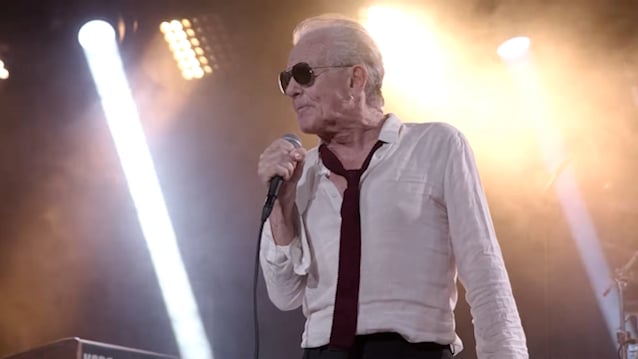
GRAHAM BONNET Remains Rock's Business Suit-Clad Ironman At 78
December 28, 2025By David E. Gehlke
The age-adverse Graham Bonnet recently issued a live album under the "Lost In Hollywood Again" banner. The 16-song platter appropriately digs into all eras of the English-born singer's storied career, leaning heavily on his ALCATRAZ, MSG and RAINBOW years, which, after all this time, Bonnet still pulls off convincingly thanks to his undeniable mid-range that is filled with grit and emotion. Indeed the man has been in the hard rock/metal game for so long that it's easy to forget that he got his start as an R&B singer in the 1960s and early 1970s, making his move into RAINBOW in time for 1979's "Down To Earth", one of most unique genre hops in memory, all the while keeping his trademark onstage look of business suit attire and aviator sunglasses.
Today, Bonnet is in his late '70s, with ample vim and vigor that should find him releasing a new solo foray in the spring of 2026 and is set to include a duet with IRON MAIDEN's Bruce Dickinson, as well as a spot from HELLOWEEN's Kai Hansen. While that gets sorted, BLABBERMOUTH.NET took the opportunity to ask Bonnet about "Lost In Hollywood Again" as well as his career journey that has found him working alongside luminaries such as RAINBOW's Ritchie Blackmore, MSG's Michael Schenker and RAINBOW / MSG drummer Cozy Powell.
Blabbermouth: Back in its heyday, did you hang out in Hollywood a lot? Were you the guy hanging out at the Rainbow?
Graham: "Not really, no. I left that for the tourists. I think we went to the Rainbow probably once when we had a little corner table with ten million people sitting around it. I think that was it. I think Ritchie was more into it than the band. I know Cozy didn't like it. And I didn't see the magic, but I know it was very popular. It meant a lot to that community, that little village there that had all of these different bands playing, ever since the Jim Morrison [THE DOORS] days. Not the Rainbow, I'm talking about the Whisky. I didn't get it; it's okay."
Blabbermouth: There was such a social aspect to it all. Was that not your thing?
Graham: "For one thing, I didn't know anybody there! It was more like a little clique, like, 'Hey! Hey Jimmy! Hey Bob, how are you doing?' Then, it was very much a family of its own. I wasn't part of it. Why would you go there? For the pizza? [Laughs] The pizza was great. We were there recently and had pizza, but I don't know what it is about Hollywood itself. It doesn't thrill me."
Blabbermouth: You didn't come up through the hard rock scene anyway, you sort of integrated into it.
Graham: "I also lived in England and moved over to the States in '79. That's when I was in RAINBOW. When I lived in England, I didn't go out that much. I probably went to the Marquee Club once in a while. No, it's not my thing to see all of these people gathering around. It's too crowded. We went to a thing last night. There was such a noise trying to talk to someone. It's all shouting, I don't like it."
Blabbermouth: Why now for a new live record?
Graham: "First of all, the record company wanted it. Beth-Ami Heavenstone, our lovely bass player, my girl, said to me, 'What about getting the band together?' We talked about music and doing something, and when we put the band together, I said, 'I like this. Let's keep on doing this.' To do this live DVD thing was a great opportunity to show people who we are. The Whisky is a very famous place and all that, and it turned out very well, apparently. I haven't seen it, but it apparently turned out well. I hope it sells ten billion copies. It has everything, when I was a solo singer, and then the different bands I've been in. It's turned out very well as far as I can see or hear."
Blabbermouth: What was the process in pulling a band together? Did Beth-Ami spearhead it?
Graham: "Beth-Ami knew a lot of people. We auditioned a lot of people until we got to where we are now. Our guitar player, Conrado [Pesinato], hangs out here once in a while, but he knows more people than I do. I don't know any musicians at all, hardly. It's not my thing to do that. It never has been. I'm wrong about that. I hung out with Barry and Maurice Gibb [BEE GEES] a long time ago. We used to go to a club that's now gone every sort of weekend or whatever and see Jimi Hendrix and Brian Jones [ROLLING STONES] when he was still alive, etcetera, etcetera. Late at night, probably about one o'clock, these guys who were famous musicians would get up onstage and play, which was really cool. But, recently, I went through that stage when I was 20. Okay, I've done that. Been there. I don't need to do that anymore, I don't think."
Blabbermouth: Do you think because you've done so many guest spots that you've earned the right to do whatever you'd like?
Graham: "I have to stick to what we've done on our past albums with the GB BAND, the GRAHAM BONNET BAND, which I hate saying. [Laughs] It sounds funny. With that band, the GB BAND, we've been doing a bit of R&B, rock, whatever, but very serious content. I think we've got great arrangements for our songs and good stories. I can't tell a story about Dungeons & Dragons. That's not me. Maybe if my hair were down to here, that is something that is so sort of gone. It's very 1970s. I can't make a song about something that I've never experienced. In my songs, mostly, I write about what I've experienced and what's on the news. I have the news when I'm making up a song. If a news thing comes on that sparks my imagination, I go, 'Oh yeah!'"
Blabbermouth: What is your relation with hard rock and metal music? You inherited the scenes because of RAINBOW and MSG.
Graham: "I haven't changed my voice to call it 'heavy metal.' It's always the same. When I first joined RAINBOW for my audition, I wore my suit and tie. Cozy called me the 'bank manager.' I said that was okay. [Laughs] I haven't changed my voice; my style is the same. Back in 1968, when my cousin and I made that record with THE MARBLES, it was the same then as it is now. I wasn't exaggerating or doing another [mimics growling vocals], like a voice with a sore throat. I always tried to sing cleanly but with emotion. If I'm powerful, I want them to feel what I felt when I sing it. I know that we've done a lot of live gigs recently, and Beth-Ami will tell me, after the show is over, I get a lot of guys coming up to me, 'You just changed my life.' And they're crying. 'You really mean what you're singing?' 'Yes, I do.' I know what it is. It's not some fairy tale. It might as well be about [English fairy tale with ancient origins] 'Jack And The Beanstalk'. I'm talking about real life. I have a song called 'The Beast In The Shadows', which sounds very metal. It's about Alzheimer's. I've lost my dad and my brother to it. It is the beast that hides in the shadows. I'm scared of it. Is that beast going to get me? I hope not. I don't think so because I've had a few tests done. It's an emotional song, and I remember doing the video for it, and it was one take because I couldn't sing anymore. I started to cry. After the shows, the guys who come up to me and say 'You're a part of my life' and they start to cry. And they well up and tremble. I say to Beth-Ami, 'That guy needs a hug.' I hug them too because I'm overwhelmed by how they feel about what I do. It's bloody singing! It is telling a story, and if they relate to one of the songs, that's great."
Blabbermouth: Real life is far scarier than a demon or a dragon anyway.
Graham: "It's true, and I didn't want to jump on the bandwagon and become a 'heavy metal singer.' I've sung the way I've always sung. In a way, my songs are like a country song—I'm telling a story. Country songs always tell a story. Most do, the old country songs, anyway. I'm reporting incidents. That's what I do."
Blabbermouth: Alice Cooper recently said his voice has held up so well because he always sang in the mid-range. Do you feel the same as him?
Graham: "That's where the power comes from. The high notes are good fun; they sound great. The power comes from around the range of, let's say, A to B. Then, top C comes in, and top D is where I can get to. Sometimes an E, but that's very thin. The lower register is more ballsy, obviously. I can sing ballsy up to top C. People love high notes. I don't know why. [Laughs] The louder they are and the higher they are, the better. I spoke with [producer/songwriter] Russ Ballard a few days ago. He said, 'I've got another song for you. I'm in the middle of it right now. I don't know what to do with it.' He said, 'I'm singing it really high.' I said to him, 'The higher, the better.' [Laughs] That always gets the crowd. I'm not quite sure about that on the guitar. Now, it's become so passe. Really? Are you going [mimics playing fast] over a beautiful melody? Now, the higher-the-better, and people ask me, 'How do you reach those notes at your age?' I don't know; I've been lucky."
Blabbermouth: Have you ever had surgery to fix your vocal cords?
Graham: "When I was younger, 20-something, when I was in THE MARBLES, I had nodes. I had to shut up for a week or two. My doctor said, 'What are you drinking?' I said, 'Scotch, Coke, beer and wine sometimes.' He said, 'Don't. Cut it all. That's fucking you up.' Well, he didn't say 'fucking you up.' He was a very posh man with his morning coat and pinstripe pants, he was a real doctor with gray hair and glasses. Well, he sounds like me! He said, 'Don't do that. You have nodes on your vocal cords. You have about four of them. We don't need to do surgery if you shut up for a week. Write everything down that you need to say.' And that's what I did. They went away, and I went back into the studio, and it was okay. It was back to normal. But I was like, 'Ugh! What's wrong with me?' Obviously, your voice gets tired. I'm only human; I'm not a robot. When you're tired, that's when you don't sing that great. I've noticed on the past gigs we've been doing, when I'm really knackered, they'll say, 'You were great tonight.' Sometimes, when I'm really tired, I'm the most relaxed."
Blabbermouth: You've always been a band guy. Do you wish you had struck out on your own and started a solo career earlier?
Graham: "I tried to do that back in 1970-whatever it was. It just wasn't working. I put a few singles out that did bugger-all. Nobody cared about me anymore. I wasn't in THE MARBLES. It was pointless, so I stopped doing it for a while and took on commercials, played bass and guitar on people's sessions, and did backing vocals. That's how I kind of existed. I was still playing music, but not what I wanted to do, which was kind of like what Marianne Massey tried to do with [Scottish pop singer] Lulu, like a Tom Jones on me and send me to Vegas with a bowtie. I said, 'Only if the bowtie spins!' No. That wasn't my thing, and so I left her and thought, 'What can I do now?' My girlfriend at the time was an actress, so I got some movie music I wrote for this bloody awful movie, plus a part in it with her and other well-known actors in England. It was good fun to do, but it was bloody awful. I wrote four songs for the movie, and they're pretty good, I think. They still sound good to me."
Blabbermouth: Do you think perhaps your longevity is also owed to your willingness to try new things? THE MARBLES are much different than some of the hard rock bands you eventually did.
Graham: "Absolutely. I was offered jobs that I probably should have taken. One was ELO [ELECTRIC LIGHT ORCHESTRA]. Jeff Lynne called me and said, 'Would you come down and listen to some stuff me and Roy Wood are recording at a studio near Hyde Park?' I went along there one afternoon. This was way before I got married or anything. They played these tapes. I went, 'Oh my god. What's that?' There were these classical sorts of melodies. I said, 'That's amazing.' They said, 'Would you like to join in and be our singer?' They said there would be two bands: One would be called WIZZARD, the other would be called ELO. They said they're willing to change members on certain nights. Some nights you'll be with this band, other nights you'll be with other bands. Roy would be with WIZZARD, and Jeff with ELO. I said, 'Wow. That sounds great.' Then Jeff said, 'We want you to play bass and sing.' I can play bass on sessions, but I have never played bass live. I said, 'I don't think I'll be able to do that. I can play guitar live. That's easy. Playing bass?' I'll be singing the bass line, I thought. I thought I wasn't good enough to be a bass player and singer. That's what I did in sessions. To put the two together didn't work for me. Roy Wood and Jeff called me. Then we got HAWKWIND, URIAH HEEP, all of these weird bands. I got lots of calls. I said, 'What the hell is URIAH HEEP?' I was in SOUTHERN COMFORT for a bit. SWEET. My producer, Pip Williams, was working with SWEET. We are working together one day. He said, 'I'm going to the pub in one minute. I've got some mates coming over, the guys from SWEET.' I went over to the pub, and there were these guys from SWEET. They had all these hit records, but the singer was gone, and they wanted a singer. They said, 'Graham, would you like to join the band?' I said, 'I don't know.' I walked away with 'I don't know.' It wasn't right for me."
Blabbermouth: Speaking of brilliant musicians like Jeff Lynne, your relationship with Michael Schenker has carried on. What makes it work between the two of you?
Graham: "He's very unique. Michael is very unpredictable, for one thing. You never know what he's going to come with. I'm the same way. I don't look at, 'It should be like this.' But Michael has suddenly become very military in the way the show should be when we played live together a few years ago. 'You should be here. You should be there. And you then come in from the side.' He was really together. But doing the album with him, 'Assault Attack', it was magical. It was really great. I loved that time. Unfortunately, Cozy Powell was the drummer. One day in rehearsal with Michael, there was an outbreak of war between Michael and him. I don't know what it was about. He punched Michael. Michael was crying, and he said to him, 'Cozy. I can't do this anymore!' So Cozy was fired. Then Ted McKenna came in, and Ted was fucking great."
Blabbermouth: Do you think about Cozy a lot? (Author's note: Powell passed away in 1998 after an automobile accident.)
Graham: "Every day. You can ask Beth-Ami and my close friends. He's there every day. He's with me because I can hear him say, 'Oh, you don't want to do that, Graham. It's fucking shit.' In RAINBOW, when we were putting down the tracks, he would say to Ritchie, 'Oh, no. Stop. Cut that bit out, Ritchie.' He arranged many of the songs on the album. We were very similar. Our birthdays are in the same month. I don't know if that has anything to do with it, being a Capricorn. He was like my brother. If I said something, I knew what he was going to say. If he played something, I knew what he was going to play. Cozy was not up there trying to do a great drum lick onstage. He listened to everything I sang, and if I slowed up, he would slow up. He played the song. He just didn't play the drums. He played the song. That was Cozy Powell. Ted, bless his heart, was very much like Cozy. Both of them aren't with us anymore, and I fucking hate that."


 Prev
Prev 