


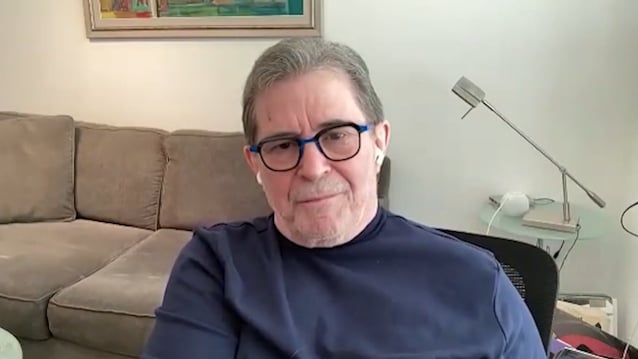
Legendary Record Exec DEREK SHULMAN Guided Careers Of AC/DC, BON JOVI, DREAM THEATER And PANTERA And Lived To Tell The Tale
December 16, 2025By David E. Gehlke
At a time when record companies and those in their employ were of utmost influence and importance, few generated a better track record than Derek Shulman. After fronting SIMON DUPREE & THE BIG SOUND, then prog forerunners GENTLE GIANT throughout the 1960s and '70s, the Scottish-born Shulman moved behind the desk at Polygram Records in the early '80s. It was here he signed and nurtured the likes of CINDERELLA, KINGDOM COME and most notably, BON JOVI, the latter's frontman so willing to make it to the next level that he took Shulman's advice and hired songwriter Desmond Child for "Slippery When Wet". Shulman then hopped over to Atlantic Records imprint ATCO, where, first, he signed a nascent PANTERA before righting AC/DC's ship for "The Razor's Edge", followed by signing DREAM THEATER ahead of "Images And Words". That run of success continued when he took a job at Roadrunner Records and worked with NICKELBACK and SLIPKNOT.
Now retired and enjoying life in New York City, Shulman just released his autobiography, "Giant Steps: My Improbable Journey From Stage Lights To Executive Heights", which, accordingly, captures all of the above action along with some in-depth music industry insight. The book also goes deep into a tragic event at the age of 16 that forever set him on a path of abstaining from drugs and alcohol — a rarity in the music business. It is highly recommended reading, which was more than enough reason for BLABBERMOUTH.NET to snag Shulman for a chat.
Blabbermouth: A key moment comes early in the book when your father passes away when you were 16. From there, you promised never to drink or do drugs. Being that you were so involved in the music industry where those things were prevalent, how did it feel being on the outside of all that behavior?
Derek: "My father was a professional musician; he was a jazz trumpeter. He drank quite often and smoked about 50 cigarettes a day. When he'd go out to gigs and come home, he'd bring musicians back and play in the front room. He was a real genius musician. He could pick up any instrument and become a maestro in ten minutes. I describe it right at the beginning of the book: He started coughing. My mom said, 'Something is wrong with your dad.' I went upstairs to get my brother, Phil, and to cut to the chase, he died in my brother's arms of a heart attack. And, having seen that happen, it traumatized me. Any kind of situation that would put me around drinking, smoking, et cetera, he didn't do drugs, but whatever the drinking, made all of us swear off doing anything. There were two sides: We thankfully had his DNA for music. At the same time, his untimely death at 50 really kind of turned us off from getting on anything that would affect our health and minds."
Blabbermouth: It's quite a feat that you managed to stay away from all of that when you were in GENTLE GIANT.
Derek: "I did. In fact, in every band or band member from the '70s who got involved with that sort of thing, things became worse. Originally, in the old mod days, it was pills, speed and black beauties and all that kind of shit. Then, as we got into the '70s, it was cocaine and other, harder stuff. I don't want to be completely untrue. I did try to smoke marijuana one time. I didn't like it. I don't like the feeling of being out of control. When I was in SIMON DUPREE, someone spiked my drink. That was the most horrific experience. I could still remember even how many years ago, 50 years or longer. I remember that feeling like I'm dying. I was literally hanging onto a lamppost outside of the club for eight or nine hours because I thought if I didn't, I would die."
Blabbermouth: Have you gone back and watched some of the GENTLE GIANT videos on YouTube? Do you ever marvel at how free-flowing and effortless you made it look?
Derek: "Actually, it's strange you should say that because I should say no, but, yes, I do. I look back and think, 'Wow. That's pretty fucking awesome.' Obviously, we worked very hard to make it like it was easy. When we rehearsed, we worked hard. We really worked our asses off. We were hard workers in both recording and going onstage. We didn't take any time off. The rehearsals for the stage work were a lot. Thankfully, having had the apprenticeship of being in a pop band before GENTLE GIANT gave us good instincts about being onstage and stage craft."
Blabbermouth: GENTLE GIANT was prog before it was a thing. You were at ground zero for it. Did you think what you were doing was truly "prog"?
Derek: "No, it was just what we were and who we were. There was no such thing as a label back then. We saw all the bills. We played with BLACK SABBATH and THE EAGLES. You name it. There was no such thing as 'We should go out with all the prog bands.' Thankfully, we went out and toured quite a lot in the early days with JETHRO TULL. TULL, they were much bigger than we were and took us out. Basically, we broke from going out with them in certain territories. We actually had mutual respect, both musically and personally. They were very similar in their lifestyle, if you like, as we were, Ian [Anderson] especially."
Blabbermouth: You go into detail in the book about how GENTLE GIANT broke up in 1980 when some of the guys started families. Have you ever pondered what it would have been like to get back together?
Derek: "We hit a wall. It was an extremely thick wall. We had a lot of opportunities and offers."
Blabbermouth: Lucrative offers to get back together?
Derek: "Yeah. In fact, in the last 20 years, if you like, or even longer, because of the internet, you asked if I watch some YouTube; there have been young people trying to play along with the band. It's great to see that. It's fantastic to see musicians picking up their guitars and other instruments and playing them, rather than getting on the computer and pretending to be musicians. Yeah, we had some opportunities, but there would be no chance. It would be wrong for lots of reasons. Number one, we never wanted to be a parody of ourselves. Also, trying to get into size 30 waist. [Laughs] Especially when you're a few sizes larger and all of the other stuff. We wouldn't want to be a parody or pretend we are the band we were back in the day."
Blabbermouth: A great line from the book is that you got a "de facto master's degree" in band management from running GENTLE GIANT. That had to be crucial when you started working for record companies.
Derek: "In the '60s, to get a record deal, there's a whole litany of things that went on from the '60s to now. To get a record deal, we went up to Abbey Road with my first group, SIMON DUPREE, and played for the entire staff and the producer. In the '70s, bands started getting bigger, and record sales were much better for LPs than for singles. Then, of course, in the early '80s, I transitioned to the dark side, if you like. [Laughs] The Darth Vader side. Then CDs were introduced, and the business blew up in a huge, gigantic way. Record companies made a fortune during that period of time."
Blabbermouth: Because you started as a musician, did you have a hard time connecting with the "bean counters" at labels?
Derek: "It was very odd, to be honest with you. I accepted the job at Polygram even though on the first day there, I was ready to quit. I was absolutely ready. I realized it wasn't the music business. It was the business of music. Every office had its own agenda, and I realized then that my group, which we had stopped, didn't have a real champion. That's what you needed. You needed someone to prioritize you. The music business was odd, but I was lucky in the fact that I was able to relate to the artists I signed because there wasn't an artist who could say to me, 'You don't know what it's like.' I've been there. In every single situation they could get into, I had been there and done that. Thankfully, I was lucky enough to be able to speak to them on their level and be part of the group and be part of a band, realizing the highest expectations."
Blabbermouth: Was bringing in Desmond Child to work with BON JOVI your greatest stroke of genius?
Derek: "Yeah, it wasn't a bad idea at all. [Laughs] When that happened, we all knew. I knew that BON JOVI and Jon Bon Jovi were going to be massive. ['Slippery When Wet'] was at the top of the charts for 15 weeks and sold 20 million records. Gene Simmons [KISS] suggested to me that I should get a hold of Desmond, who had been in a band called DESMOND CHILD AND ROUGE. I met him and said, 'Would you like to work with Jon?' That was right up there with one of the best moments for their career, the company and me."
Blabbermouth: Maybe that says a lot about Jon Bon Jovi that he was willing to do that. What would you have done if someone asked the same of GENTLE GIANT?
Derek: "What I would have said if somebody said to GENTLE GIANT to write along with Phil Collins? No! [Laughs] They wouldn't get past the word 'will.' [Laughs] Jon was that determined and driven to be as big as Elvis [Presley]. That's what he said to me. The fact was that the first two albums did pretty well, but I said, 'Let's try it. What do you think?' I have to hand it to them that they were open to doing that, and Desmond was ready. All the stars aligned."
Blabbermouth: How crazy were the amounts of hookers and blow thrown your way when labels were wining and dining you to work for them?
Derek: "I can't tell you how crazy it was; it was insane. It's funny. There were these well-known executives who are still very well known, but they thought they could woo me with things I had no interest in. I have a wife and kids: hookers and whatever, that was not on my radar. Blow? I never touched it in my life. Anything else they could bring up to woo me to be part of the company just didn't work at all. They didn't know that. I went along to these meetings, and these guys, the Walter Yetnikoffs [CBS] and Ahmet Ertegüns [ATLANTIC], would imbibe. Somehow, or rather, I'd get myself out of the situations. I don't know how I did. My smooth talking, maybe. [Laughs] Nevertheless, I never got dragged into a situation that would make me do things that I didn't want to do. However, the one thing that made me start at ATCO was a crazy little thing — Steve Ross, who said, 'Listen. I think this is the place here.' Having come back from a trip to Turkey with Ahmet and seeing the crazy things he got up to and seeing the things he wanted me to get into, which I didn't, but Steve, we sat down, and he said, 'We really admire what you're doing.' Warner Music Group was a great company then. They had Warner on the West Coast; Elektra and Atlantic on the East. He said, 'We could reboot ATCO Records.' I said, 'That sounds interesting.' Then I saw a straw basket at his side. I said to Steve, 'What is that?' They had a corporate apartment or house in Jamaica. He said, 'This is from Jamaica.' Inside this big basket were little tiny baskets with a lollipop. He said, 'Do you want one?' It was a one-dollar lollipop. It wasn't the basket. It was the lollipop. That was it."
Blabbermouth: I thought it was cool that you were able to bring over the people you wanted to ATCO, too.
Derek: "I had people that, to be honest with you, I stole from Polygram. Polygram was an interesting company back then. It was still evolving into a company because it was owned by a German company, Siemens and a Dutch company, Philips. They were trying to evolve into this company, and no one was in charge. It was like the pirates were steering the ship. Effectively, there were some great people there. I hired two or three of them to be part of the staff. I had a great time for the first four or five years. It was fantastic. We had some great successes. We had some failures, of course, which you never admit to. It was a great time. Then it wasn't."
Blabbermouth: You mention in the book that some of your premonitions paid off, like replacing all of CINDERELLA's lineup except Tom Keifer, asking Desmond Child to work with BON JOVI and singing PANTERA. Was there any band you thought would succeed, but didn't? Maybe DAN REED NETWORK?
Derek: "Absolutely. One hundred percent. DAN REED NETWORK should have been as big as DEF LEPPARD, BON JOVI and Prince. They were that good. They still are. Dan Reed and the band, playing-wise, were probably one of the best live bands I've ever seen. Recording-wise, the first couple of albums were superb. For whatever reason, I tried and tried and tried, but unfortunately, at Polygram, they were trying to get DEF LEPPARD's 'Hysteria' into the charts at that point. They spent millions of dollars on that record. They eventually did, and it worked, but all the priorities went to DEF LEPPARD. I couldn't get Dan Reed into the cracked door. It was so frustrating. I felt so bad for me and for Dan and for the company because he should have been as big as all of the other bands I worked with."
Blabbermouth: What do you think the key ingredient was for you when you worked with AC/DC?
Derek: "By the time of 'The Razor's Edge', AC/DC was going to be dropped. I inherited a couple of artists, and I had Doug Morris, who was running Atlantic. I said to him, 'Don't drop AC/DC.' He said, How about trading something? I traded Stevie Nicks for AC/DC. Thankfully, AC/DC, I got their trust for many reasons, but the prime reason was George [Young], Malcolm and Angus's brother, who was in a band called THE EASYBEATS, and knew me from SIMON DUPREE. He said to Angus and Malcolm, 'If it's the same Derek Shulman, you can trust him. He's cool.' Then they invited me into their very exclusive world. I was able to sit down with Angus and Malcolm. Malcolm, I realized, was the real heart and soul of that band. Angus was the front guy; he was the star, but Malcolm was the soul. I took them to Vancouver to my favorite producers, Bob Rock and Bruce Fairborn, and I sent them the demos, and they said, 'This is fucking fantastic. We love it.' I was there, and they allowed me into the studio, which they never did with Atlantic. We came and put out 'The Razor's Edge'. The first single was 'Thunderstruck', and the rest was history."


 Prev
Prev 