


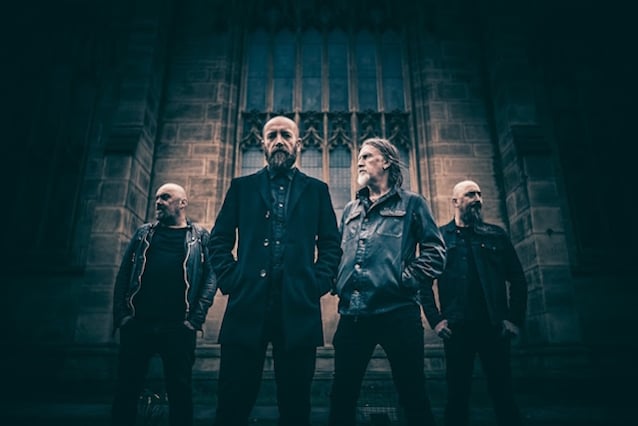
GREG MACKINTOSH Channels Classic PARADISE LOST To Write 'Bombastic' And 'Mournful' New Album 'Ascension'
September 17, 2025By David E. Gehlke
A primary factor in PARADISE LOST's stability and status as one of the most impactful doom metal bands ever is guitarist and songwriter Greg Mackintosh's conviction in his ideas. The Brits have traversed multiple musical paths throughout their 37 years as a band, including highly debated forays into electronica and experimental rock that followed undeniable classics like "Gothic", "Icon" and "Draconian Times". Even as critics assailed PL and fans balked, Mackintosh remained firm in his principles — it's where he wanted to take the band, everyone else be damned. It's a state of mind that continues to reap the benefits circa 2025 with PL's 17th studio effort, "Ascension". Inspired by the 2023 "Icon 30" album and ensuing tour dates, Mackintosh set about creating a collection of melancholic, somber, dark, and even "Christmas-like" songs that are primarily driven by his trademark guitar melodies and Nick Holmes's ever-reliable death/clean vocal broadsides. The result, the band's first album since 2020's "Obsidian", is an LP that will warm even the darkest of hearts as winter approaches.
PARADISE LOST's body of work is now so impressive and robust that they have nothing to prove. For a band that has prided itself on being faithfully miserable, Mackintosh, Holmes, along with fellow founding members Aaron Aedy (rhythm guitar) and Steve Edmondson (bass),still find plenty of joy and fun in the creative process and being around each other. However, the recent dismissal of drummer Guido Zima wasn't exactly a barrel full of laughs for PL, who, unfortunately, have grown accustomed to changes in the drum stool. Taking Zima's place is returning sticksman Jeff Singer, who has long remained a favorite within the band and was the first topic of conversation when BLABBERMOUTH.NET caught up with Mackintosh.
Blabbermouth: I'm going to read you something you once told me about Jeff after you had him do some fill-in dates a few years ago: "When Jeff is back playing with us, it's like he never left. There's something about him that just fits." Did you have the same feeling when he rejoined?
Greg: "Oh yeah. He just slots in, of all the drummers we've had, we've had better heavy metal drummers, we've had more technical drummers, all different styles, but Jeff just fits in the pocket. As a person and with his grooves, he's the most solid rock drummer you'd ever meet. He's so enthusiastic. Not in an annoying way either. [Laughs] Those things are quite annoying to me, as you know. It's nice. The last few festivals and the KING DIAMOND shows, he's been in top form. It makes me smile. It's nice to have this groove back that you can't put your finger on. I can't put my finger on what it is; otherwise, other drummers, I would have said, 'Can you do a bit more like this?' It just sits and swings right."
Blabbermouth: Was he the only choice after Guido was dismissed?
Greg: "He was the first one we rang. We had nobody else. Nobody else was in our heads. We're like, 'Are we going to go through the whole rigmarole of auditioning and getting to know people again? Let's ask Jeff. Let's see if he can do anything.' He said, 'I can do a few shows.' That turned into, 'Okay. I can do the rest of this year.' We just heard the other day that he's on board for whatever now. He has a day job, but he's almost the boss of where he is. He's not the boss, but he said he's got the blessing of his boss to do what we need to do, which is awesome."
Blabbermouth: Is it fair to say you were not expecting to change drummers after finishing the new album? Did things fall apart that quickly with Guido?
Greg: "I was the last champion of Guido. He butted heads with a lot of people on tour. It originally started quite a while ago with our drum tech, who left because of Guido. He went over to OPETH. At the time, I thought it might have been a clash of personalities. You can't put it down to anything like that. Then, it happened within the band as well, a lot of butting heads. You know, when I was going through some tough times, that was the last thing I needed to deal with, all of this band politics that was needlessly stressful. It didn't have to be. I was the one who said, 'Come on, give him a chance.' Then, we recorded the album, and it was a nightmare. For every album we've done recently, it took three days to record the drums. He took two weeks. Then it was me and him butting heads, he had a really bad attitude. There's even an argument that I overheard with the engineer, Lawrence [Mackrory], and Guido, and he was saying to Guido, 'You do know that Greg has done this a lot of times. You're talking like he's just started.' I came out of the studio and said, 'I can't do any more recordings with him.' I told him, flat-out: 'Look, that's the last time we do any recordings. Live? I don't know. We'll see how it goes.' We did the South American and American dates, and it was the same thing."
Blabbermouth: I saw you in Baltimore in May when you did all of "Draconian Times". He seemed to manage Lee's [Morris] parts fairly well, but I guess it's hard to pick up what's really going on sometimes.
Greg: "When you take all of that away, he's a nice guy. He's talented. I think he was a square peg in a round hole. Sometimes you can't make things work, no matter how hard you try. He did us a favor and got us out of a hole. Waltteri [Väyrynen] left right before we were supposed to start touring for 'Obsidian'. We had no one to do the tour. I had Guido doing [Mackintosh's black/death metal side project] STRIGOI. I said, 'Guido could probably do it.' He said, 'Yeah, I'll try it.' He came in and did that. It kind of worked out okay. Then he just kind of stuck. We never looked for anyone else. He was there. What was essentially supposed to be a temporary thing turned into a few years. I should have seen it earlier that it wasn't working out."
Blabbermouth: At this stage in your career, there are few things more important than being surrounded by good people for the four of you.
Greg: "We spend so much time together. Traveling can be brutal sometimes, and when you're tired and hungry, the last thing you need is pointless little arguments that turn into things that you don't need. Jeff's very easy-going on that score. He gets tired and hungry like the rest of us, but he's so enthusiastic and appreciative to be here. I think because he's done other stuff, he realizes that it's actually easy in PARADISE LOST. Some people come in and they think, 'Oh, wow…' But they've never done anything in the same way before, like the heavy touring, the festivals, the bang, bang, bang, you're out here, you're out there. Many of the people we had before in the band had never experienced anything like that. They come in and say, 'Wow, this is hard.' We don't take anything too seriously. We don't take ourselves too seriously. You have to be able to have a little bit of a laugh in small doses. Jeff gets it."
Blabbermouth: What made you take on the formal role of producer for "Ascension"?
Greg: "It was mainly in name because for a lot of records we've done, the people listed as 'producer' aren't producing in the classic sense. In the '80s and possibly the early '90s, producers did a lot of pre-production work with the bands. They looked at your song structures; they looked at your sound. They almost became an extra member of the band, figuring out how the songs would be. That doesn't happen anymore, and it hasn't happened for a long, long time. The more it went on, the more I thought, 'I'm just telling someone else what to do, but not getting the production credit.' I've thought, 'Look. I've done everything on this from the ground up. Surely that's a production credit.' I realized that over the years, we've learned how to get the sounds, so we don't have to tell someone how to get sounds. I've produced a couple of records for other bands, and I've realized that it makes more sense for PARADISE LOST to do that kind of thing. We know our sound. I know exactly how I want things to sound at any given time. That changes over time, obviously. At any given time, I know what I want to achieve and how to achieve it. It made more sense that way."
Blabbermouth: The album is heavy on your patented guitar melodies. It's probably your most melody-intensive record in a while, actually. What brought that about?
Greg: "I think it started with doing the 'Icon 30' thing. Re-learning those tracks and doing all of the guitar and bass recording for that as well, it was like, 'Oh, I don't think about writing guitar parts like that anymore.' That definitely bled into when I was writing the record. I'd say that was the initial catalyst for it. Then, as I went on with the songs, I wasn't trying to make them that way, but it just all fell into place. You know how it works: I started to adopt the mindset I had in 1992 or 1993. That's the only way I can put it. I was excited about the music that I was similarly excited about at the tail end of 'Shades Of God' into 'Icon'. It was ticking the boxes for me again. It made sense to pursue music like that again. I remember when TROUBLE played with us in America [earlier in 2025], that was like a dream come true."
Blabbermouth: You've always been vocal about your love for them.
Greg: "When I saw them, that was like, 'I've definitely done the right thing with the music. It's what I want to be a part of right now.' We've been speaking to TROUBLE about doing some European dates with us. They can't afford to do it. We know it's a big thing, trying to get over here. Touring is insanely expensive and difficult to do. We'd thought we'd ask them since we had so much fun with them."
Blabbermouth: "The Skull" is great, as is "Run To The Light", but nothing may top the self-titled record they did in 1990.
Greg: "I love everything they did up until the BEATLES stuff. 'Manic Frustration' still had some good stuff on it, but they were headed down a different path, but that's what bands have to do: They can't do the same thing over and over."
Blabbermouth: You're a prime example of that.
Greg: "Exactly. Those first three TROUBLE records, then the self-titled, they are all just gold. There's not a bad song on them."
Blabbermouth: That's what really helped PL in the early days: Where most doom bands were looking to BLACK SABBATH, you always leaned into TROUBLE.
Greg: "I got into TROUBLE before SABBATH, which is weird to say. I came through the metal scene in a different way. When I got into metal in the mid-'80s, it was TROUBLE, the first CANDLEMASS ['Epicus Doomicus Metallicus'] album and the early CELTIC FROST albums. And maybe the first KREATOR record ['Endless Pain'], I love that record. That was my introduction to more extreme stuff. Then, I retrospectively went back to BLACK SABBATH, and of course, I love BLACK SABBATH. I was around in the early '70s, but I wasn't listening to them!"
Blabbermouth: You recently said that "Ascension" has a "Christmas vibe," which is a fitting take. It does have a sort of wintry, chiming feel to it.
Greg: "It's something we used to say around 'Icon', like 'Is this melody church-y enough?' Also, we used to say, 'Weep openly at the sheer pomposity.' It's like how bombastic and mournful can you make it without crossing into cheese? You're treading a fine line there. I went down that route again. I was thinking a lot about early DEAD CAN DANCE. I grew up with church music because you had to go to church as a kid. My generation was forced to go for some reason. DEAD CAN DANCE opened up a lot of other music to me that I would have never been aware of, like world music.
"I was writing 'Ascension' over autumn and winter, which is my favorite time to write. It's coming out in the autumn and winter this year, which is perfect. Hopefully, people hear it and will get the same vibe. When I realized that was the vibe of the record, I went all out on a couple of tracks to make them as Christmas-y as possible. [Laughs] Like 'Salvation'. It's basically an anti-Christmas song, the alternative to Christmas. I've asked the label to see if they'll do something with it around Christmastime. Hopefully it will happen. I managed to get sleigh bells on three tracks and nobody noticed, so that was good."
Blabbermouth: It's also nice to hear acoustic guitars popping up on "Lay A Wreath Upon The World' as well as "Savage Days". You haven't used them as much in the past. Are you more comfortable with them now?
Greg: "I've had these acoustic guitars knocking about for years, but they weren't in recording shape. I had to borrow an acoustic guitar from someone. It's a U.K. company called Faith. They won't sponsor me, which is annoying. [Laughs] But the guitar felt really good and was nice to play. I thought, 'I can't get this into the type of material I'm doing at the minute.' Then, a few songs presented themselves as I was writing that needed some acoustic parts. I actually recorded them in my kitchen. I didn't even go to my studio; I sat in my kitchen. I had a mic on the counter, and I was playing the acoustic. I did all the parts that I wanted for the songs. Then, they stayed with the demos, and when it came time to record it properly for the album, I couldn't get it to sound as good. They didn't have the same vibe. The ones on the record that you're hearing are the ones I recorded with a mic in my kitchen. I was pleased with that. It worked so well that it was good enough to keep on the record."
Blabbermouth: That's a first for PL: Acoustic guitars recorded in a kitchen. That sort of keeps with the spirit that Nick brings up a lot, that it's still fun for you guys and you're trying new things.
Greg: "I think for Nick and me, the most enjoyable part is the creative process, which a lot of people would say. When you first start a new record, it's always, 'What are we going to do?' It's a world of possibilities because we don't feel tethered, which is a good thing. It's good that he's quite open to whatever I want to do. It's a lot of fun. We have all sorts of iterations of songs and different styles before we start to figure out what an album will be. It's just a really nice process. It's good that we don't butt heads too much either. It's easier now than it ever was. I think we're both like, 'Whatever works. Whatever sounds good for the song.' If it excites us, then it's good enough to put on a record. It doesn't matter what style. That entire process, from recording to mastering, is the most enjoyable part for us. And it's great that we still get to do it. It's a shame it took five years."
Photo credit: Ville Akseli Juurikkala


 Prev
Prev 