


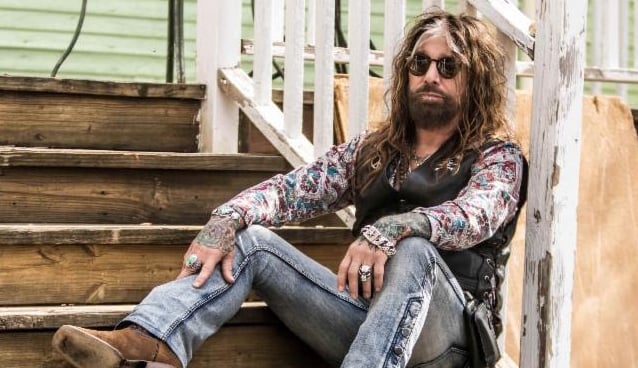
JOHN CORABI Did Exactly What He Wanted With His 'New Day' Solo Album, And It's Nothing Like MÖTLEY CRÜE
May 5, 2026By David E. Gehlke
John Corabi's just-released "New Day" solo album bears little resemblance to the down-and-dirty rock stylings of his late '80s / early '90s outfit THE SCREAM, nor the dark heaviness supplied on MÖTLEY CRÜE's acclaimed self-titled 1994 LP. And that's the point. Despite building a reputation as a guy who can handle hard, gritty rock, Corabi's heart lies with soul and blues music. Ask him, and he'll go from waxing on CHICAGO, STEELY DAN in one breath to THE ROLLING STONES and SLY AND THE FAMILY STONE in another. He's more 1970s soul than 1980s Sunset Strip, and it shows across the 12 tracks on "New Day" that capture his identifiable, whiskey-soaked vocals in top form, with some help from producer Marti Frederiksen (AEROSMITH, BUCKCHERRY) and guitarists Richard Fortus (GUNS N' ROSES) and Paul Taylor (WINGER).
Corabi remains a member of the rock supergroup THE DEAD DAISIES, still makes the rounds playing his THE SCREAM and MÖTLEY numbers, and will even hit upon some cuts from UNION, his late '90s, post-MÖTLEY act with ex-KISS guitarist Bruce Kulick. In essence, Corabi could keep digging into his past, but in speaking with BLABBERMOUTH.NET, it was clear that the singer (now 67 years old) knows his future may lie in the acoustic-driven, less aggressive avenues that have emerged from "New Day".
Blabbermouth: You've done a lot of things over the course of your career. Why a solo album now?
John: "It's maybe a little bit of a misconception — I did do solo records in the past. I did an unplugged record in 2012 ['Unplugged']. Now, I guess, the 'fault' is that I took some of my old songs like 'Father, Mother, Son' [THE SCREAM] and 'Hooligan's Holiday' [MÖTLEY CRÜE] and re-worked them acoustically, for an album which had 60 or 65 percent new shit. But for some apparent reason, since it was an acoustic record, it doesn't count. Then I did the 'Live 94 (One Night In Nashville)' thing and put it out in 2018. In all honesty, I got offered this deal last year from Frontiers. I was like, 'Okay, cool. I'm going to try this.' Then the DAISIES were like, 'We're going to take 2026 off.' And I go, 'Okay, awesome. This works out!' I immediately went into the studio. I turned the record in, I think, in November. Once it comes out, it will be five or six months since it was finished. I just thought, 'I got a year off from the DAISIES. I can put this record out. Do whatever the fuck I want to do, and it's not going to interfere with anything that the DAISIES are doing and vice-versa.' That was the main thing. I wanted to do this record before. I know you guys [Blabbermouth] have been pretty supportive of what I'm doing. You kind of mention me a lot. I was going to do this before, but I've got to be honest: I'm the most computer-illiterate human being on the planet. I'm like, 'Dude. What are you talking about, 'algorithms'? I don't even know how to spell the word.' I put two songs out that are on the record ['Cosi Bella' and 'Your Own Worst Enemy' in 2021 and 2022, respectively], but I was like, 'I don't understand this new-finagled streaming shit and whatever.' I kind of put the brakes on, and the DAISIES called and asked me to come back. It just worked out this way."
Blabbermouth: There's a large segment of people who would probably really enjoy a dark, heavy, brooding John Corabi record. What made you go back to your roots instead?
John: "This is probably, even my wife said it, this is probably the most 'honest' record that I've ever done. Even when I go out with my wife, we go to this little bar around the corner from our house in Nashville. I have TouchTunes and Ami, and I'll load some money onto the thing. I immediately get in there and start playing shit, and I can watch everyone in the bar, and they start looking around, 'Okay, he's in here somewhere.' I've got this playlist of songs that I just enjoy listening to. Everybody's like, 'I hear him, but where's he at? He's in here somewhere?' [Laughs] I grew up with THE GUESS WHO, THREE DOG NIGHT, CHICAGO, CREDENCE [CLEARWATER REVIVAL], STEELY DAN, just all the great, classic shit. In all honesty, the only thing that I had in mind when I was doing this record was that I told Marti, 'I want to do something that's just classic sounding.' The thing I wanted to do was classic sounding, but all the bands I grew up listening to seemed to have this creative freedom to do whatever they wanted. The only reason why I use this as an example, when you look at a band called THE ROLLING STONES, who are considered the greatest rock and roll band on earth, and you go back and listen to the brilliant shit they were doing, like, 'Exile On Main St.', 'Sticky Fingers', all this stuff, and they were at the height of their career, yet they were not afraid to do songs like, 'Dead Flowers', 'Waiting On A Friend', 'Wild Horses', even 'Honky Tonk Women' to a degree. If you placed the same parameters that we have in music now and took it back in time to that era, you would have industry people, the streaming people, the writers, concert promoters, they'd be like, 'You can't do 'Wild Horses'.' Or, 'You can't do 'Waiting On A Friend'. That's country!' A lot of those bands that I grew up listening to, I felt like they had that freedom to put a pen to paper and play their guitar: 'Oh, hey, check this riff out. It's really cool.' So, that's all I wanted to do. I wanted to do a record that people would have a difficult time putting into a box. It is retro sounding to me. But the other thing, too, all those other records that I'm known for, were also made showing up to rehearsals with almost finished songs and having to compromise with two or three or four other guys. Being in a band is much like a marriage. Inevitably, you come in, and you've got a finished song, and you've got a chorus that kicks ass, then you bring it to the band, and you're all excited about it and the guitar player goes, 'Man, I really don't like soloing in the key of F. Can we change that?' Or the drummer is like, 'Man, great drum beat, dude, but I'm a drummer, and you're a singer. This is what I would have done.' You wind up making compromises. As much as I love the MÖTLEY record, it was way heavier than anything I probably would have done on my own. It was me adapting to whoever I was playing with. Even though Marti was heavily involved in this, he always said, 'Your name is on it. What do you want to do?'"
Blabbermouth: I guess, then, the thought may have been, "John Corabi is doing a solo record. Of course, he's going to lean into that MÖTLEY album."
John: "The first single came out in December. I see these comments, and it's like, 'Eh, it's okay. I'm going to wait for him to do something heavier.' Please don't hold your breath. [Laughs] Even the MÖTLEY record, 'Driftaway'. I wrote that and even some of the heavier stuff, some of the riffs, I've always started, everything that I've ever written, I started on an acoustic guitar and translated it with whoever I'm playing with. I got to be honest: This record was probably the most effortless record, artwork, just the entire process was effortless."
Blabbermouth: Was it fun to dig into your soul background on "Faith, Hope And Love" and "Good To Be Back Here Again"? How did they come together?
John: "It's weird to me — obviously, I had comments about those two songs in particular. It was funny from my perspective. I could tell you, for example, 'Good To Be Back Here Again', I was at Guitar Center, and I just happened to go where they have the acoustic guitars. They're called 'Gibson-inspired' Epiphones. It's a line of guitars that Epiphone is doing, and they're a little more than their regular Epiphones, but they're inspired by certain years of Gibson. So, I saw this J-200 acoustic guitar, and I picked it up, and I started strumming it, and I go, 'Holy shit.' I grabbed a real J-200, and I'm like, 'Fuck. I don't hear that much of a difference.' So, I bought the guitar. They set it up for me, and I picked it up a day or two later. We had started the record, and I came home, and I'm sitting on my couch. My wife was goofing off in the kitchen, and I started playing the pattern I'm using on 'Good To Be Back Again'. No idea where it came from. I just started singing [sings opening line]. I did the first two lines and said, 'That was cool.' I put the guitar down. I got on my computer, my wife went into the bedroom, and I sat here for 30 minutes, writing all the lyrics. I always run shit by my wife. I go, 'Hey, what do you think of this idea?' I printed the lyrics off the computer, and she goes, 'That's amazing. Did you write that?' I go, 'Yeah.' She goes, 'Play it for Marti.' I played it for him, and he goes, 'It's great. Let's put it on.' That's the amount of thought that went into it. I thought it was a cool tune with some cool lyrics. We tracked it. Marti added some keyboards. I got Richard Fortus to do the guitar solo. Paul [Taylor] did some stuff. It just happened. People are like, 'Hey, man. What was your thought process?' I go, 'I didn't really have one.' I just played the song and go, 'This is cool. Put it on the record. Just a short little ditty.' That's another awesome thing about the record: I didn't put a lot of thought into why a song shouldn't go on, or it should go on. It was like, 'I like this. Put it on.'"
Blabbermouth: Plus, you had no one to debate you. Your wife and Marti seemed like good barometers.
John: "Marti would have suggestions. Marti and I wrote, 'When I Was Young'. Originally, it was almost a ballad-y type of thing. Then we took a break for the weekend. Marti had a gig somewhere, and I think I went, had a gig and came back. We were like, 'Let's meet on Monday.' We got back into the studio. We had already mapped out the song; I wrote the lyrics, then Marti's like, 'Hey, man. I was kind of thinking about this: I don't think we should do that song as a ballad. I think it should be a little more up-tempo.' I was a bit perplexed, but Marti goes, 'I just want you to think about 'Maggie May', Rod Stewart.' So we jammed it, and as soon as we started jamming it, I go, 'Yes, you're right. Let's do it a little more up-tempo.' Later, we were getting ready to mix, Marti goes, 'Dude. I know I said the Rod Stewart thing, but 'When I Was Young', I think it needs a mandolin. If we're going to go Rod Stewart, let's really go Rod Stewart.' Marti would suggest things to me, and he would say, 'It's your solo record. Your name. You have the final call.' I'm like, 'Okay!' We just try shit, and I'd go, 'Yeah, I love it, dude. Let's do it.'"
Blabbermouth: How did something like "Everyday People" by SLY AND THE FAMILY STONE come about?
John: "I have a few motorcycles. I've had SLY AND THE FAMILY's 'Greatest Hits' on my phone forever. My wife and I were riding around. I have a motorcycle, and I also have a trike that I ride with her on. I was just cranking that. I've always loved Sly Stone. I thought he was the original Prince, like this awesome black musician who could cross over into white America. He was able to make political statements without pissing anybody off. I always loved that song for multiple reasons. I'm going to get a little nerdy on you: I loved the message and the lyrics, but the thing that perplexed me even more is if you go and listen to the original version, Sly's version, that entire song, as beautiful as it is, is one chord."
Blabbermouth: Those are sometimes the hardest songs to write.
John: "Yeah! The only thing he does is that little sus thing [hums chords]. It's a G-note through the whole song. He's got that verse and the chorus, then there's after the chorus, there's another chorus, 'We've got to live together.' I go, 'What a fucking genius!' I told Marti: 'Dude, you're probably going to think I'm nuts, but I really want to cover 'Everyday People'. And Marti goes, 'Fuck yes. Let's do it.' We worked up a slightly different version. I added some chords to the solo to take it in a slightly different direction. My wife goes, 'You're going to record SLY AND THE FAMILY STONE'Everyday People'? I don't know how you're going to pull it off.' I recorded it and brought it home, 'What do you think, muse?' She goes, 'That's fucking awesome.' I always loved that song, even when I was in grade school. I'd cut school, go to this candy store and play this pinball machine. I'd listen to CREDENCE, 'Travelin' Band' and SLY AND THE FAMILY STONE, 'I Want To Take You Higher', 'Dance To The Music' and 'Everyday People'."
Blabbermouth: It's a nice way to close out the album with a positive message.
John: "It's weird. A lot of people ask me, 'How do you write your lyrics?' I go, 'Dude, turn your TV on for 30 minutes.' We're inundated with bad news, and if you look in any direction, something is going on in life. Like, 'Faith, Hope And Love', '1969'. That came about when I told my wife when we were watching the news, and she's like, 'Oh my god. People are fucking nuts anymore.' I go, 'You know what's crazy? I was old enough to have lived through 1969.' Even the divisiveness of pro-war, anti-Vietnam War, the hippie movement, the guys who wore suits and had short hair. I go, 'Dude, we were so divisive. We're here 60 years later, and we haven't learned a fucking thing.' I don't want to say it was easy, but literally, somebody was channeling something through me. It was weird."
Blabbermouth: You have some dates with Tom Keifer coming up. How do you format the set between the new album and your back catalog?
John: "Before we do this tour with Tom, I need three different sets. I need a set I can do, since there are a lot of dates when I'm not with Tom. I'm doing some solo headlining shows, whatever you want to call them. I need 90 minutes. Then there are shows that I'm doing where it's Tom and I, and I'm doing about half of that, like 40 to 45 minutes. Then there are shows that I'm doing with Tom and BUCKCHERRY, where I'm only playing 30 to 35 minutes. I'm going to try and give everybody a little bit of everything, a little taste of THE SCREAM, MÖTLEY, UNION, new shit, but depending on what set I'm doing, there will be a little more of everything. We spent three weeks in Europe. We did a little bit of SCREAM, a couple of UNION songs, MÖTLEY, four or five of the new tracks and a couple of cool covers that I grew up thinking were awesome."
Blabbermouth: The health of some of your peers has been in the news a lot lately, but how are you feeling? How is your voice holding up?
John: "It's okay. Right now, I'm a little beat up. When I was in Europe, I guess it's part of age, but I bit into a piece of bread, and I chipped a tooth. I wound up having an abscess, but I had three acoustic shows to do. I'm like, 'Ah, fuck it. I'll deal with it when I get home.' I wound up getting an abscess. Yesterday, I went to the dentist and got antibiotics. I've been fine, but a lot of these cats that I'm looking at now — and I'm not naming names — I was never one to abuse myself. I've smoked cigarettes on and off throughout my life. I like a cocktail or five like the next guy. [Laughs] But that's the extent of my abuse. I've never been an overly crazy party type of guy. I can honestly sit here and say I've never done coke or any hard, hard drugs. I think a lot of these cats that are having these issues were staying up until four or five or six o'clock in the morning, doing cocaine for two or three days in a row. It's going to catch up to you at some point. One of the people that I admire the most in life is Robert Plant [LED ZEPPELIN]. Robert got to a point in his career where he's like, 'Dude. I can't sing 'Black Dog' like I did when I was 23. I need to figure out a new route.' Or, 'I need to figure out a path that I can take where I'm still contributing, I'm still doing something.' I've been thinking about that for a few years. I don't want to be one of these guys who is dyeing my hair black and trying to do something I did 35 years ago. I would like to, at some point, be given the opportunity to grow old gracefully, if that makes any sense at all. [Laughs] It was funny because a couple of years ago, I was standing onstage with the DAISIES, and the second song in the set is a pretty heavy tune, 'Rise Up'. I remember Doug [Aldrich] going to the front to do his solo, and I'm standing behind him, and I'm back there, and I'm fucking swinging my hair around, and I'm jumping up and down. I'm talking to myself, 'Corabi. You'd better slow down. You're going to shoot out a hip. You're not fucking 20 anymore.'"
Photo credit: Enzo Mazzeo (courtesy of Freeman Promotions / Frontiers Music Srl)


 Prev
Prev 