


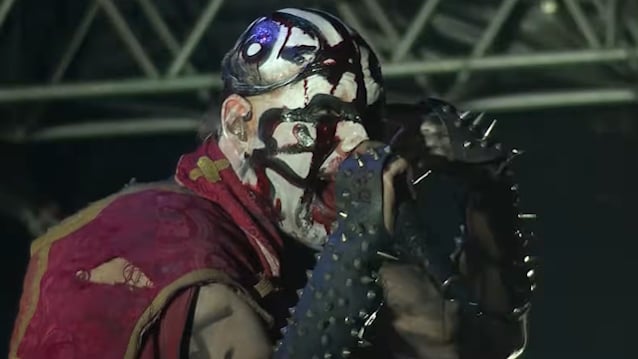
MAYHEM's ATTILA CSIHAR Confronts His Mortality On 'Liturgy Of Death'
February 4, 2026By David E. Gehlke
Recent chatter from founding MAYHEM bassist Jørn "Necrobutcher" Stubberud suggested there's an expectation that the long-running, infamous and highly influential Norwegian black metal outfit will survive long enough to celebrate their 50th anniversary in 2034. It's not an unrealistic idea. Since 2012, the band has maintained the same lineup: Stubberud, drummer Jan Axel "Hellhammer" Blomberg, vocalist Attila Csihar and the guitar duo of Teloch (Morten Bergeton Iversen) and Ghul (Charles Hedger). The air of controversy and chaos no longer follows the band around: unless you're counting the half-dozen enduring quotes Stubberud made during the promotion for the 2018 movie "Lords Of Chaos". Instead, MAYHEM is a regular international touring entity that has been on a creative upswing since 2014's "Esoteric Warfare".
The band's newest studio foray is "Liturgy Of Death", which, as the title suggests, focuses on mortality and the fragility of human existence. Such a topic feels at home for MAYHEM and long-time vocalist Csihar, whose inhuman vocal stylings and captivating stage presence are among this particular incarnation's defining factors. The Hungarian Csihar, who provided vocals on MAYHEM's legendary 1994 "De Mysteriis Dom Sathanas", then re-joined a decade later, is now the band's driving visual and spiritual force. He can also pontificate on a number of items, which is why BLABBERMOUTH.NET hooked up with him for a chat.
Blabbermouth: Necrobutcher recently said he doesn't wish to slow down, he wants to keep going. Where are you on that front?
Attila: "The pandemic was very bad for us. The last album came out [2019's 'Daemon'], then it happened. Since then, yeah, we've been touring a lot. I don't have any other plans anymore. [Laughs] I used to do stuff other than music, but now my whole life is music, and I'm very thankful for it. I hope it's going to be with MAYHEM or my solo project, I'll do until the end, VOID OF VOICES. It's my solo experimental project. I hope MAYHEM has another five years of promoting the new album ahead of us. We'll do another one, the last one, but this could be the last. We always feel like it could be the last, then we do another. We'll see. For sure, from my side, knock on wood, I feel like I'm in good shape. The last tour was the 40th anniversary tour, when we did a two-hour set, which is pretty challenging when you play black metal. At least for Hellhammer and me, we have the most physical jobs on stage. We're running a marathon, but I'm exercising and training every day. I'm even straightedge. I'm doing planks every morning to strengthen my core. It's very good for vocals. It's good to have those muscles, so I don't have much of a bubble in my head when I do long screams. I think we could go on. We'll see."
Blabbermouth: "Liturgy Of Death" centers on mortality. So, along those lines, do you think about it much?
Attila: "That was a topic that came to me via my channels, so to say. It's not like I planned it. I don't have a list of topics, so I'll pick one. No. I was meditating, and it came to me somehow. I thought it was maybe the biggest challenge. Death itself, the topic, is so intense if you think about it. It's everywhere, like in art, mythology, philosophy and even religion. I'm 55 now. Somehow, I feel like I've grown up for this topic. We've had people in this band pass away, so it's made sense in every direction, but to me, I don't know, I'm thinking about it every day. A little bit. Not all the time. I'm not a dark person, but when it comes to art and MAYHEM, of course, I am. During the day, I like to balance it with some light too. [Laughs] It's an example: I'm here in my son's place in California. I was there when he was born. I was there in the room when he was taken out of the womb. I never forget the thought that it's a majestic moment; it's unbelievable. I had this thought: Hold on. Life is not starting now. He was alive five minutes before, an hour before, or a week, a month, or you go to the fetus, then the egg and the sperm. Where is the beginning? We come to this world from somewhere else, which is the womb. In a way, if you like, it's another dimension. You're in a living thing, another thing. Every mother is a holy mother to me. We all come from the womb. I understand this. Every mother has suffered from this. It's not just a thing. It's very interesting how painful birth is. We think it's beautiful, but it's painful. But the point is that we come from another dimension, but life didn't start there. It doesn't start at birth. You could say I've been living since the 29th of March 1971. No. I was living before. Also, I can't remember the beginning. It's very hard. That's when it started, and it's fading away.
"Talking about it, it's a daily thing, which is very simple and nobody thinks it's strange, but if you think about it, we may come from another planet. We go to sleep every night and wake up every morning. That's also a strange thing. It's the only thing we remember is what happened yesterday. It's impossible to catch the moment when you fall asleep. It's very difficult to catch the moment, it's a transition like the moment when you wake up. Somehow, you're half there and half here. Same with a baby. Physically, it's here, but the mind is somewhere else. Also, when people die, their minds are slowing down. Sometimes they lose their minds, and they're somewhere else. Also, another interesting thing: It wasn't long ago that I was home when my electrician came over. He's a construction guy and was fixing my electricity. We started talking about reincarnation. I was like, 'Excuse me. What are we talking about, bro?' He thought I was one of the few people he could talk to. He told me he had an electric shock and he was five minutes in a clinical death. He was talking about the same thing that other people talk about: the end-of-life experience. He was flying into the sun; it was a tunnel. At the other end, it was another dimension; very peaceful and great. He didn't want to come back. He had to come back. Since then, his life has changed, and he has become a certain kind of believer. I was like, 'Whoa, man. That's super interesting.' All of these topics, somehow, like for me, that's what death is about. Also, the lyrics, I know, are super imaginative. This is a MAYHEM album. There has to be that aspect. I also think that in the lyrics, it's the end of the misery. It's the end of the suffering. It's the end of the confusion in life. It's the end of the pain, which your body might experience when you get older. A lot of people have it. Also, compared to birth, if you think about birth, birth is always very painful, extremely painful, like mothers used to die in giving birth. Or children did sometimes, but when you die, sometimes it's painful. Sometimes, people just fall asleep and don't wake up. It doesn't look that painful. All of these things came to me when I started this topic. That was a basic idea of writing about this, this topic, this theme. It's so universal. Every human being, I think, has to face this question one day. I think it's one of the most universal themes I could come up with. It's really deep and profound."
Blabbermouth: Can you speak to the benefits of working with Teloch and Ghul? What does their songwriting bring out in you?
Attila: "I think we've gotten very closer and better. I think this is the longest lineup we've had. It's really amazing. On the last album, I asked everyone to contribute to the lyrics. I wanted to make a unity, like a spiritual unity. This time, we went back to our traditions, and I handled the lyrics. Ghul and Teloch, or Charles and Morten, handled the music's composition. It took a long time, three years to make this album. We took it easy. It's not constant work since we were touring and doing stuff all the time. I think it was three years ago when Charles was sending me song ideas. I made some demos and sent them back. We don't rehearse as we did back in the day, as I did with my first band, TORMENTOR. We were rehearsing every week for at least three days for a year before we went to the studio. Even this phone I'm holding can record stuff. It's almost a mini studio. That's crazy. We all have recording facilities back home, and we record each other's stuff. We share ideas and shape songs, and it still takes a while."
Blabbermouth: You've been on albums with (founding MAYHEM guitarist) Euronymous (Øystein Aarseth),then (MAYHEM guitarist from 1994 to 2008) Blasphemer (Rune Eriksen) and now these two. Has it prompted you to change your vocal approach at all?
Attila: "We started with the theme, then I sent some sketches. We sent some ideas, and they started to compose songs. We just sent the demos back and forth, shaping and throwing away ideas and bringing in new ones. Toward the end of the recording, I became closer to the studio time. It got more and more intense, this work. I put some limits on pressure, which is healthy. Then the work got intense. Even the studio work, a few things changed. Sometimes, changing a little bit can have a big effect on a song. Actually, I can't foresee whether each song will be better than the other. It's never, 'Okay, let's make three good songs and the rest will be whatever.' I bring full intensity to all of the lyrics: everything. It's hard to see how it will turn out in the end. Even now, when they ask me to pick a single, which should it be? I was like, 'Dude. I don't know. You guys should pick.' Same with live songs. I don't really have any preferences. For me, all the songs are equal at the moment. It's too soon. Honestly, I don't listen to much. I needed a break. When we made the album, I listened to it a few times. When I do something, I like to leave it behind. It's my philosophy. I like to let it go on its way. They are like my babies, my little demon children. They are all watered, the plants, the same way. Music is my passion. I listen to my music all the time. I have a nice vinyl collection and a hi-fi stereo. I put on a vinyl, and I was listening, going, 'This is cool. It's not bad.' Turns out, it was me. [Laughs]"
Blabbermouth: Do you recall which album it was?
Attila: "I can't tell you! Some bands ask me to do guest vocals. That time I heard it, it was probably me, and I didn't know what it was. Another time, it was [a project] with my friend from Germany. It's beautiful music. He had a guitar from the 1500s, or the Middle Ages. He played acoustic music, which was pretty interesting. I listened and said, 'This is okay. This is me!' But this other band, I didn't know. I was listening. I was like, 'This is cool!' Then I looked at the artwork and was like, 'Holy shit! That's me.'"
Blabbermouth: While on that note, you have done a remarkable amount of projects over the years. Going back further, though, it was a pretty big deal that you, a Hungarian vocalist, were hooking up with a Norwegian band.
Attila: "It was something else. I didn't know about MAYHEM. I had TORMENTOR. We were kind of famous in Hungary. We had many shows in the '80s; MAYHEM was not so active. They weren't playing too many live shows, as far as I know. TORMENTOR was like the SEX PISTOLS, lots of small clubs; chaos. There was no security. People would burn vinyls, fights, there was no security. I don't miss that at all. There were broken noses and fights. We were proud of it! [Laughs] Like, 'Dude, this is crazy.' I came from that. Then, we were drawing a thousand people at shows in Hungary. TORMENTOR was my high school band. High school black metal. When I joined MAYHEM, the first thing I heard from them was very strange. My name was 'Mayhem' in TORMENTOR. That's why I'm Attila now. I was like, 'That's such a strange omen.' I was like, 'This is something special.' Then I heard more about the band, and I figured it out; it was something serious. For me, Norway was so exotic, since I am from Hungary, an ex-communist country. The system fell. I remember I was reading in an encyclopedia. There was no internet. That's how I had to learn about the country. I looked at the map and the shape. I knew about Sweden because BATHORY was a big influence. Norway, I didn't know much about. The scene was very small, very underground. I remember when Euronymous sent me the tapes. We had been talking since '91. It took some time. First, he sent me 'Deathcrush'. I was like, 'Okay, this is cool. It sounds punky.' I thought, 'Okay, I've been there with TORMENTOR.' I was already doing PLASMA POOL, my dark electronic band. I was interested in it. I was like, 'Why not?' It was such a huge deal for us. The scene was totally different than today. For me, going to Norway or getting in touch with a Norwegian band was a big deal. Euronymous sent me the tapes for the 'De Mysteriis' [Dom Sathanas] album, I thought, 'Holy shit. This is something I've never heard before.' Now, it's old school. But then, I never heard any drumming or anything like that. I thought the scene was dead, which is why I had PLASMA POOL. I didn't know it existed. I was listening to SLAYER and SEPULTURA, but it was something different, something really majestic. Of course, no one could have foreseen it would have gotten that big or important."


 Prev
Prev 