


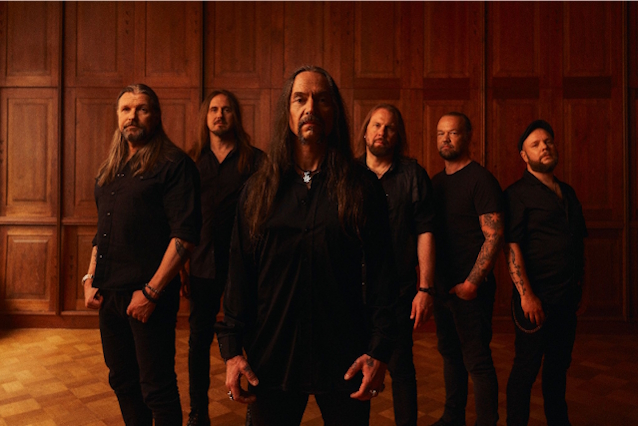
SANTERI KALLIO And TOMI JOUTSEN Discuss Why AMORPHIS Took A 'Leap Into The Unknown' On New Album 'Borderland'
September 23, 2025By David E. Gehlke
AMORPHIS is on album number nine of the Tomi Joutsen era. What began with the 2006's world-beating "Eclipse" has spawned at least another world-beater in 2015's "Under The Red Cloud", with the remaining LPs bearing the Finns' now indelible stamp of progressive, melodic and slightly melancholic metal. It's a brew that only AMORPHIS can concoct, yet the band remains one of the few willing to place immense responsibility upon their producers. After three albums with renowned Swedish knob-twiddler Jens Bogren, AMORPHIS has drafted the well-established Dane Jacob Hansen (ARCH ENEMY, EPICA, VOLBEAT) to man the controls and steer the ship for their 15th studio album, "Borderland". And with a change in producer comes another mild alteration with AMORPHIS — the experimental, sometimes ponderous nature of 2022's "Halo" has been replaced by catchy, dare we say "poppy" numbers that cover "Borderland".
The fact that AMORPHIS continues to find ways to challenge itself shouldn't be lost on anyone. They are, after all, responsible for 1994's groundbreaking "Tales From The Thousand Lakes" and its brilliant 1996 successor, "Elegy", two albums that turned the Finnish metal scene on its head for wielding folk in a way like never before. After experiencing a natural rough patch circa 2003-2004 following the release of "Far From The Sun", AMORPHIS has yet to disappoint since then, something that remained top-of-mind for Joutsen and keyboardist Santeri Kallio when BLABBERMOUTH.NET caught up with them for a chat.
Blabbermouth: Jens had become such an integral part of the last few records. What made you switch over to Jacob Hansen?
Tomi: "I thought Jens wasn't going to do albums anymore. Maybe that's one reason why we started to think about someone else to do the latest AMORPHIS album. Of course, Jacob has been working with VOLBEAT. We are friends with those guys, and we heard some good things about Jacob [through them]. We chose him because he's really friendly and an easy-going guy. He also got a great sound for us."
Santeri: "I think Jens already said after 'Queen Of Time' that he's going to stop producing and concentrate on the plug-ins, but he didn't. From my perspective, doing three albums with one producer is enough. 'Under The Red Cloud' was kind of the 'get to know each other.' 'Queen Of Time' was 'now I know the guys and I'm going to set up the fire.' After that album was so successful, 'Halo' was a more experimental album. I think all the tricks with him were used. The band needed to freshen up and bring something new to the table. It was kind of obvious that one way to do it was to change the producer and find some new winds to push us to the uncomfortable zone, if you know what I mean. We didn't ask that much about Jacob. We knew a few bands that he had worked with, but we really didn't investigate them. We thought that he's Scandinavian and he's done pretty good sounding metal; everybody likes his sound. We took a leap into the unknown and changed producers, hoping for the best. Let's see if it paid off. The band is happy with the album. The label and management are happy. To be honest, all I care about is what the people think about it when we release it."
Blabbermouth: As you noted, albums like "Queen Of Time" and "Halo" were progressive and experimental. The line from the bio, then, of 'This is the most AMORPHIS sounding record yet' rings true, don't you think?
Tomi: "Jacob picked the songs for the album. We started with 25 songs for the album, so we gave him free rein to pick the songs he liked the most. If you are listening to the whole album, you have to thank Jacob. [Laughs] I guess you are right: It's not that progressive of an album. You don't have to listen to it 15 times before you can form an opinion about it. It has really catchy songs, and some of them are quite poppy, to put it that way. I think it's a good one; it's good to have really catchy songs for the new albums and also for the fans who have been following us for many years. We are not doing anything completely different on this album. When you listen to it, you can recognize that it's AMORPHIS. We didn't want to change the formula that much. In general, we don't think that much about albums beforehand. We go with the flow. At this point in our careers, everyone trusts each other. Whatever we do together, it sounds like AMORPHIS."
Santeri: "We didn't try to reinvent the wheel. We have a Google drive for the demos. There were 25, as Tomi said, from Olli [Pekka Laine, bass], Esa [Holopainen, guitar], Tomi [Koivusaari, guitar], and one from Jan [Rechberger, drums]. However, even at that time, we had some sort of mutual understanding or feeling that all the songs were more melodic and straightforward compared to 'Halo'. Maybe everybody unconsciously knows that 'Halo' was the end of a certain era and tried to move toward fresh, surprising elements, but still, we want it to sound like AMORPHIS. All the music was actually sounding like AMORPHIS. We may have veered slightly back to the melodic side. I wouldn't say 'poppier,' but the catchier style of the 'Skyforger' era, with new elements like the grooves and patterns that we weren't using back then. It's very melodic compared to 'Halo'. That's a positive thing that we didn't try to continue from 'Halo'. It was an opportunity to find a new direction for the music, and by the song selections, sound-wise and song-wise, Jacob found these elements for us. The new album sounds way different than the previous."
Blabbermouth: Who wrote "Dancing Shadow"? It's like AMORPHIS has gone disco.
Santeri: "I thought it was pretty groovy, but Esa has always written those kinds of songs, like 'The Smoke'. That was a groundbreaking thing. There was a disco beat in the chorus. Also, 'Towards And Against', I think it was on 'Silent Waters'. Esa has, now and then, brought disco vibes to the pile. This time, the demo was titled 'Disco Tiger', which ended up as 'Dancing Shadow' on the album because of Jacob. We like to experiment; I think it's a great, great, great party song."
Tomi: "I listened to the whole album earlier this morning. I wanted to do my homework because I haven't listened to the album that many times. [Laughs] I did it before we had some listening sessions with the media, but I haven't listened to it that much then. I took some notes while listening. I put, 'It's like disco or a rollercoaster.' It has the feeling like you're going through something interesting that's not that fast, but like a trick, in a way. It's a really diverse song."
Blabbermouth: Tomi, do you find this one to be more vocal-oriented than "Halo"?
Tomi: "Maybe it is vocal-oriented. I think the keyboard is a little bit more at the forefront. You can really hear what Santeri is doing. That's not a new thing, but it's something you can find in this album. I had to work a lot for this album, but it's nothing new. It always takes a lot of time and nerves to record a whole album. [Laughs] I did some pre-production here in Finland and recorded all of my stuff here as well. It's not the wisest or smartest way to work like we do. Pekka [Kainulainen] wrote lyrics for us, and then we had to translate everything into English, and then we had to arrange the music and lyrics together. I had to practice a lot. I had to compose a lot of things and think about where I should put growls and where I should use clean vocals. It's fun, but it takes a lot of time. It's nothing new if you are in a band. You have to work a lot. It's like a trick. You don't know where it will go. A lot of things happen when you are using emotions, and you have to be really open-minded or open when everything is happening around you."
Blabbermouth: The Finnish language is a tricky one. It must take a lot of work on the translations.
Tomi: "It's a difficult language, Finnish. When you're translating stuff, you always lose something. If you are using a lot of Finnish words, it's almost impossible sometimes to translate them straight to English. But we have a talented guy called Ike Vil. He's a Finnish singer. He was very active and remains active in the music business here in Finland. He's really into vocal stuff and all the weird stuff. [Laughs] He's a perfect match for us as a translator. When he's translating stuff, he thinks about how the words work when you are singing them. That's a big help for me. I'm really proud that we're continuing cooperation with Pekka because he's doing great and beautiful lyrics for us. There are always big emotions, and he always wants to put something important on the table. He's really honest. He's really into 'Kalevala' and all the other folklores coming from Finland. With music, it's great and beautiful; we must have beautiful lyrics behind the music."
Santeri: "People say the Finnish language is almost as tricky as Mandarin Chinese. Yes, as Tomi said, we probably lose something in translation when the text is translated into English, but as he mentioned, we used a professional translator. I think he has written some books and is also a singer. It's a big help because I don't think that much is lost because of him. He knows how to present things in English. The stories are there. Then, when we encounter difficult words, I have to look them up on Google. [Laughs]"
Blabbermouth: I was surprised to see a song titled "Despair". You've always had a melancholic element to your music, but you've never taken it as far as other Finnish bands.
Santeri: "It's the Finnish mentality to talk pretty openly about things without being too obvious or being fake. We always try to create powerful atmospheres, like this time, which is particularly melancholic. It also gives you the feeling that you want to listen to the album again because it's so moody and atmospheric. I don't find any better place for that song than at the end. It gives you a moody feeling. I wouldn't say 'excited' is the right word, but I call it 'moody.' Melancholy is totally normal for Finnish people and the nation. We like the dark side of life a lot."
Tomi: "I think it's a great ending for the album. I think it was during the listening session when one reporter said she started to cry when she heard this song. I think it's really beautiful and tells that it's an emotional song and there is something real happening."
Blabbermouth: We're now a little over 20 years since Tomi joined the band ahead of "Eclipse", which blows "Far From The Sun" out of the water. What's your first thought when the year 2005 is mentioned?
Tomi: "Of course, I was really nervous about joining the band. We did some shows and tours before we recorded 'Eclipse'. I already had some experience working in AMORPHIS. Still, when I entered the studio, I was shocked. [Laughs] It was a costly, high-quality studio, and the producer was Marco Hietala from NIGHTWISH. It was a somewhat unusual situation when you come from a small city with a limited music scene and you go to a professional studio for the first time. At the same time, I had some experience with other bands before AMORPHIS. I knew that I could do both clean and growled vocals. That's something I wanted to do in AMORPHIS. 'Far From The Sun', AMORPHIS was more like a clean-singing band. I wanted to bring the growls back. For me, that's the most powerful way to express myself. After 'Eclipse', it's been easier, of course. It was a great album. The fans also loved it. I knew that I could be the frontman of AMORPHIS."
Santeri: "It's not a secret that the band was not happy with how 'Far From The Sun' and how much effort Pasi [Koskinen, vocals] was putting into the band. I was really happy that he left, but, on the other hand, we were in big trouble. We were at the bottom of our career, and we didn't have a singer. Then we shut down the record deal with EMI Finland because they couldn't handle any distribution outside of Finland. They took care of Finland quite well, but they didn't have any connections anywhere. That's the first and only time we've been on a major label. Then we did the worldwide search in magazines and listened to fucking two big bags of demos of singers. We read their bios and checked out their photos, but we couldn't find anyone suitable for AMORPHIS. Then, through one of our friends, Tomi was introduced to us. He came to our rehearsal studio. It changed the whole career of the band. He's the right person for AMORPHIS. He got what we were doing. He is a phenomenal growler and a good singer. So, everybody thought that 'Now we have a chance to put the band together and keep our career going.' We've said many times, 'We don't plan on how we make the next album. We don't talk about the music.' At least from me, and I've been around since 1998. The guys have said the same thing. That's the only time we talked about the music before 'Eclipse'. Because Tomi said he would like to growl. We didn't have the growls, well, 'Tuonela' had one song with growls, but 'Am Universum' and 'Far From The Sun' didn't have any. That's the only time in the history of the band where we've talked about it: 'Yeah, please. Growl. Let's do metal again!' Those were interesting times. We were all shocked when 'Eclipse' topped the charts in Finland. It went Gold after that, then our spare time was devoted to touring. It changed our career."
Photo credit: Sam Jamsen


 Prev
Prev 