


Veteran Guitarist IRA BLACK Sets His Sights On World Domination With APOCÆLYPSE
October 20, 2026By David E. Gehlke
It's not uncommon for guitarist Ira Black to play MORBID ANGEL's "Maze Of Torment" one night in I AM MORBID, then throw down DOKKEN's "In My Dreams" another. In an era when utility and reliability are of paramount importance, Black ranks among the most called-upon guitarists in metal and hard rock. His CV also includes his active role in DIO DISCIPLES, along with previous stints with BULLETBOYS, LIZZY BORDEN, METAL CHURCH, VICIOUS RUMORS and VIO-LENCE, among others. Yet, for all of the woodshedding and globe-trotting Black has done, he had yet to stake out on his own until very recently with his new band, APOCÆLYPSE.
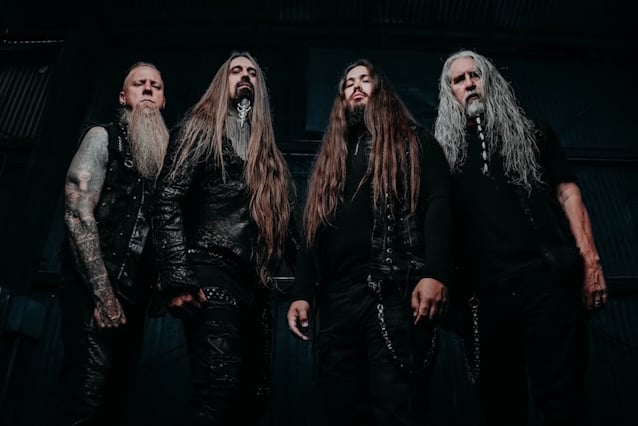
Joined by his son and second guitarist Ira Black IV, ex-FIVE FINGER DEATH PUNCH bassist Matt Snell and former KILL DEVIL HILL drummer Lonny Pasillas, APOCÆLYPSE is a modern, big chorus-heavy romp that is already scoring the band some followers on Active Rock Radio. It's a long-overdue happening for Black, who is also handling lead vocals in addition to his regular guitar duties. With their debut "FÆNIX" making the rounds, BLABBERMOUTH.NET caught up with Black to learn more about his journey, playing in a band with his son, artificial intelligence and whose material is more difficult to play: MORBID ANGEL's or DOKKEN's.
Blabbermouth: You're always that dude who gets called on to help out other bands. Why start APOCÆLYPSE now, especially at this stage in your career?
Ira: "Being a guitar player for 44 years and an avid songwriter, I've always had that desire. I can play so many different things, but it's been a matter of, 'Which direction do I go in?' So I get a little lost in that sometimes over the years. Then, a lot of times when I get something going, I get a call to join a big band, and it pulls me away. That's happened a lot. The pandemic was a turning point for me, like, 'This is where I'm going to get my studio together. I'm going to be locked away at home. I'm getting my studio together. I'm going to crack the code.' That was my first idea: 'I'm going to figure out how to crack the code on getting my own sound.' And I started going, 'God, I'm really learning how to make great sounds.' Then I started dabbling in singing and found a way to sing for myself that really worked. I was hitting the notes, but it didn't sound that good. Then I was like, 'What is missing?' I stumbled upon the idea that if I sing from the heart, if I sing with meaning, with passion, with feeling attached to it, then all of a sudden, it was like, 'That's me.' And that just blew me away. I thought, 'I can do this.' And I had a few people along the way say, 'Hey man, you should try it. I've heard you do a little bit of this and that.' But it really came down to the pandemic. I had that defining moment. I can remember how I felt. I literally broke down in tears because I was like, 'Oh my God!' And it was funny because the biggest part of the realization was like, I already do that playing guitar. I play with feeling. Why didn't I think to do that with vocals? As long as I hit the notes, but the notes don't matter that much. It's really the feeling that people hear more than anything — and that's what I've learned to tap into. I always go there when I'm working on a song."
Blabbermouth: What made you land on this direction? It's very modern and song-oriented, but still a very heavy type of music.
Ira: "There were a couple of different things that led me to it. But I have this thing where I'm always like, 'I want to do something modern. I want to do something I haven't done before.' I listen to all different styles of music. Over the years, it's been a little bit at odds in my head. If I'm going to do my own thing, how do I take the fact that I'm an avid acoustic-guitar player and bring that into a metal project? How do I add some EDM? It was always confusing trying to figure out how to mix these things together. I'd dabble in it, but it would just sound kind of whatever. And I'm like, 'If I'm going to do this, man, it's got to make an impact. I want people to hear it and go, 'Oh my God, what is that?' That's always been my desire, to reach higher levels with what I'm doing. And like I said, during the pandemic, when I really started getting into producing, I began figuring out ways to intermesh my different styles and make everything sound like one thing. Like, 'Oh my God, everything is just epic.' So if I have a metal riff, but I add some EDM or programming in there, maybe even a blues riff comes out in the middle of this heavy thing, somehow it still sounds like me, or like APOCÆLYPSE, especially with the singing, obviously. But yeah, I really wanted to intermesh these styles, and I wanted to make sure it wasn't something I'd done before. I didn't want to put out a thrash metal record or a death metal record. I mean, I love playing thrash. That was really my forte more than anything. I love playing thrash because of the energy. But when it comes to my own record, I'm like, 'No, I have to have the balance of all the perfect things.' I want the chorus to hit so hard and be so catchy that people wake up singing it. I want the guitar riff to be the kind where a metal fan hears it and goes, 'My God, that riff is the baddest riff ever.' So I'm always striving to make every element I put together the best it can be, while still making sure it works within the song, too, of course."
Blabbermouth: I was surprised to see you go in this direction, given your pedigree. Then again, APOCÆLYPSE is a melting pot of everything you've done.
Ira: "Yeah, you could look at it that way. I mean, obviously, you can't take away your past. It's always going to be part of you. But for me, I was just like, 'I want it to be futuristic.' Look, nowadays you put on a metal record and kind of go, 'Okay, Cookie Monster vocals.' Then the second song sounds like part two of the first one. I didn't want to run into that, either. I wanted every song to kind of be its own standalone thing. Of course, I still wanted to have my own sound, where you go, 'Hey, that sounds like Ira singing,' or his songwriting, or his production style, whatever. But I really, truly wanted to make sure that when someone put on the record, it took them on a journey, kind of like the old days. Back in the '70s and '80s, you'd put on a record, and each song had its own thing going on, so I wanted to tap into that. I wanted to take people on a journey and not just do the same thing over and over again. I didn't want to be compared to other bands. I mean, it happens anyway because that's the nature of putting out music. People are going to compare you to something. But I was always forward thinking. I was like, 'I'm going to do something different and new.' I'm always going to strive to do that with this band. That's the mission statement."
Blabbermouth: How does your son get involved in this? How does he end up playing with his old man and his new band?
Ira: "To make it simple, from a very young age, I had joint custody of him. I'd have him for a week, and then his mom would have him for a week. So he became my little buddy. He wasn't just my kid. I was still doing music, and it wasn't easy. I'll probably write some music about that down the road because everyone was telling me, 'Hey, you've got to quit music. You can't keep doing music when you have a kid.' Especially because I didn't have that support system, I literally brought him on tour with me when he was six years old for a couple of months during the summer. I was playing with METAL CHURCH, and I brought him out on the W.A.S.P. , Stephen Pearcy [RATT], L.A. GUNS and METAL CHURCH tour. People were like, 'Dude, you're crazy.' And I'm like, 'Well, yeah, I'm in kind of uncharted territory, but I don't really have any other way to do it.' I just did what I had to do.
"He always had an interest in music. During his teenage years, he got a little more into hip-hop. Long story short, he ended up taking lessons at School Of Rock because my wife was managing it. I came back off tour, and suddenly he started playing LED ZEPPELIN and stuff. I was like, 'All right. Yeah. That's awesome.' Then he really put in his own time. We'd jam together sometimes. I'd show him some stuff, and he'd even show me stuff. But he put in the work on his own and became his own player. He started getting really good. He played in a couple of metal bands in Los Angeles. He even did a tour of Europe that I booked for them. He just filled in for Claudeous [Creamer] with POSSESSED, and he recently played a festival in Mexico with them. So he's really making his own way. This isn't a 'Well, it's my son, so I'm going to bring him in,' kind of thing. He's truly become his own guitar player. He's earned the right to play with me. Of course, I want him to do it because I love him and I want to hang out with him. But he really is worthy, and he deserves it. He's a total badass."
Blabbermouth: Who has the longer hair: You or your son?
Ira: "I might have an inch or two, but his hair might be a little bit healthier. [Laughs] I mean, he's younger; his hair is pretty thick. He's half Filipino, and he has a little bit thicker hair than I do. Each strand is a little bit thicker, so his hair is kind of, you know, pretty thick. But yeah, I mean, people say we look like twins and stuff sometimes!"
Blabbermouth: There's a heavy technological aspect to this record. How much is AI a consideration for you?
Ira: "I've always been a juxtaposition kind of person. I'm always balancing a lot of different things in life, so I tend to write like that, too. I have 'The Lamb And The Goat' and nobody's really used that title before. It's rooted in the whole biblical concept. It's Jesus versus Satan. And guess what? Satan came from Jesus. Somehow, it always comes back to one source. On the technological side, though, it's about humanity pulling away from religion. People always say technology is kind of the dark side of things, and we've definitely seen some of that happen. I remember the early iPhone days when all the apps were free. Now everything has a subscription, and we're all hooked on it. So is AI going to go in that direction? Of course, it's the trending topic of the day. Everybody's asking, 'What's up with AI?' A lot of musicians are resisting it. I'm not. I'm like, 'You know what? I'm going to embrace it.' If it can make life a little easier and help you navigate things, then why not? Now, I'm using it as a tool. I'm not using it as, 'Hey, make my career for me.' I've been doing this for a long time. I know how to do everything from A to Z. Can AI help me a little bit here and there? Sure. Why not?"
Blabbermouth: If it can help Ira Black do something in 20 seconds versus two hours, then maybe that's the advantage there.
Ira: "If you remember when digital recording first came out, people were freaking out. 'Oh, my God!' And in some ways it did kill certain things, but it gave us a lot of benefits, too. Just look at the editing you can do nowadays and the convenience of having your own studio that doesn't cost a million dollars. You're not spending two hundred thousand dollars making a record while watching some guy mess around with two-inch tape all day. I mean, there are still bands that do it, but those days are largely a thing of the past. They always have that question: 'Are you a boomer?' My son says that sometimes because of the generational gap. The boomers are definitely more anti-AI, and I get it. Nobody wants to kill creativity. But on the other hand, do I have one thousand or five thousand dollars lying around, especially with inflation, to pay someone to do my album cover? Or can I perfect a prompt and get my album cover exactly how I want it? Maybe it'll still take me a few days to get there, but I can. And yeah, there are debates about that. I'm just not going to worry about it. It's like, listen to my music. I'm just trying to get it out there so I can play live. Maybe in the future, if I make a sizable chunk of money, I can turn around on the second record and say, "Hey, let me pay an artist to do it." I'm totally good with that, too. But right now I'm focused on launching APOCÆLYPSE, and whatever it takes to get from here to there, I'm doing it. Whatever that process looks like, I'm committing to it. I'm not looking back. I'm just going for it."
Blabbermouth: Is this type of thing you plan on taking on the road? What's the approach going to be?
Ira: "Oh, yeah, 100 percent. We're already having conversations about opportunities for next year, including potential European festival appearances. My attitude is to jump into this as quickly as possible and keep building momentum. My wife, Jessica Chase, works with FM Music Management and is managing the project. They have a strong network and work with bands like TESTAMENT, EXODUS and DEATH ANGEL, so we're connected to a lot of great agents and industry contacts. The plan is simple: keep pushing forward and get this music in front of as many people as possible. My goal is world domination. I say that half-jokingly, but there's truth to it. I've spent a lifetime learning this business, and now I want to put all of that knowledge and experience to the test. I want to see just how far I can take this project. So far, everything seems to be moving in the right direction, and that's exciting."
Blabbermouth: Flipping back to all of the work you've done over the years: Are you on speed dial for a lot of bands?
Ira: "That's definitely a thing for sure. [Laughs] And I kind of want to start to limit that. I mean, if DOKKEN calls me, I have to do it because it's DOKKEN. I love DOKKEN. I love playing that music. It would only be, you know, like maybe ten shows or something like that. So I'm like, 'Okay, let's do it,' but I'm launching APOCÆLYPSE to be my thing. I want to go out and do full-blown tours. If I can stay on the road for six to nine months in the beginning, I'd be happy with that because I really do want to truly push this and launch it and show people what this looks like live."
Blabbermouth: Let's wrap with this: Whose material is more difficult to play: Trey Azagthoth's [MORBID ANGEL] or George Lynch's [DOKKEN]?
Ira: "It's an interesting question. The thing about I AM MORBID was that Dave [Vincent, bass/vocals], right out of the gate, goes, 'Look, I want you guys to play the songs the way that I play them.' So we all have this certain tightness. If you noticed that, the way we did it was more of a kind of tight unit thing. Trey is a little bit looser — you know, I always call him the 'Eddie Van Halen of death metal.' He writes these cool, really interesting riffs, but he's pretty loose about it. We were a little tighter in the way we played; we were locked with Dave, and we really made a point of that. But the other thing was Dave was like, 'Hey, do your own solos, guys. I don't care.' So I wasn't really trying to recreate what Trey did, but I did every once in a while, a little piece here and there. Bill [Hudson] was a little bit more than I was because they're sort of signature pieces.
"Now with DOKKEN, I approach it like, 'I'm going to play this exactly like I grew up listening to it. I'm going to listen to the records, and I'm going to try and get as close as I can to nailing all the solos and the little details, the right pitch harmonic, the right time and the right slide.' If I go to see DOKKEN, that's what I want to hear because George has a different approach; he just tears his own songs apart. And that's fine; I know why he does it, because he's bored with playing the same thing over and over. He's been doing it for 40 years, so he wants to experiment within the context. But for me, if I'm going to fill in for a couple of months, I'm going to go in and just nail the stuff. And I did get a lot of compliments from fans going, 'Dude, thanks for playing the songs.' So that's cool. What's harder? I don't know. Probably for me, it's DOKKEN because I really got into the headspace of Lynch's parts the best I could."


 Prev
