


SIGH Prove Why They're Still Japan's Most Enticing Extreme Export On 'Goh-Ka'
October 15, 2026By David E. Gehlke
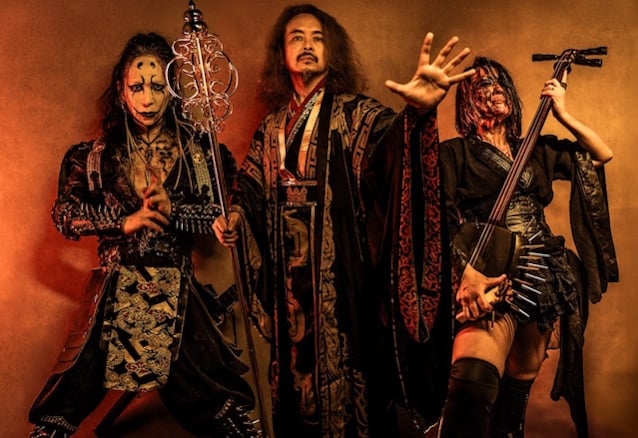
Japanese extreme metal innovators SIGH recently released their 14th long-player, "Goh-Ka". The main theme is "Kuso-zu", a series of Buddhist paintings or illustrations depicting the nine stages of a human body's decomposition after death. This time out, founding member, vocalist, songwriter and multi-instrumentalist Mirai Kawashima is joined on "Goh-Ka" by core members Dr. Mikannibal (vocals/saxophone, who is also married to Kawashima) and Nozomu Wakai (guitar),along with guests Frédéric Leclercq (bass, KREATOR) and Mike Heller (drums, RAVEN),the latter of whom has a massive impact on the proceedings. "Goh-Ka", as with any SIGH effort, matches the band's innate weirdness with the sheer scale of its compositions, which, as anyone familiar can attest, leap multiple genres in a single song. "Cinematic" has often been jostled about to describe SIGH, and across "Goh-Ka", the band fleshes out avant-garde scenery with classic metal potency and a flair for the exotic.
SIGH were a true original when they emerged from the Japanese metal underground in 1990 as one of the first true representatives from their country. Their discography remains unparalleled in its experimentation and variance — from forerunning black metal to dalliances with classic metal to anything else under the (rising) sun. Thirty-six years since their formation, one thing remains true: No one is like SIGH. Here is Kawashima, chatting it up with BLABBERMOUTH.NET on "Goh-Ka", Heller, the band's up-and-down record label experiences, and why bringing his children on tour is more important than sending them to school.
Blabbermouth: When did the shift away from classic metal begin? It was so prevalent around the late 1990s and early 2000s with "Scenario IV: Dread Dreams" and then "Imaginary Sonicscapes". Was it somewhere around "Hangman's Hymn" or "Gallows Gallery"?
Mirai: "'Hangman's Hymn' was almost like a 'backlash' album toward 'Gallows Gallery'. Back then, the reactions were pretty bad. I guess it was a mixed bag, but most fans and critics probably didn't like it. 'Hangman's Hymn' was a backlash; I wanted to make a more straightforward, harsher album than 'Gallows Gallery'. 'Hangman's Hymn' is much more straightforward and less varied than other SIGH albums. I only used extreme thrash metal and German classical music. Nothing else. I think it's quite a different album."
Blabbermouth: I remember you had a great quote for a while: "You can't write extreme metal music if you're not listening to it."
Mirai: "People may think I take in every kind of music, but I only use the music I love. I never try to incorporate anything I don't like or listen to. I just love heavy metal, classical music and jazz. I love the elements. That is a philosophy."
Blabbermouth: Is that what you're still listening to today?
Mirai: "Yes. I work for record labels. I have to keep up with today's heavy metal scene. I still listen to extreme metal, even though I'm 56. I have to keep up."
Blabbermouth: Do any newer metal bands excite you? Or do you fall back on the classics?
Mirai: "I'm mostly into the classics. I listen to a lot of the '80s thrash metal stuff. We were touring with DEVIL MASTER from the U.S. Their new album ['Bloody Dreams'] is classic. I mean it! It's one of the most original and unique things I've heard. I love DEVIL MASTER for sure."
Blabbermouth: How did you land on the theme of decomposition for "Goh-Ka"?
Mirai: "The main theme of the album is 'Kuso-zu', which is a traditional Buddhist painting that depicts how a corpse rots away, which is the essence of Buddhism: Nothing lasts forever. Even a beautiful woman can get ugly when she rots away and dies. You shouldn't stick to anything. You shouldn't stick to life; you shouldn't stick to beauty. I've been obsessed with a fear of death since I turned 50. I'm still full of it. I try to soothe it; it's very hard. I was pretty much impressed by the Buddhist philosophy. I'm still trying. I'm still scared of death. That's what impressed me and what I wanted to make the centerpiece of the album: Nothing lasts forever."
Blabbermouth: When you put out the first single, "Unputenpu", it felt like "Goh-Ka" was going to be an uplifting record. Evidently, that's not the case, right?
Mirai: "Some people say it's a happy song, but actually it is not. It is about how your life can be very cruel all of a sudden. I'm doing an interview right now, but I could die right after this. Sometimes you have to go through that kind of misfortune, so the song is about the cruelty of life. It's not a happy song at all. But yes, I think some parts of the album are very beautiful, especially toward the end. Sometimes it may sound uplifting, but I usually do not intend to make something that is very uplifting. But something like 'Unputenpu' has a traditional Japanese festival sound with Japanese taiko drumming. It may sound happy to Western ears, but my intention was actually a bit different."
Blabbermouth: Mikael's (Åkerfeldt, OPETH) solo on the song is fantastic. Did you give him any suggestions?
Mirai: "Nah. I didn't give any instructions at all. I think we share the same musical background. We both loved prog rock from the '70s. We both loved those kinds of vibes, so probably no instruction was needed. He just nailed it without any instruction or explanation at all. He was the perfect choice for that."
Blabbermouth: Did you guys go back at all?
Mirai: "Yes. I forgot how we met, but actually, OPETH came to Japan this year. Then I was thinking about the solo for the song 'Unputenpu', and I heard from Mikael, so I thought it would be a good idea to ask him to participate. OPETH comes to Japan every few years, so, yeah, I know him quite well."
Blabbermouth: Do you want to talk about Mike Heller's drumming? His work on the album is really impressive. He colors the songs in ways you wouldn't expect.
Mirai: "Mike is probably one of the craziest and greatest drummers in the heavy metal scene right now. And I'm not a drummer, so I don't think it's a good idea to give instructions to the real drummer. So it's probably best to let him do what he wants. It's been working very well. This is the third album with Mike Heller. He did 'Shiki' and the re-recording of 'Hangman's Hymn'. Every album has worked perfectly. This time, I didn't give him any instructions again. I let him do as he wants, which is the best way.
"I always make a demo, and then I just keep listening to it until I think it's perfect. Then, I just give them the demo, and they are very quick. Mike sometimes finishes two songs a day on drums. And Fred is very quick as well. He sometimes finishes up the bass and sometimes the guitar. He does three songs a day or something like that. They are very efficient, and I think they know what they are doing and understand exactly what I want, so it's very good. When I worked with the previous guitarist, he took more than two weeks to finish one song, which is crazy and, honestly, very annoying. I don't know about the drumming, but our guitar riffs aren't very complicated. They're simple and straightforward, so you don't need two weeks to record one song. It's very easy to work with Fred and Mike. They always meet the deadline, and they work very quickly. I can trust them, both as musicians and as people; they're the perfect choice to work with."
Blabbermouth: Before all of this, Mike was a relative outsider to SIGH. It's not like you share culture since he's American.
Mirai: It's cool because the band is now a mix of cultures. Frédéric is from France, Mike is from the U.S., and we are Japanese. And, of course, heavy metal is Western culture, so it's a mixture of cultures from the very beginning. If it sounds too Eastern, even if it sounds too Japanese, I don't think it's a good idea. I think it's a matter of the balance between Western culture and Eastern culture, and it worked very well on 'Goh-Ka' and 'Shiki'."
Blabbermouth: Has there ever been a time when you thought SIGH went too far out?
Mirai: "'Graveward', because I overused the orchestral arrangement too much. Honestly, I don't like the guitar work at all, so that's probably my least favorite, which is why I didn't use any orchestral arrangement after that. But last year we did the 'Hangman's Hymn' re-recording, which is full of symphonic orchestration; that's changed my mind a little bit. So I started using some symphonic arrangement again. Of course, I didn't overuse it, but there was no symphonic arrangement on 'Shiki', but this time it came back a little bit."
Blabbermouth: If we can go back to "Goh-Ka", how much of the music is centered around the music? Do the lyrics ever come first, especially after you've developed a concept?
Mirai: "I don't care about the connection with the lyrics and the music that much. Whenever I write songs, I always make a demo and keep listening to it to see if it flows and fits the theme of the album. When I write songs, it is much more spontaneous. I try not to, probably especially from 'Shiki' to 'Goh-Ka'. I don't care about the connection between the lyrics and the musical themes. It's not easy because the theme is very, very oriental. It's a very Japanese theme. If I try to make them connect, I think the music will sound too oriental, too Japanese."
Blabbermouth: "Goh-Ka" is your third album with Peaceville. They seem like a good home for SIGH since they've not been afraid to sign some unorthodox bands. How's it been working so far?
Mirai: "Well, we've worked with a lot of labels, from Deathlike Silence, Cacophonous, Candlelight Records, The End Records and now Peaceville. I'd say they are the easiest to work with. They are very, very supportive. Even the cover artwork was the label owner's idea. He's very artistic."
Blabbermouth: Are you referring to Paul Groundwell?
Mirai: "Yeah, he just sent me some sketches he made himself, which is so great. He's very talented, and I've known him for 30 years now, since he was just a worker for Peaceville. He's a good friend of mine and very easy to work with. You know, when I worked with other labels, if I sent an email, I had to wait two weeks for a reply, but Paul is very quick; he just gets back to me very quickly. They are very supportive and easy to work with. Definitely the right label for us."
Blabbermouth: Has all of this put your time on Cacophonous in perspective?
Mirai: "Well, I'm sure that probably every band on Cacophonous had problems with them. The problem is that when Euronymous [a.k.a. Øystein Aarseth, MAYHEM] was murdered [in 1993], Deathlike Silence was gone. I was talking to Candlelight and Cacophonous. It was a choice between Cacophonous and Candlelight. But Cacophonous answered the fax faster. Back then, we didn't have the Internet. So you had to go to the post office, or you had to use the fax. Cacophonous answered faster, so I chose them, which was a big mistake. Later on, we signed to Candlelight anyway, but it was definitely a big mistake, and I should have signed to Candlelight."
Blabbermouth: It goes to show that things could have gone either way for SIGH, yet you're still here after 36 years.
Mirai: "It's crazy. I never thought, because when I was 20 or 21, a friend asked me, 'Do you think you will still be in the band when you're 30?' I just laughed at it. Back then, Cronos [a.k.a. Conrad Lant, VENOM] was in his 20s. I think Tom Araya [SLAYER] was in his 20s too. So it wasn't easy to picture you in an extreme metal band at 30. I seriously left it off. I never thought I would be in SIGH at 30, but I'm 56 now and still in the band, so it's crazy. Nobody was in their 50s in 1999. Everyone was in their 20s because thrash metal was the culture for young people, not middle-aged men. Things were totally different back then."
Blabbermouth: Speaking of which, you bring your family on tour and on stage with you. What's that like? Most musicians leave their kids at home.
Mirai: "Yeah, the parents are in the band, so at first that was the only way — we had to take kids on the road. At first, they were staying backstage and killing time, then all of a sudden, they said, 'We want to be on stage too.' We said, 'Okay, if you want." At first, they were just standing and holding skulls and things like that, but now they're both in brass bands. My daughter plays the trumpet; the boy plays some percussion. They have their roles on stage. It's easier for us. We have to take them on tour anyway, so it's good they have their roles here in the band. It's not easy, but probably it's easier for them. They're just kids. And we always suffer from jet lag, but kids can sleep anywhere, anytime."
Blabbermouth: How do they balance their education with touring?
Mirai: "I think now they're with us in Europe and actually the school has already started, but I think it's a better education to go around Europe rather than sitting in the classroom. I believe so. I hope so. And they meet a lot of different cultures, different people from everywhere. I think it's a good education for them."
Photo by Poka


 Prev
Prev 