


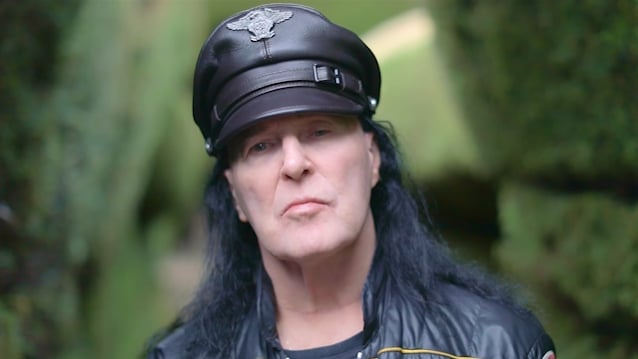
Original AC/DC Singer DAVE EVANS Looks Back On Band's First Show: 'It Was Packed To The Rafters'
December 28, 2025In a recent interview with Belgische Radio Unie, original AC/DC frontman Dave Evans was once again asked how the band got its name. He responded (as transcribed by BLABBERMOUTH.NET): "Well, we were trying to find a name because the guy that was gonna manage us at the time, he said, 'Look, I've got you a show coming up in two weeks' or something. 'You'd better get a name for yourselves because I've got a gig at the famous Chequers nightclub.' It was the number one nightclub in Australia. And so he said, '[You'd] better get a name.' So at rehearsals we were all tossing around names, and no one could agree with the other one. And I'd come up with a great name, but they didn't like it. And then Malcolm [Young, AC/DC's founding rhythm guitarist] would come up with a name, and I didn't like it. So we couldn't agree on a name. So we said, 'We've gotta get a name. So next rehearsal, we're gonna have three names each. We're gonna put them in a hat. And then we're just gonna pull one out and whatever the name is, that's gonna be the name of the band. 'Cause we've gotta make big posters up all over town for the Chequers nightclub.' We said, 'Okay.' So the next rehearsal, I had three names in my pocket, and we got to rehearsals. And before we could do that, Malcolm said, 'Oh, by the way,' [Malcolm and Angus Young's] sister-in-law, [their older brother] George's wife, I think [her name was] Sandra, 'She has a name that she suggested.' 'So what is it?' And Malcolm said, 'AC/DC.' And it was just went off like that, yeah. Because AC/DC is an easy name to remember. AC/DC, AC/DC, A-B-C-D. It's easy. And it means power — AC/DC, alternate current, battery, direct current, plug it into the wall. And I had an AC/DC record player that I could plug into the wall or take it down the park and be a hippie and sit in the grass and under the tree and be a hippie and play it on batteries. So that's what a AC/DC means. It means you can power it by batteries and take it wherever you want or be at home and just plug it into the wall. And I thought, 'That's great. It means power.' And I thought to myself — this is all going very quickly through my mind — and I thought, 'And we're getting free advertising all over the world because all these appliances have got AC/DC on the side of them.' AC/DC. Yeah. I thought free advertising, it means power, easy to remember. And I remember quickly going, 'Yeah, I like it. I like it.' And then Malcolm goes, 'Okay. What about you, [then-AC/DC drummer] Colin [Burgess]?' And Colin said, 'Yeah, I like it too.' And then, [then-AC/DC bassist] Larry [Van Kriedt], what do you think?' And Larry went, 'Yep. Okay.' So Malcolm said to us, 'Well, shall we call ourselves AC/DC?' And we all put our hand up like that. He said, 'Okay.' And we all shook hands. And he said, 'We are now AC/DC.'"
Asked if he still remembers his first concert with AC/DC, Dave responded: "Yeah, of course I do. You never forget your first. Anyway, yeah, I remember, of course. It was Chequers nightclub, the number one nightclub in Australia, and it was New Year's Eve, which was massive. It was packed to the rafters. It was just everyone, just crazy. And we had to go on at 11:30 on the 31st of December. So it was the 31st of December, 1973, and we're gonna go through midnight into 1974. And I [did the countdown], all that stuff, and blah, blah, blah. So I remember it distinctly because we didn't have enough songs. We had two sets to do. We were gonna do that one and another one. And Malcolm said, 'We haven't got enough songs. What are we gonna do?' And I said, 'Well, look, I'll make up some names of songs, and I'll just announce them during the set. We'll do the ones we know. Then I'll just announce a name.' I said, 'You just start jamming, and I'll make the song up on the spot.' I used to do that when I was a kid. I said, 'I can make songs up right now if you want me to.' It's just something I could always do, just make up a song quickly, and it just happens. So I said, 'I'll just announce the titles and you just start jamming something and I'll sing the song.' So that's what we did."
In the past, it had been reported that AC/DC got its moniker when Malcolm and his brother, AC/DC lead guitarist Angus, were hunting for a catchy name, and their sister Margaret saw the letters AC/DC on either her sewing machine's power adapter or on the back of a vacuum cleaner. The Young brothers reportedly thought it was a good name for their band, because "it had something to do with electricity, so it seemed to fit".
Dave recorded AC/DC's first two singles, "Can I Sit Next To You Girl" and "Baby, Please Don't Go". But in October 1974, less than a year after AC/DC's first gig, Evans was out of the band. He was replaced by Bon Scott, who sang on AC/DC's first six studio albums and became a legend himself after his death in 1980.
Evans discussed his stint with AC/DC in an interview with Brazil's Guarda Volume podcast. Speaking about the way his time with the band ended, Dave said: "We were very young — we were all very, very young. And our ambitions were forever. I didn't go, 'Oh, I'm gonna be in a band.' No. I had my whole career, my whole life to sing. I've been singing since I can remember. It ain't gonna stop because of a band I was with, I split from. I was in bands before AC/DC, of course. I was with bands before AC/DC. I split. VELVET UNDERGROUND [not to be confused with Lou Reed's group] I was with, a top band. AC/DC, Okay, I kept going. RABBIT, my own career. I never thought about splitting or stopping to sing. It was just another band I was with, but a very successful band. We had a hit record, 'Can I Sit Next To You Girl' was named as the best Australian group record of the year. First up. Great. Fantastic. It was a hit record. And to have a young band, first record, against all the other bands in Australia, [named] the best Australian group record of the year. That was fantastic. But there were different reasons why I split from the band, mostly because I wasn't getting paid any money."
He continued: "The manager was the third manager at that time. We weren't getting paid for the shows, and we were doing the biggest shows in Australia. The Sydney Opera House, the famous Sydney Opera House, Hordern Pavilion in Sydney, Festival Hall down in Melbourne, all the shows. Where's the money? Show me the money. No money. We toured with Lou Reed from the USA. [We played] the biggest venues, sold out — all sold out. How about some money? No money. So in the end, I couldn't stay with the band, because I was paying off my car in Sydney, paying my car off, my flat, and I'm working hard. So we had a bit of a meeting one night and had a few drinks and stuff. And the manager was there. And he was making money because he was getting money off the top. The rest of the money, I don't know what happened to it. We didn't have any. So, the manager, nice new permed hair, new jeans, bell bottom jeans, leather valise, flying around the country, us in trucks. He had the money. We had no money. So at, I said to him, 'What's happening here?' I confronted him. We were all bitching about it. And he got up and smart-mouthed to me. So I got up and bang, knocked him down. And the other boys got me and pulled me off the manager. So it was decided that when that tour we were on finished that this had to be resolved. This had to be resolved. I said, 'If I'm not getting paid, I am not gonna go on tour again.' So I said, 'I'm not going.' Who would? I'm not stupid. So at the end of the tour, no resolution. They weren't gonna give me what I wanted. So I split from the band. I said, 'Well, that's it.' I said, 'Okay. See you later.' I wasn't gonna take it."
Elaborating on his reasons for walking away from AC/DC, Evans said: "It's like any job. If you're a carpenter or you're a teacher or something, and they don't pay you, what are you gonna do? 'Oh, it's okay.' No. How are you gonna feed your children? No children for me, but if you had children, how would you feed your children? How would you pay your car off? You can't. And you're working hard. [AC/DC founders] Malcolm and Angus Young lived at home with their parents. They lived at home with their parents. They didn't have to pay any money. I did. I had my apartment in Sydney, so I had to pay. Otherwise I was gonna lose it. My car, they'd come and take it away. But Malcolm and Angus, [they had] no car. And they lived at home with their parents. So it didn't matter so much to them, but it mattered to me. And I wasn't gonna take it. So I stood up for myself."
Regarding the iconic singer who replaced him, Dave said: "Poor Bon Scott. Bon Scott joined the band and he went through a lot of crap too. And he ended up dead. He was working, working, working, working, working, working. And he was depressed, sad. He looked happy, 'cause he was drunk all the time. Bon Scott drank all the time. Alcoholic. You see photographs of Bon Scott, he's always got a bottle or a drink all the time. Sad. Sad. But it killed him in the end. But he was going through a lot of hell, too, with the band.
"I spoke to Bon Scott after he joined [AC/DC]," Evans revealed. "We had a private conversation about things, which will remain private. And so when I found out what happened to Bon Scott, when I read about it, and I spoke to his wife about it too — I saw his wife who told me what happened and stuff — I wasn't surprised. I was not surprised."
Evans previously talked about his exit from AC/DC in a 2021 interview with DJ Grant from New Zealand's Galaxy 107 FM. At the time, he said: "You've gotta remember that Bon Scott did a lot of the songs that I already did, like 'Baby, Please Don't Go', we already did that. That's the song that I got Angus up on my shoulders, and, of course, he used to watch us doing our show, so he copied that. I understand that he copied what I was doing. And the songs too, and re-recorded them and re-wrote the lyrics to some of the songs that I had already put down. But he was told to do that. I know that he was under instructions to do this, so I don't really hold it against Bon Scott for that, because when he joined the band, he was washed up at the time, and he got a great chance to do something, and he did too. He did a great job, but his lifestyle just let him down."
Evans also talked about the enduring popularity of "Can I Sit Next To You Girl", which was originally released as a single in July 1974 and featured drums by Colin Burgess and bass by George Young (older brother of AC/DC co-founders Malcolm and Angus Young).
"It's one of those songs, I play it around the world — I still do, of course, every show I do — and people love the song," he said. "And it's amazing how many people say to me that's their favorite AC/DC song. I can't believe it. [AC/DC has] 'T.N.T.' and all those great songs, 'Highway To Hell' and all these other great songs, and fans come up to me and say that that's their favorite song."
Earlier in 2021, Dave was asked in an interview with The Rocker Diaries if he thought "that would be it" for AC/DC after Bon's death in 1980. He responded: "No, not at all. I mean, we all keep going. And AC/DC has had that many players through [the history of] the band. I don't know how many. 20? And three singers, plus a stand-in singer as well.
"We were always ambitious when we first started," he continued. "We always wanted to be the best in the world — all of us. And after me, Bon Scott got his chance. He did great with the band. And when he died, I just thought, 'Who are they gonna get?' I never thought [I would be approached about it] myself, because that's water under the bridge. And I was busy with bands as well at the time, and doing my own music and recording. I was just wondering who it would be. I had heard of [Brian Johnson's pre-AC/DC band] GEORDIE — just the name GEORDIE. I'd never heard of Brian. And then Brian popped up and, of course, the 'Back In Black' album came out, which was a massive album around the world, and they were off and running with Brian. But if Brian quit, they'd get another singer, and another singer. [They've gone through] different bass players [and] different drummers.
"The drive was always Malcolm Young," Dave added. "I remember Malcolm when I first met him. He was such a driving force. Just a tiny little guy — just a little touch over five foot tall — but, boy, he had a big heart and a big personality. And he was tough, too — Malcolm was very tough. And no matter what, he was AC/DC through and through. And, of course, once he passed away, which is very sad, AC/DC, of course, will never, ever be the same without Malcolm. How can it be?"


 Prev
Prev 