


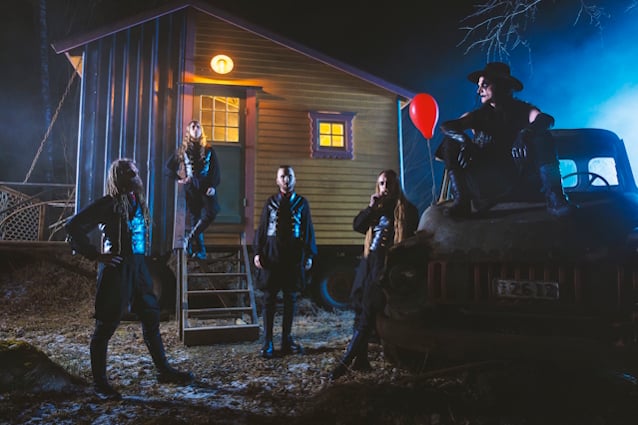
AVATAR's JOHANNES ECKERSTRÖM Finds Joy In Grind Of Touring: 'We Keep Bumping Into Way More Successful Bands Than Ours That Seem Miserable'
October 30, 2025By David E. Gehlke
Among the Scandinavian bands to break through and establish a strong Stateside following, Gothenburg, Sweden's AVATAR ranks among the most unlikely. Initially formed in 2004 as a melodic death metal band, AVATAR evolved—quickly—with their 2009 self-titled album, which introduced groove into their sound while shedding the ever-popular influences of their hometown. From there, the Swedes have been all over the map, dropping in alternative, industrial and radio-friendly flavors, each of which has carefully served the band's core purpose of being an anti-Gothenburg melodic metal band.
AVATAR's ninth studio album, "Don't Go In The Forest", appropriately arrives on Halloween and again finds the Swedes up to an assortment of tricks, specifically the title track, along with the oddly catchy "Tonight We Will Be Warriors" and "Howling At The Waves", the latter finding vocalist Johannes Eckerström (he of the clown regalia) building upon his clean vocal repertoire. "Don't Go In The Forest" sets up what should be AVATAR's most daunting run of dates yet, including a North American headlining tour, coupled with dates opening for IRON MAIDEN and METALLICA. As Eckerström shared with BLABBERMOUTH.NET, AVATAR is more than willing to put the work in on the road, mainly because they like what they do, and each other.
Blabbermouth: AVATAR started as a melodic death metal band, which underscores a few interesting points about your evolution. How quickly was it decided that you weren't going to stick with that style?
Johannes: "I think it's the effect of the fact that we started so young. We are a band that started in the midst of puberty, and now we have mortgages. We kept being the same band through it all, so, of course, in the beginning, it was 'Want to start a band?' "Yes?' 'What bands do you like?' 'I like this, this and this.' The common ground was a lot of death metal and melodic death metal. Those were the covers we did when we were learning to play, and they were the springboard for when we started writing songs. Already by [2007's] 'Schlacht', I think with the ambitions and what we tried to put into those songs, it became constraining to stick to that genre. Also, since then, of course, the mission statement and the whole idea of what the band is and what we do have evolved because we have as well. That's the most important part of it, to allow the band to become whatever we needed to be. I'm a huge fan of Devin Townsend. I feel like he might be the best at making any new album that very much reflects where he is at a given time. Because to let yourself evolve like that, I feel like that opens the door to the possibility that the next thing you do might be the best thing you've ever done. Once you've invented the formula, if you stick with it, you're stuck with diminishing returns."
Blabbermouth: When did you start to notice this shift? After "Schlacht", it was fairly drastic.
Johannes: "It was around the third album. I remember feeling, around the time, as a vocalist, in terms of just extreme vocals as an expression, I wasn't done with it, obviously. As a hungry musician, I started to feel like a glorified bongo drummer because I wanted to find new things to do. The patterns, if that's all I did, because I was hungry for the challenge, I felt limited by it. It was very conscious: 'I'm going to learn to sing now.' On the third album, there are so many vocal dubs on everything in such a long, grueling process to record all of it. I sang in choirs in school. I had a couple of other, more short-lived bands, but to really do something on an album and on stage, it was a very steep learning curve there. It was also very much on purpose, like feeling dissatisfied with, not with 'Schlacht', but with what the next natural step would be if we stayed in that lane. There were rules: 'Yeah! We're from the Gothenburg area.' If someone comes up with something and someone says, 'That's cool! It reminds me of IN FLAMES!' It was banned. [Laughs] Nothing against IN FLAMES, but it's more the exact opposite. It was something good about IN FLAMES. It meant that style was all-encompassing for us at the time. It was like, 'Now we have to free ourselves of this and see who we are.' That was very conscious and grueling. The third album tainted it by being stuck thinking of what others would think. We wanted to make it, and whatever that means. That seeped into the songwriting. 'Black Waltz' was evolved, more groovy, more of those things, but also very much more for us. Never against, with hat in hand, asking for permission and begging for love. That was a good idea. Stylistically, we have gone to a bunch of places since then. The ideology to form an identity of our own and all of that, that journey really started with 'Black Waltz'."
Blabbermouth: You've shared your reverence for Rob Halford (JUDAS PRIEST) and Ozzy Osbourne. How does that translate into a new song like "Howling At The Waves", which is pretty close to a ballad?
Johannes: "To talk about one of the old masters of heavy metal that creates a bridge here, I had a lot of thinking that had a lot to do with Ozzy Osbourne. I brought him up a lot in conversations after his passing. He got a Live Aid of his own for his retirement party. He's one of the big ones. I still feel he's underrated. Because he had droves of that natural charisma, intangibles like a unique voice — all of these things that can't be taught, all these things that he was one of the best at, which take skill and some work, are conveying lyrics in your singing. The most important part, the part that can make some snotty punk your favorite singer, even though they've never hit a note correctly, is that these people have a storytelling quality. I read this in-depth article about BLACK SABBATH. There was a sentence about the roots of their music that mentioned the usual suspects of the British Invasion, psychedelic rock, [Jimi] Hendrix, and the '60s stuff that led to the '70s. One thing that was mentioned was soul music and it was so true. That's where you had the belting, the loudness, the high notes, the passion, the drive in the music, the Motown beat, all those forces. Before you had metal, you had it there many times. If you look at those lyrics, if you read them off a piece of paper, it's not going to win a Nobel Peace Prize any time soon, but when the right singer sings it, it's pure poetry. From the very beginning, from the song 'Black Sabbath', Ozzy's afraid. On 'Changes', he's crushed. In 'Symptom Of The Universe', he's manic. I think for that reason, while the rest of us in metal our greatest hits, biggest songs seem to be about demon devils with huge tits on top of a motorcycle on top of a B-52 bomber on top of a dragon riding through hell. Awesome. Among his greatest hits is 'I'm going home to see my wife soon' [referring to 'Mama, I'm Coming Home']. His ability to convey that it means something. That became interesting. Then, to write around it, to give myself a bit more space to do it, both in the lyrics and in the music, so it gives a bit of room. Of course, a song like 'Howling At The Waves' gives a bit of legwork for that. The melody is a bit more melodic. Also, as much as I still, many times, feel and do on this album, the thing of, 'Well, it's heavy metal singing because I get really sweaty and it raises my pulse.' You sing with your whole body, which is still true. Then you listen. The verse to 'Breaking The Law' [JUDAS PRIEST] isn't like that. But it still slaps and drives. It tells a story. The syncopation and his sense of timing still help drive the song without him driving his lungs out. He saves it for later: 'You don't know what it's like!' It's a bit of a journey, and there's room for storytelling. This is all finding stuff to be excited about on each album. Finding a fresh challenge and finding something that I haven't really nailed before I started working on it. Just by writing songs, you build in these little opportunities to improve as a musician and as a performer. It's now, 'We like this song now. I must not suck at performing it.' [Laughs] The writing pushes you."
Blabbermouth: Is the "Don't Go In The Forest" album title as suggestive as it sounds?
Johannes: "Yes, exactly. When we were little kids attracted to metal, that's what it was about. Drawn into the taboo, drawn into the darkness. It's exciting because it's forbidden, but it's also cathartic and therapeutic. It can also mean you go into the forest because it is a good time. It is also about confronting fears. There's this weird marriage in metal. Why do we have such a great time hearing songs about bloody murder and depression? The catharsis to put those feelings out there like that, and the healing potential that can only happen if you open the forbidden door in your soul. That's also the forest."
Blabbermouth: "Tonight We Will Be Warriors" is remarkably catchy, yet it has an unconventional melody. Where did it come from?
Johannes: "I had the main melody on the guitar forever. Sometimes you tie yourself in knots in writing when so much stuff is happening. To make it work, the song grew increasingly direct over time. When you have something that feels big and epic and grand, but from fairly few pieces, then, of course, it has the potential to work in other places than your complex stuff. Yeah, I did feel, more so than with other single choices, where it's like we deliver the album, they go, 'Here's the single.' 'Okay. Sure.' I just hear songs. Now that we've done it a few times, some start to surface as a potential single way more."
Blabbermouth: You've been willing to come over to North America and do quite a bit of touring. You're now starting to see the results. Other than putting in the work, do you have an explanation?
Johannes: "Our debut album in North America was 'Black Waltz'. That was our first licensing deal in the States, and because we had a good amount of years of failing miserably behind us, that was part of it. It's absolutely fine. That also meant that when we came over for the first time, seemingly fresh to you guys, but in secret, we had owned the craft in Europe. I think that helped. We got a running start for that reason, both the label we were on and the management we're still with. and all of those pieces fell into place for the first time, together with a new beginning in the States. We put in a lot of work, but it was immediately more rewarding work. What happened was that we traveled all the way west, and now, over the years, we've slowly worked ourselves into an equal position in Europe as we have in North America. It's been a lot of work. It just fell into place immediately in a different way."
Blabbermouth: On top of that, it's not like AVATAR has a niche. That may make it even harder, yet here you are.
Johannes: "Same with Europe. In the early days of the band, we toured with both OBITUARY and HELLOWEEN within a few years. [Laughs] Both kind of made sense as much or as little as the other. That says something about us. We are our own thing, our own little satellite orbiting it. Fundamentally, what we do, back to what I said at the beginning, reflects where we are at; therefore, it keeps changing. Fundamentally, it's metal. It's not retro, but very old-school ideals of what we think makes a good song, makes a good riff, makes a good groove. No matter what kind of songs we record or the recording method, it comes down to the decades of actual musicianship. As much as we use the digital world of recording, there are certain things we don't cheat with."
Blabbermouth: Through it all, you've largely kept the same lineup. What has kept this version of AVATAR together for so long?
Johannes: "Here's the job description: We want to write and perform our own material. And we want to take that, whatever it ends up being, as far as we can, without compromising. We want to take it as far as we can while remaining friends. We keep bumping into way more successful bands than ours that seem miserable. I'm like, 'Go home!' I love doing this. I love the circus life and the people I get to live this life with. But it's under those strict conditions of feeling like that that I have an interest in doing this. Without it, you'd stop feeling like you're going somewhere. You're not going on tour. You're leaving home all the time. That seems unbearable. It's an absolute priority. We made short-term business decisions that weren't the best for the band but were beneficial in the long term, as we want to stick around with one another for another 10 years. That's the secret."
Photo credit: Johan Carlén


 Prev
Prev 