


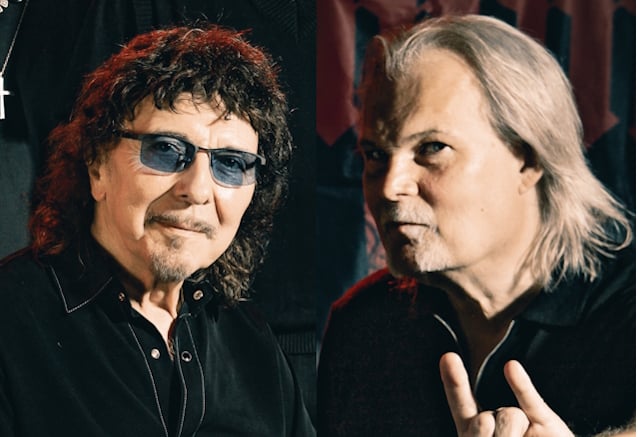
JORN LANDE's Moment Has Arrived On New TONY IOMMI Solo Album, 'From The Dark'
October 27, 2026By David E. Gehlke
Tony Iommi's decision to enlist veteran Norwegian singer Jorn Lande to perform vocals on "From The Dark", his new solo album, was one of those "Ah, this makes perfectly good sense" moments. Lande is cut from the same cloth as his hero, Ronnie James Dio, whom he has not only subbed in for the 2010 HEAVEN AND HELL date in London after Dio's passing, but also recorded a Dio tribute album the same year (simply titled "Dio"). While no one can ever equal or better Dio, sufficient evidence suggests Lande, more than anyone, comes closest. And with Ozzy Osbourne-era BLACK SABBATH now done and dusted for good, Iommi's pivot to the much-beloved Dio-era SABBATH sound has made "From The Dark" one of 2026's most celebrated releases.
Lande certainly does not disappoint across the album's eight cuts. His snarling, cutting vocal style blends well with Iommi's patented dark, broad power chords, hitting both the epic and the doomy in full stride. Iommi's compositions here are weighty and deep, reflective of the might and sterling songcraft of "Heaven And Hell" and "Mob Rules". Much like Dio, Lande's lyrics on "From The Dark" carry a trace of optimism, fitting words from a man who has seemingly waited a lifetime for an opportunity like this. And none of this should discount Lande's solo career, which is still going strong, nor his work with SYMPHONY X frontman Russell Allen in ALLEN-LANDE, not to forget ARK and MASTERPLAN. (Lande's vocals on MASTERPLAN's 2003 self-titled debut still rank among his finest.)
Nevertheless, Lande's soft, gentle speaking voice virtually belies the person we hear behind the mic, and the thunderous Norwegian had plenty to say when BLABBERMOUTH.NET had the good fortune of snagging him for a chat the day before "From The Dark" was released.
Blabbermouth: Can we go back 16 years to when you got the call to jump onstage with HEAVEN AND HELL not too long after Ronnie had passed? What's going through your head when all of this was happening?
Jorn: "That was a special call to get, but I need to start from the beginning since Tony and I did something in 2004 and 2005. I did several trips there, and we did demos together, but for various reasons, it didn't happen. Glenn Hughes [ex-DEEP PURPLE] did the solo record, 'Fused'. I worked on some songs and demos without vocals, and I wrote stuff for that, but then Glenn came in and wrote some stuff on the same demos, as far as I can remember. In the end, the record company came in and said, 'It would be good for the record if Glenn did it.' It wasn't meant to be back then, but Tony was always very encouraging. He got in touch with me in the first place because he loved my work. It was a good confirmation anyway, but of course I was disappointed when it didn't happen back then.
"Then, the HEAVEN AND HELL thing. I don't know who called who or whoever. Ronnie was sick and still wanted to tour. He still wanted to do it to the very last minute. There were talks about doing some of the shows where HEAVEN AND HELL was already scheduled. They were already booked, so I don't think he wanted to disappoint his fans. He wanted to go. I had a phone call about whether I could sing parts of the set, or maybe Ronnie could do some songs, and I could do some things. I don't know who came up with that idea. I don't know if it was Ronnie since I met him back in 2000 when I was touring with Yngwie [J. Malmsteen]. Of course, I usually thank Yngwie. That's how I met Ronnie. Despite any stories you may have heard, he's always good for something. [Laughs] Without that happening, I would never have met Ronnie, and that was a big moment. I have to thank Yngwie for that. I know Ronnie liked my vocals then. He used to be in the gallery; he and Jimmy Bain [DIO, bass] used to be there watching me. They usually came when we had three or four songs left. Usually, the galleries were closed, and I'd see them in the shadows up there. Of course, I was younger and a big fan and all. I was giving it my all. It was like, 'Jimmy and Ronnie's up there!' I was this fanboy. That was a great moment, and then when you get to talk to somebody and meet somebody, have a beer with somebody who is your hero, I learned a lot from that. Also, it helped me with my own position, like how to navigate into the future. I guess because of Ronnie, I also decided that I wasn't going to experiment too much with my singing. I should look for something more natural. I went back to my classic rock roots again, bit by bit. I did have some band members that were a bit experimental. I mean, it was difficult to do something and not get recognition for it. You had to think in terms of creating something that was some kind of development or evolution in rock or metal. At the time, I had a black metal drummer. He's the drummer for MAYHEM."
Blabbermouth: Hellhammer!
Jorn: "Yeah, Jan Axel [Blomberg]. He played with me in the early days and when we recorded 'Worldchanger'. He never played anything like that. I told him, 'You have to play a steady beat, and you can fill in whatever you want.' That was kind of new to him at the time. He had a hard time holding back with all of the fast stuff going on: the double pedals, drum breaks and fills. He did a great job with that. I think we were in this transition, crossing over into the millennium. The '70s and '80s were kind of over, and it was hard to build a career on something these older guys had already done. Then again, you were a fan of that style and that genre. That's the reason why you were in the business, at least for me, and that was the case. I just wanted to sing in the style that I loved. I didn't always want to try to look for these crazy mixes of styles or whatever people were doing or would do later, which isn't wrong. You are a child of your time. Ronnie brought me back to that way of thinking and also to listen to my heart, which sounds like a cliché, but it's true. I thank him a lot for that. That was a great moment, that month or whatever it was, on tour with him across the United States. For that show in 2010, I don't know who it came from. It could have come from Tony; it could have come from Ronnie. I don't know. I can ask him, Tony, if he remembers. We were in talks even before Ronnie got sick. We were in talks before Ronnie did the 'Devil You Know' album [with HEAVEN AND HELL]. At that time, I think Ronnie and Tony and the guys, maybe the guys could tell you, I don't think they were communicating for a few years or many years; I don't know. I never asked them that. I remember they just wanted to find a singer that wanted to play live. I didn't know what it was then. Maybe they didn't think about that concept of HEAVEN AND HELL. Probably not. It was a branch of that, and they asked me; Vinny [Appice, drums] was in then, too. That's how I knew. Then, I had the phone call again — the same as when Glenn did the record with Tony. 'Jorn, sorry again. I'm sure you understand. It's best for the band. Ronnie, Tony and the guys, they've decided to reunite and all that. I'm sure you can understand that's the best solution for the band.' I was disappointed, of course. Looking back now, when you see the results and hear the results of what they did with that record, it's like, 'Okay. It wasn't meant to be. The constellation wasn't right at the time. I wasn't meant to be there.' The good thing is that it happened 22-plus years later. Tony always stayed in touch. We met again in 2010 at the memorial show in London when Glenn and I shared the vocals, and we raised money for cancer. After that, I received messages once in a while. He would say, 'Jorn, we have to do an album.' I thought that was great. I was like, 'Yeah, great!' [Laughs] As the years went by, it was a little bit like 'Spinal Tap'. You get this message and then, 'Ah, yeah! Right! Right on!' You're happy as an old fan. When you look back, he's the godfather, he's the guy. Some of the stuff that I wrote myself and my guitarists, they took a lot of stuff from Tony. Everybody did. Obviously, growing up with SABBATH and with Ronnie, it was kind of in my DNA. Everything I write always has that touch of something Ronnie could have done. It's not deliberate; it's not something that I plan to do; it's just there."
Blabbermouth: The fact Tony asked you to do the entire album made sense to a lot of people. If there's anyone to "carry the torch" of Ronnie, so to speak, it's probably you.
Jorn: "I always say that I never really saw myself as anything else but a simple man and musician. I'm just trying my best. I was always looking up to the best, which was him. I didn't discover ELF until after I discovered RAINBOW. You could say I followed Ronnie into BLACK SABBATH. I wasn't a huge SABBATH fan as a kid in the '70s. I grew into SABBATH with Ronnie. Also, in the Ozzy era, I liked 'Technical Ecstasy' and 'Never Say Die'. I was born in '68. I was running around with diapers, or I had just finished them or something, when SABBATH did their first couple of albums and started touring. [Laughs] I heard some of the stuff. My father was a musician and a singer. He had a career and all that stuff. I was used to having a lot of music then. He had some great records. Not much metal, but he had JETHRO TULL'Thick As A Brick', and the first couple of [LED] ZEPPELIN records. I had it early from that generation."
Blabbermouth: You were originally asked to do just "Beyond The Dead" and "Stormwatcher" on the new album. Did Tony provide you any parameters for these two songs? Or was it a matter of you doing your own thing?
Jorn: "They were all instrumental tracks with a drum machine when they came with Tony's guitars, of course. It was all open. I could do whatever I wanted with the tracks. I didn't have the main project, so I sometimes had to edit bits to illustrate where I wanted to go. I said, 'I have another verse for that.' Or, 'I think that part should be doubled.' I recorded it in Denmark at Jailhouse Studios, with an old friend of mine, Tommy Hansen. He's retired now, but he used to do HELLOWEEN, like 'Keeper Of The Seven Keys'. I recorded most of my early JORN albums there or mixed them there. I thought, 'How can I keep this a secret that we're going to do this?' I thought if I went to some of the younger guys to do the demos, I was afraid it would leak."
Blabbermouth: Does Tommy even have social media?
Jorn: "Well, I knew he was retired, so I just called him: 'Hey, Tommy. How are you doing? It's been a long time. Do you still have everything up and running?' He said, 'Yeah, the studio is still there. I'm mostly working on my music, and now and then, there's a little project, but nothing major.' It was a great thing. It's not that far to get there. I'm from Norway, but I live in southern Sweden with my wife. We have had a house for many years that we used as a holiday home, but now, after the pandemic, we decided to move. It's a few-hour drive across the bridge to Denmark. I did that. The first track was 'Beyond The Dead'. They loved it, and I remember we re-did a lot of vocals for 'Beyond The Dead' in a studio called Abbey Recording Studio in Oxfordshire. That was the first track, and I think Mike Exeter, our producer, wanted to check: 'Could we pull more things out of Jorn?' This was the beginning of the collaboration, even though Tony and I had done things in the past and Mike was involved in some of that. There was a time Bob Marlette was involved as a producer back then for those early demos in 2004, 2005. Then Tony came, and we recorded the vocals again, but I don't think they came out better than what I did in Denmark. Maybe some bits were changed, but that's how that came about. Then, 'Stormwatcher' was the second track. I did that one without changing anything. The track that's on the album, the second single, everything is exactly like it was from Jailhouse Studios in Denmark. I think that first song was kind of a give-and-take thing. We tried things out and shared ideas and stuff like that. I think both Mike and Tony realized what we did before was well-crafted and solid. I'm not a guru at producing or anything, but I've produced a lot of albums myself over the years, and they sound really good. I think it's because I'm picky. Tony always laughs about that, and Mike as well, like when he's sitting on the couch, and Mike would push a button on the talk-back: 'Jorn, we have it. It's great.' 'No, just please give me one more.' [Laughs] That's typical of me. It's because I want to try something I feel we're missing, or I'm not sure. And then the British humor comes along: 'All right. I'll give you one more, but we won't use it.' [Laughs] That's funny and annoying if you're picky like me! It was all great fun in the end and hard work, of course. That's what it's about."
Blabbermouth: Your lyrics here have a positive, uplifting angle. It's a nice contrast to Tony's riffs, which are dark, as to be expected. Was this balance ever discussed?
Jorn: "No, I had one-hundred percent freedom to do whatever I wanted, but I had some messages once in a while, or we had talks when I was there, either at Tony's home studio or at the other studios. Gospel Oak is another studio we recorded in, which is where Mike usually works. The funny thing is, I always got messages, especially from Tony's manager, Ralph Baker. 'Jorn, it's so dark. Can you do something less dark? We need something positive.' I had to explain, 'Well, the riffs are so dark. It's all dark!' [Laughs] I always put hope in there somehow, but obviously it doesn't fit this 'happy' thing going on. I mean, we don't want to do something that doesn't fit with the power and the sound of the music. I had to explain that I'll do what I usually do, but I will keep it in mind and try to add some of that hope and light to the songs, which I always do. The combo between Tony and me, I mean, my own band, can play a dark note, and maybe they also pick up something from Tony. Then you have this chorus or verse or maybe one song that we work on, and it's going into the darker stratosphere or musical landscape. I think Tony, everything he plays, his style is so dark. It's powerful and beautiful. When you combine the way I write with his way of playing, maybe it gets a little darker than usual. [Laughs] I don't know. But I think the lyrics are all about the fire of life. It's all about keeping the spirit in everything you do. It's this journey. I always wrote in those terms, from birth to death and beyond, reflecting on life and whatever happens after. You have to believe; life is short. You have to believe that something happens. Speaking from my perspective, there are so many great things about life. You want to be present in your consciousness; you want to remember. You have all of these ideas, abstract thoughts, 'Yeah, well, Jorn, you're going into a different thing when you pass.' I say, 'I don't believe that. I want to remember everything. I want to be the Eyes of Time. I want to be fucking going forward. I want to remember everything, and I want to see the future.' I think that perspective kind of gives you a lot of power and fuel. That also brings the positive thing into the darkness in this from birth-to-death kind of thing. It's life. Thoughts about the past. Reflecting on the present and thoughts about the future. This keeping-the-faith thing, which, again, many people will say, 'Oh, that's kind of cheesy.' Or, 'It's a cliché.' That's what it is. That's life. Life is about staying solid, staying strong and asking your heart for something real. What your heart tells you, you have to stick to it. And the compromises you do, you sometimes do them because you have to. You have to minimize compromises in your life, and I think that's when you become a happier person. You're a better person toward other people as well, like your family and your friends."
Blabbermouth: It sounds like you're grateful to be in this position. You've had to wait for your chance, and you're not bitter.
Jorn: "I was lucky. I sold a lot of records over the years. In the U.S., I've been on the Billboard charts many times with my albums. 'Life On Death Road' was on the charts in 2017. Even though it's not the same as it was in the '70s, '80s and maybe parts of the '90s, I've had some success in my career. I've been able to live off the music, and I've toured the world. You could also say that the albums have been my shrink or my mental health. I could get everything out. I could talk about everything. I could share everything through the lyrics, and that energy transcends into the world or to people. And the feedback you get when people are struggling with something. Some people are sadly not here anymore, but they've written me letters, thanked me for the music, and said it helped them a lot. People who were sick or had financial problems or got divorced or whatever, it really means something. We all look for a purpose in life: what's the meaning of this? Even though you don't care, you still need some kind of reason to get going. For me, the music was that, and all that feedback and a lot of love from people, combined with the fact I did quite well with my records."
Blabbermouth: Where would you put "From The Dark" in your discography? Do you feel like you're following in some big footsteps here?
Jorn: "Well, I wouldn't say I wanted to follow in anyone's footsteps, to be honest. I just wanted to do my thing and put my stamp on it. I can't get away from the fact that I'm kind of filling some shoes here because Tony didn't work with that many singers either. I mean, there are a few, but not that many. So you're going to be evaluated, and you're going to be in the spotlight and reviewed. So I think I'm proud that this happened to me in my life right now. And it's kind of like when you thought it wouldn't happen and you put the idea to rest, then the timeline. Yeah, that's the coolest thing. And it's also proof that when you work hard and you stay in there, I mean, you don't have to be 25 or 30 or whatever to achieve anything. There's no rule for where you have to be in your life or age or anything. I think Tony is a good example of that. He could be my father, but I don't see him as an older person. He's a colleague and a friend now."


 Prev
