


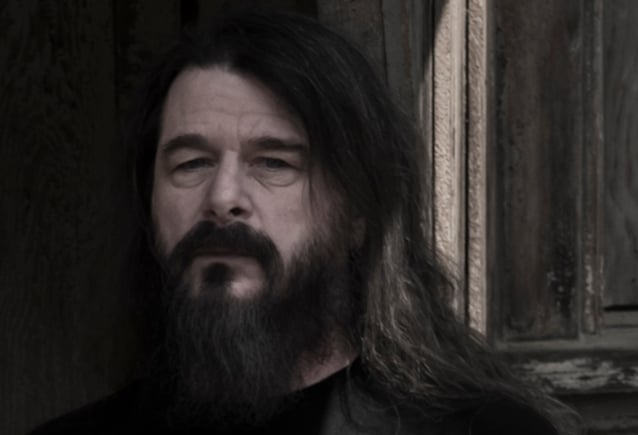
SLAYER's PAUL BOSTAPH Is Still Trying To Prove He's More Than Just A Thrash Metal Drummer
July 30, 2025By David E. Gehlke
Given the near-impossible task of replacing Dave Lombardo in SLAYER in 1992, Paul Bostaph has built his reputation as being the slightly more exacting player than his predecessor, whose unpredictable, unrelenting style remains the benchmark by which all thrash metal drummers are judged. While Bostaph found himself in and out of SLAYER on two separate occasions (1996 and 2001, respectively),since 2013, he's been the reliable anchor behind the band, and also now holds down the stool for the eponymous KERRY KING. And at the not-so-young age of 61, Bostaph remains in top form, with plenty of good years ahead of him for SLAYER's spare reunion gigs and KERRY KING, who are now working their way up the ladder all over again.
Bostaph's playing has long been dissected: a natural function of replacing Lombardo. He had to morph his style to even join SLAYER from fellow thrashers FORBIDDEN, an outfit that was certainly no slouches in the technicality department. But SLAYER is SLAYER, and Bostaph's ability to land the gig 33 years ago altered the course of a career, that, unbeknownst to many, was initially influenced by rock and R&B. Having just wrapped the Yamaha-sponsored "A Night In The Pocket" event in Nashville, TN, with an assemblage of legendary drummers, BLABBERMOUTH.NET was put in touch with Bostaph to learn a bit more on what truly makes the sticksman tick.
Blabbermouth: You recently did the "A Night In The Pocket" event in Nashville. Obviously, you've cut your teeth as a metal drummer. What's it like getting to stretch out a bit and play other styles of music?
Paul: "I didn't grow up only playing heavy metal. I had seven kids in my family. I had two older sisters and an older brother, there was a lot of diversity in the music they listened to. My brother got into rock and roll and heavy metal; my sisters were kind of into rock and roll, soul and funk. Back then, we had records, not CDs. There was a great deal of diversity in the music we listened to at home. Also, the radio station I grew up listening to played everything. I grew up listening to a variety of different styles. I don't usually get a chance to stretch out. It's kind of funny, and I'll describe it: I did a record with Chris Impellitteri [2024's 'War Machine']. We went into rehearsals, and Chris can play almost anything. He would get into a riff from some DEEP PURPLE or VAN HALEN, and I'd start playing to it. He couldn't believe it. And that's what's funny: Once I start playing outside of metal, people are surprised I can even groove at all. [Laughs] I guess there's a preconceived notion about me that all I can play is metal. During the 'Night In The Pocket' event, their style isn't metal. They're known for playing great grooves. To play with a bunch of guys like that really was a treat."
Blabbermouth: I spoke with IMPELLITTERI last year, and he sang your praises for the work you did on his album, yet, as you said, there's the perception of you being just a thrash guy when it's not really the case.
Paul: "I'm not only a thrash metal drummer. I didn't grow up playing thrash. I grew up playing LED ZEPPELIN, AC/DC, THE COMMODORES, EARTH WIND & FIRE, GRAND FUNK RAILROAD and BOSTON. Then I found IRON MAIDEN and JUDAS PRIEST. The music kept getting heavier and faster. One day, I found myself in a thrash metal band. Whenever I get the chance to play an open groove, it's so much fun because I never get to do it. People are always like, 'You can actually groove!' Whenever I get the opportunity to play a wideopen groove and not have to play thrash, it's a lot of fun. I think because I don't get to do it very often, I throw myself into it because I don't get to do it. The fun factor comes out."
Blabbermouth: When you do these kinds of events, are you trying to pick up on what the other drummers are doing?
Paul: "Yeah. I watched everybody, every last one of them. Donald Barrett, Gordon Campbell and I did a Yamaha snare drum video about five years ago. I was one of the guys to play last. I got to watch these guys play first, and these guys are just laying down a groove, really tasty, really good. I was like, 'How the heck am I going to play after these guys?' [Laughs] I grew up listening to TOWER OF POWER, so Dave Garibaldi, I never got a chance to meet him until this event. Anton Fig's stuff on Ace Frehley's [KISS] solo album is legendary. You got Paul Liam. I didn't know much about Paul, and I looked at what he's done, and he's played on decades of hit records. All of these guys. Tommy Igoe, Kendrick Scott and Bill Gibson from HUEY LEWIS AND THE NEWS. I grew up on HUEY LEWIS AND THE NEWS. It was such a treat. Obviously, when I go on tour and see the other bands, they have pro-level drummers. When you get an opportunity to see Anton Fig, Paul Liam or Lee Kelley, who is Hank Williams Jr.'s guy, and he's a metalhead. A total metalhead. He loves SLAYER. It's funny, these events are just a treat to watch these guys perform. You get to see it in real-time, up close. I took so much away from it."
Blabbermouth: Do you get intimidated being around other drummers of this level?
Paul: "Yes, especially my heroes. Everybody who was invited to this, every single one of them, I knew what they had done. I never met Dave Garibaldi, and there's stuff he's done, like 'Back To Oakland', which is magical. I'm really intimidated; if I open my mouth, I don't shut up. [Laughs] I'm really shy, and I don't want to bother anyone. For instance, after the first rehearsal, I was in a van, and we all shared Ubers to return to the hotel in a group with the other drummers, who had also rehearsed. There was another rotation to rehearse with the house band. All these guys get in one Uber, then there was another, and I'm in the van with Dave Garibaldi for 45 minutes. I'm like, 'Okay, dude. Don't fan out!' It doesn't matter how many people you play in front of. If it becomes old hat and there's no excitement in the music anymore, I'll always be excited and nervous. I just try not to let it get the best of me."
Blabbermouth: You brought up your influences, and what is unique about your career is how you had to adapt your playing style when you rolled over from FORBIDDEN into SLAYER. Can you elaborate on the work that went into that?
Paul: "A drummer has a toolbox. You have all these ideas, so I always had them and was always trying to stand out. Not stand out in a way where it's like, 'Look at me. Look at me!' We were in the Bay Area thrash scene, and you could really easily be doing what everyone else is doing and get lost in the Bay Area sound. We were trying to do our own thing, come up with our own identity. You've got to throw a lot of spaghetti against the wall to make that happen. FORBIDDEN, I wouldn't describe myself as an over-the-top drummer in that band. I think I played more for the sake of the parts. I was technical inside the parts, and I immersed myself in the riffs. Then with SLAYER, the big jump there, the first thing I needed to do was learn how to shut my mouth. With FORBIDDEN, I was one of the main guys, along with Craig [Locicero, guitar]. Then we got Tim Calvert [guitar]. If they brought in a riff I didn't like, I'd shoot it down. I'd admit: They needed a lot of patience with me. If I didn't like it, I'd say it would suck."
Blabbermouth: As in, you wouldn't play along to the riff they presented?
Paul: "They would bring riffs in. There would be a part that would be really cool, then there would be other parts where I wasn't into it. We had to be original, or else we would have been lumped in with everybody else. It's not that everybody else wasn't good. There were tons of good bands. When you listen to a band, you go, 'They're different. They sound different.' It's a double-edged sword. You can be different and miss the mark, and people don't get you, or you can be different, and it will take people a minute to catch on, and people will say, 'You are doing something different.' It was really hard back then. With SLAYER, they had Lombardo. They had Dave. Let's face it: Dave is and was a fantastic drummer. He was pushing the envelope in that style, without a doubt. With FORBIDDEN, we wanted to be like two bands: SLAYER and JUDAS PRIEST. They were our benchmarks. We didn't sound like SLAYER at all; we didn't sound like JUDAS PRIEST because we were a thrash band.
"When I went into SLAYER, obviously the first thing I had to do was learn Dave's parts. That wasn't my drumming style. I had to practice; I had to learn his parts. I had to learn the songs, but I already kind of knew them; it was the drumming that was challenging. It was somebody else's style. It was the first time in my life, although I had listened to records and played other styles, that I had to learn the style of a drummer as well as I could. When I got the audition, it was like, 'If you close your eyes and you hear something different, it's not going to be right.' It was about being as close to what Dave could do as humanly possible. That's what I tried to do. Obviously, it worked out in my favor. I was able to do it, and I got the gig. Moving forward, it was during the songwriting process that I learned the most. I toured with those guys first. I did about eight fill-in dates, and doing those gigs, I got more confident in playing with them. Kerry [King, guitar] and Jeff [Hanneman, guitar] were very unflappable. You couldn't do anything to get their attention on stage. But if you did something cool, they'd turn around and look at you. Once I got comfortable with them and the set and the songs, I would throw some stuff in there, like, 'I want to do this anyway. What are they going to do? Fire me?' And they loved it. Those kinds of things, that experience, moved over into songwriting. That first record [1994's 'Divine Intervention'] took us about a year. We were ready within the first six months, but Kerry and Jeff were watching NHL hockey. We had to wait another six months. For the first time, I really immersed myself in the parts. That first record, I improvised some stuff, but everything I did was not calculated; it was thought out. I taped every rehearsal and listened to it at night or the next morning to see if it was good enough. The benchmark was Dave. That standard he set had to be met as best as could be."
Blabbermouth: Was your intro on "Killing Fields" improvised?
Paul: "We did the 'Judgment Night' soundtrack, which had a medley of tunes that Ice-T sang with Tom [Araya, bass/vocals]. The first song, 'Disorder', of the three in the medley [of THE EXPLOITED songs], starts with drums, real tribal. That's what the original drummer did on the punk track, and I thought it was great. Jeff, Kerry and I were talking after rehearsal, and they said, 'What will the fans' first introduction to Paul be? Why don't we do a different drum intro to this one?' Right before that happened, a few months before we did that track, 'Painkiller' [JUDAS PRIEST] came out with Scott Travis's intro. I watched it on MTV with Kerry since we were roommates. The video came on with the drum intro, and my jaw dropped to the ground. I said, 'That is the baddest drum intro.' It's hard to come up with something. Think about it: RAINBOW on 'Stargazer' with Cozy Powell. 'Where Eagles Dare' with Nicko McBrain [IRON MAIDEN] and 'Rock And Roll' with John Bonham [LED ZEPPELIN], these drum intros, they come along every once in a while and they'll stand the test of time. Scott Travis's drum intro on 'Painkiller' was, in my opinion, the most amazing thing I had ever heard. It's explosive, technical and just badass.
"I would go down to the studio and I would play around. It inspired me so much. I'd go by myself before the band got there and on weekends when the band wasn't around. I was playing around with it, going, 'You know, the truth is if I did the same thing with my feet and hands, you can't beat it. You can't beat that.' I'm like, 'There's no way I can do that. If I tried to do that, it would sound like I was copying him.' It was an inspiration and kind of a challenge. I didn't think I would ever use it, but it inspired me that much. I thought, 'What are the elements I like? I like the snare and the china, which are so explosive.' I thought, 'I could use that.' I wouldn't rip him off; I was inspired by it, so what happens around it and how I phrase it, that's everything. Where he's got feet, I've got hands. I would do this thing where I would do sixes: One, two, three with the hands, one, two, three with the feet. I thought, 'Let me try that.' [Mimics intro.] I thought, 'That sounds explosive, but it sounds like crap.' I was playing around with it, and after one of the practices, Jeff said, 'We should have you do a drum intro.' I said, 'I like the original, but I have an idea that I need to work on over the weekend.' Over the weekend, I worked on it and I finally got it. I worked on it, and I got it to flow. I said, 'I don't know if this is going to be good enough, but it's the best I can make that idea.' Monday came around, and I said, 'I have a drum idea.' I had no idea how it would go into the track. I didn't even figure out that part. There was no glue; I just had the intro. I said to Jeff and Kerry, 'Here's my intro, but I don't know if it's going to work with the song. This is what I have.' I played it, and after I played it, Jeff looked at Kerry and pointed at me and went, 'That's going to be the drum intro to the new record. We're not wasting this.' At the time, 'Killing Fields' started with one, two, three, four on the hi-hat, then into the double bass. When we did it, Jeff said, 'Why don't we do it at the beginning?' It worked out perfectly. The rest is SLAYER history."
Blabbermouth: Do you want to comment on the long-running assessment that while Dave was often over the top and spontaneous, you are the more precise player? Do you agree with it?
Paul: "I'll take the compliment. [Laughs] Someone could say the exact opposite, like, 'This guy really sucks.' The first time I heard that — I'm a perfectionist at heart, but I'm not trying to play perfect. I'm trying to give the best performance that I can, and how my style has developed is just my development. That's the best way to describe it—it's just my style and how I play from the heart. I like things to be tight. I like to keep my headbanging; I like to keep the band in time. I can't do what Dave does. I watched Dave play live when I wasn't in the band, and I said, 'I could never get away with that.' I will never try to do that, and that's his style, which I appreciate. My style is what comes from the heart; it's what comes out when I play."
Blabbermouth: Do you remember the "Live Intrusion" VHS? You bring up banging your head when you play, and it was such a cool visual at the time to see you banging your head so hard while playing.
Paul: "I bang my head a lot differently now. Back then, I was banging my head so hard that at times, it might have hampered what I considered to be tight. I was into it that much. I do it a little differently now. I'm still into it, completely, but I try to keep the song on the rails as much as possible. Looking back at myself then, I was in great shape. Although I'm in good shape now, if I tried to do that now, I wouldn't be as tight. My double bass is different from what it was then. A lot of things are different, and I think part of it is that over time, back then, everything, like the double bass, was technical, but technical in a different way. More syncopated patterns began to emerge with SLAYER. When you're headbanging and thrashing around, sometimes you're off-balance and that gets in the way sometimes of performance. I think, also, some of the drummers I really enjoy watching play, they're super-tight and they're not thrashing about, either. Here's the incredible irony: You made me think about it, when you're going off and you see a video of somebody playing in a stadium if you're lucky enough or you're playing in some place like a big theater, and somebody's watching you and see a video done by somebody from the top row, all those movements that are big, they look tiny. [Laughs] You just go, 'Eh. I'm killing myself. For what?' I'm always going to get into it. It's part of my playing."
Blabbermouth: Between Jeff and Kerry, who was pushing for the band to be tight?
Paul: "It wasn't either one of them — that came from me. Before I joined, I don't think the guys rehearsed before they went on tour. I remember before every tour, I'd want to get together for two weeks. I needed to rehearse; I wanted to rehearse. People were there to see us play and make comments that this was the tightest the band had sounded. They didn't say it was a bad thing; it wasn't bad to begin with. It was great before I showed up, but people went, 'Wow, you guys are on. Everybody's on it.' It wasn't that Kerry and Jeff — they always wanted to be tight. We rehearsed more, and because we rehearsed more, everyone was tight. Sometimes, you do the first show, and the first four or five dates are rocky, then you're a machine. We hit the ground running."
Blabbermouth: Is it also a matter of knowing that it's easy to get lost in a SLAYER song, and if you do, it's going to be hard to find your place again?
Paul: "Yeah, and a lot of times when I've gotten upside down or gotten into the wrong part of the song, you fix it quick. That's the thing. The chemistry that Tom, I, Kerry, and now Gary [Holt] and when Jeff was alive, we just all knew. When something's wrong, we know how to fix it. It can be something massive or something small. There's no margin for error when you're playing that fast. You have to be on. Everyone makes mistakes; one of the best things about being in SLAYER is that they have a real punk rock attitude. In FORBIDDEN, you couldn't make a mistake. If you made a mistake, it was as if a certain individual was going to let you know about it, and I never appreciated that. Everybody's human; everybody makes mistakes. Practice is for making mistakes and then getting it tight. Playing live is putting on your best performance. That should be as mistake-free a performance as possible. If you're putting on a show for people and you're into it, things are going to go…it's not a matter of it being perfect, it's the energy and what people are feeling. That's the funny thing about precision: I live in the realm where it's about performance, and everyone says I'm 'precise.' I'm like, 'I guess you don't hear all the mistakes I make!' [Laughs]"
Blabbermouth: SLAYER played Ozzfest in 1999. What do you remember most about the tour?
Paul: "I'm a big Bill Ward [BLACK SABBATH] fan, and I'd see him walking around the backstage area. I told my tour manager, 'I see Bill Ward walking around, but I don't want to bother him.' She said, 'You should talk to him.' I said, 'I don't want to bother him, I'm a fan.' Three shows before the end of the tour, we had two days off in between. My tour manager told me, 'You wouldn't believe what happened when you flew home.' I said, 'What happened?' Bill Ward came back and said, 'I really want to talk to Paul, but I don't want to bother him.'' That was the same thing I said! They arranged for me to meet Bill. I sat down with him and told him, 'Look, I'm a fan. I got to get this off my chest first.' I said, 'I used to play all your records.' Fifteen minutes later, I was like, 'I'm good.' I got it out. He was so nice. He was a really nice man, a super-cool dude. The things he said about my drumming, I'll never forget. It was amazing to hear it."
Blabbermouth: You also played the "Back To The Beginning" show in Birmingham a few weeks ago. Do you want to share what it was like?
Paul: "There were so many different levels emotionally. I was very nervous. There were so many great bands there. You were walking down the hallway, checking out the bands; my wife and I went to the show. She's never seen BLACK SABBATH live, and we got the chance to do it. Just walking down the hallway, you're passing TOOL, ALICE IN CHAINS, Tom Morello [RAGE AGAINST THE MACHINE], you name it. At one point or another, there were so many great bands on that bill. Everybody was there for the same reason: to pay homage to Ozzy and BLACK SABBATH. You could tell. I could feel how much it meant to everybody. Typically, every event crescendos. I feel like that event didn't crescendo. It started at the highest level of intensity and just emotion. Everybody there thought the same way: everybody in the whole stadium. You could feel that, especially when Ozzy came up and performed, then they did BLACK SABBATH. The crowd was there from the beginning, right from when MASTODON played. The crowd: they were for it, all of it. That was something I'll never forget. I'd have to say it was the all-time, probably the most special show I've ever played."


 Prev
Prev 