


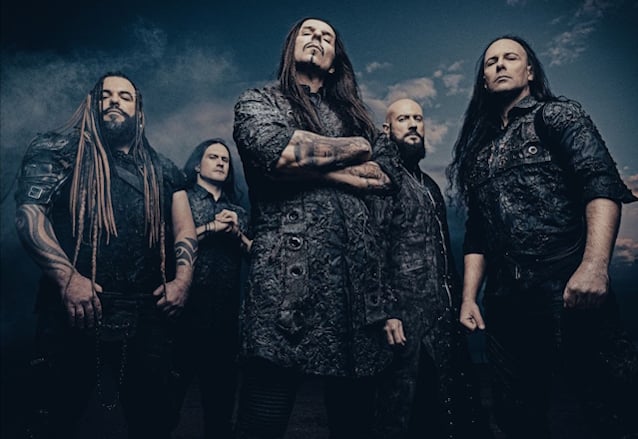
The Battle Between Metal And Orchestra Still Goes On For SEPTICFLESH
October 6, 2026By David E. Gehlke
SEPTICFLESH and an orchestra are now inseparable. The long-running Greek extreme metal outfit has taken a union that was originally popularized by the likes of CRADLE OF FILTH, DIMMU BORGIR and even METALLICA, via 1999's "S&M", making it such an integral part of their core sound that it's difficult to imagine that they will record future releases without some kind of cooperation from a symphony. The results speak for themselves, too. Starting with their brilliant 2008 comeback album, "Communion", SEPTICFLESH doesn't use an orchestra as an adornment — they use it as a feature, with sweeping arrangements and moments of sheer grandiosity that fire alongside extreme metal flourishes and Spiros Antoniou's prominent, guttural vocals. It's all made possible by Spiros's brother, Christos, who studied composition at the London College Of Music and now is a professional composer.
Circa 2026, the Greeks are hard at work on a new studio album to follow up 2022's "Modern Primitive" and have recently performed with the Plovdiv Philharmonic Orchestra and the National Opera Choir Of Plovdiv in Plovdiv, Bulgaria. In the more immediate future, SEPTICFLESH will be trekking across North America with ARCH ENEMY and THE BLACK DAHLIA MURDER this fall, a reminder of how far the band has come since their formative melodic black/death years in the mid-1990s to their controversial detour in 1999 with "Revolution DNA". Christos Antoniou is here to bring BLABBERMOUTH.NET up to speed. (Note: This interview was conducted weeks before the announcement that Antoniou would not join his bandmates on their North American tour due to an injury.)
Blabbermouth: SEPTICFLESH went on hiatus for three years, then came back in 2007. Looking back, how beneficial was it for the band?
Christos: "I think it was a wise decision. We were a bit lacking with the release of 'Sumerian Daemons' because the label, at the time [Hammerheart Records], had some issues with DEATH, Chuck Schuldiner. I don't know the real reasons, but the label went bankrupt. [Author's note: In 2003, Schuldiner's family blocked Hammerheart from releasing the unfinished second album demos from Schuldiner's CONTROL DENIED, leading to a costly court battle.] We sat down and said it was time to take a break; I also had work in England as a composer at Pinewood Studios. My brother was focused on album covers for metal bands. Sotiris [Vayenas, guitar] had his own work. It was a decision, as I said before, and as SEPTICFLESH, when we release something, it has to be important for us. We just don't want to release an album to say we released an album. We didn't have anything to offer our listeners at the time. I think this break played an important role. It was a positive act, for sure."
Blabbermouth: So it was more of a business decision than anything? Did you not get the support you needed behind that record?
`Christos: "Money's not the most important thing. The most important thing is to have the desire, the fire. As I said, the vision there was destroyed in a way. It's important for an artist to have a vision and the fire that will let him create. Suddenly, we didn't have this fire. It's not about money. It's about soul. We felt that the right decision was to take a break. Of course, during that time, we didn't know we would return. [Laughs] It was the final chapter for us, 'Sumerian Daemons'. The circumstances led the band to return with 'Communion'."
Blabbermouth: How do you view "Sumerian Daemons" now? Do you see it as the band's musical turning point?
Christos: "We always try to experiment and to find a new way to suggest colors, new sound — a fresh sound. After 'Revolution DNA', we said it was time to become more aggressive. We don't regret 'Revolution DNA'. I think 'Revolution DNA' was 1998 and 'Sumerian' was 2002. During that time, we felt that our composition process was more aggressive, more experimental and more brutal, in a way. But I don't think 'Sumerian Daemons' is the most important album. I think the most important album was 'Communion' because it was the first time we had a serious label behind us [Season Of Mist]. It was the first time we had a live orchestra. We recorded in Prague with the Prague Philharmonic Orchestra, and it was the first time managers and agencies approached us. This was the turning point for us. We don't regret our past. Many people say, 'Why don't you play songs from your past?' We're about the future. We are looking forward. The sound of SEPTICFLESH today has the sound of the orchestra."
Blabbermouth: If memory serves, the response to "Communion" was overwhelmingly positive.
Christos: "When we said that we are going to form the band again, we said, 'Take it easy. We don't have to be anxious. Let the things go on and see how it goes.' Gradually, we saw all of this positive feedback. We saw a big difference with a label that had bigger distribution channels. Gradually, things kept getting better and better. With 'Communion', we started to do big tours. We did a European tour with CRADLE OF FILTH, MOONSPELL and GORGOROTH. Then, we went to the States for the first time in 2009 with CRADLE OF FILTH and SATYRICON. Things started to get serious. We were really happy about this. We said that 'Now it's our moment. We need to follow this momentum.'"
Blabbermouth: How much of your education helped when writing songs like "Anubis"?
Christos: "We were beginners with 'Communion' in terms of the battle between metal and the orchestra. Although I had started classical music composition and orchestration, the battle still goes on. [Laughs] We're still learning. The most important thing is to give the orchestral and metal fields space to breathe and not conflict with each other. This is a big headache for our producer, but during 'Communion', the sound is more raw. We were still adapting the orchestra. Gradually, after 'The Great Mass', 'Titan', 'Codex Omega', we've reached a moment where sometimes we have to be more careful with how metal and the orchestration blend. With 'Communion', we didn't have this experience. Of course, the material is more raw. It's different, 'Communion', than 'Modern Primitive' or 'The Great Mass'. We're still learning. We were still learning. We did a good job, though, but there was always room for progress."
Blabbermouth: What kind of reactions did you get from people within the orchestral world when they discovered you're in an extreme metal band? Did anyone give you a hard time?
Christos: "If you are a conservative person, then yes. Nowadays, metal is everywhere. It's good that our music is everywhere. If you are conservative, of course you will find it strange that someone who listens to metal also listens to classical music and does film scores. I think nowadays, it's not so common. For example, in Athens, we played with the biggest orchestra in Athens at the Acropolis. Most people there really enjoyed it. Of course, some people will be against it. They are blind and conservative. When you are conservative, you have many limits. You will think our music is Satanic; we don't have any connection with that. My brother's voice, to someone, will sound a bit like a dog. [Laughs] I think we're in 2026, and things are getting better. Crossover projects are everywhere."
Blabbermouth: Do you have to flip the switch on either one of these? Or do you live in both worlds?
Christos: "I'm myself. I don't change face when I compose classical music, or when I'm playing music for SEPTICFLESH. I'm the same guy. I don't have to switch. I'm an introverted guy who studies this work when I have to compose music. It's the same as when I study, using it as a reference to write for SEPTICFLESH. For me, music is the most important thing. It doesn't matter if it's classical or metal. The fire, as I said, has driven me to compose music for metal, classical music and concert music."
Blabbermouth: Is this all you do?
Christos: "Yes. I'm a professional composer. When I write a song for SEPTICFLESH, I don't write it as a songwriter. Maybe that is a difference I took from the concert music world. I take the work as a composition. It's different because I always have to study. I want my sound to evolve. On the other hand, my brother, Sotiris, Krimh [drummer Kerim Lechner], when they write music, have their own agenda. Mine is this. It's totally different. They have to compromise because I deliver the most complex things to them. [Laughs] They get worried sometimes. We have a good relationship. We have found the formula that we know works. 'Communion', if we take a song that is very complex, like 'Babel's Gate'. It was a strange situation. [Ex-drummer] Fortis [Benardo] had to take a score for months to memorize the pattern. Nowadays, it's getting easier. They know how I work. I know how they work. They give me their parts; I orchestrate; I add some of my style. On the contrary, I give them my orchestral motifs, and then we'll make the metal parts. We work like that."
Blabbermouth: You and your brother have been doing this for so long. Do you guys ever fight?
Christos: "We fight so much. [Laughs] If he weren't my brother, we wouldn't be in the same band. [Laughs] Maybe many other bands have this, but because we are brothers, we continue."
Blabbermouth: Can you tell what the other is thinking?
Christos: "Of course, but that doesn't change our minds. You know when a fight is coming. Our bandmates know how to deal with it."
Blabbermouth: You've always had a strong lineup. I'm sure that helps whenever there are any dustups.
Christos: "Sotiris has been with us from the beginning. We are the backbone of SEPTICFLESH. We have never changed the original members. This is a plus. I would say we are like a factory. Everything has to be delivered from our factory to the label. My brother does the art and cover. Sotiris does the lyrics. I am on the classical side. All of us compose. I also want to mention that Krimh does excellent work. We take releasing albums very seriously. The biggest trouble for an artist is not to repeat himself. We have so many minds that provide ideas; it helps us. On the contrary, a person who is alone might be drained because you don't know when you are repeating yourself. You have to follow your inspiration and filter out what's best for you. This is a common mistake for artists. They repeat themselves. I'm not saying you have to play jazz, but you have to experiment. Knowledge is power. You have to develop your sound. Always."
Blabbermouth: Speaking of which, how is the new album coming along?
Christos: "We are nearly at the end of our compositional process. It's getting faster. Each of these songs needs to find its own shape. Things will change when we add vocals and lyrics, and when we go into the studio; I will be in Prague. Before the mixing, things will change a lot. At the moment, we have 50 percent of the new album."
Blabbermouth: How does it compare to "Modern Primitive"?
Christos: "I know it's faster, but it doesn't mean the number of beats, the tempo, the BPM. It's more about how you will blend the dark moments with the fast elements. At the moment, it looks more brutal for sure."


 Prev
Prev 