


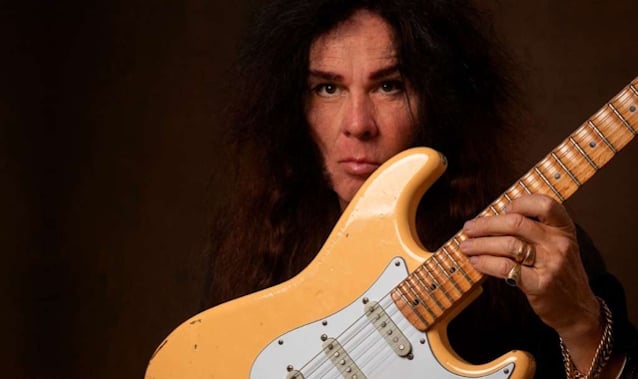
YNGWIE J. MALMSTEEN Is Happy, Healthy And More Committed Than Ever To Doing It His Way
September 15, 2026By David E. Gehlke
Yngwie J. Malmsteen's decision to take on vocal duties 14 years ago hasn't been popular. Considering the volume of highly capable frontmen who have come and gone in his band, not to mention the stable of available veteran or up-and-coming lead singers who could do "I Am A Viking" or "You Don't Remember, I'll Never Forget" justice, Yngwie simply prefers to do it all himself, which, for anyone following the Swedish guitar hero's career, has been the constant theme. He's sort of put himself in an untenable position by employing such a wealth of top-tier vocalists in his solo band. Yngwie is capable, but he's not a Jeff Scott Soto, Mark Boals or Tim "Ripper" Owens.
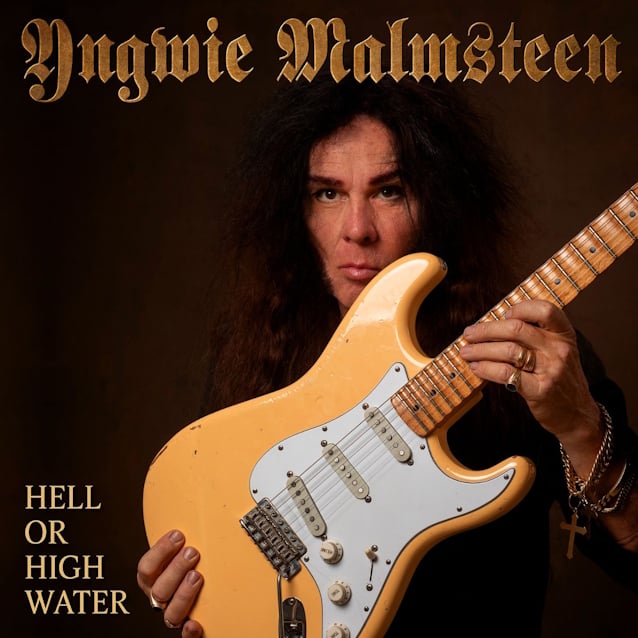
Yet, by the album, his vocal performances have improved, culminating in his new offering, "Hell Or High Water", which will see the light of day this November. Sure, vocals are an accessory in a Yngwie album, we're all gathered to listen to him shred, but moving through "Hell Or High Water" will reveal some well-crafted hooks, particularly on lead single "Now Or Never" as well as "(He Is) Living A Lie", a cut that carries on the tradition of Yngwie taking aim at someone who has wronged him.
The now-63-year-old Yngwie appears to be in a good place. Aside from the occasional press jab at the many men who previously fronted his band, Yngwie has fought long and hard to get what he wants (total autonomy) and be recognized for it. When BLABBERMOUTH.NET caught up with him over Zoom, Yngwie was happy, easygoing and in storytelling mode. Here's what transpired.
Blabbermouth: Where are you on A.I.? Does it excite you? Scare you?
Yngwie: "It's a great question because everyone I know, that's all they're on about. There's a lot of talk. To be honest, I don't have that much experience with it. I've seen things that you can do with it, which is pretty amazing, everything from pictures to stuff like that, but I'm still pretty old school. No A.I. here."
Blabbermouth: It's a little scary in a way — especially with all the shortcuts people can take with it.
Yngwie: "I see the huge potential, obviously. I'm not so sure if it's going to be…listen, I don't think I'm the right person to ask. I'm not really involved with it, and what I've seen is very impressive, but I don't think it's going to threaten real artists. Not right now anyway. It may. Who knows? [Laughs]"
Blabbermouth: Are you getting more comfortable as a singer? It's a big shift; you've always had guys who can sing in your band, but now you're doing it.
Yngwie: "I think I've gotten better. Here's the funny part: I've done so many interviews, so I forget who I said it to. Before I came to America, I was born in Sweden. I'll do a quick summary: I grew up as the youngest child in a family of musicians, opera singers; even my uncle was part of the team that invented CD technology. It was a very cool environment. On my fourth birthday, I got a violin. On my fifth birthday, I got a guitar. On my sixth birthday, I got a trumpet. Then when I was seven, they showed me Jimi Hendrix smashing a guitar, so I already had a guitar. From day one, I was taking charge of everything. I remember in second grade, I went up to this kid: 'We have a gig on Friday.' 'What do you mean?' We have a gig on Friday?' 'Get prepared.' 'What do you mean? I don't have any drums.' 'Don't worry: I have drums.' 'I don't know how to play.' 'Don't worry: I'll show you.' From day one, I've always done that. That was 1971. Up until 1982, I lived in Sweden, and I did everything. For instance, 'Black Star', the song — I wrote that song by accident because my recording studio, which I inherited from my uncle. I had drummers and stuff like this who came in and out, but they had jobs and all this stuff. I was 15, 16 years old; I would be down there playing drums. I got this new mixer and tape recorder, put the microphones on, sat down and did a beat. Then I added the bass and keyboards. I created things like a painter because no one else was there. I was singing, too. I would do keyboards, everything. Then, in '82, I was offered a chance to come to America, which is the greatest thing to happen to me. God bless America! Then, first I started joining bands or forming bands. Then, my solo career started in 1984. It was a very [formulaic] time. The '80s were very — there was no guest work. Now, there are ten billion people on YouTube playing in bands, but back then, there were 50,000 bands in every city, and maybe in ten cities, a band got signed. There was a selection process. It was formalized: You got a song on the radio, a song on MTV, and you got to tour. Everything was like that. I fell into that: 'Okay, I'm going to put this band together around me, even though it's a solo career. I'll write everything. You play keyboards. You sing. You play drums.' But around 2010, I kind of went full circle. The formula had been out of the way for a while. I was never really a fan of following this, but I've always considered myself fortunate that, wow, I managed to get a song on MTV. I was signed to a label. I always knew I had to play the game to win. You want to play in the pool; you have to play by the rules! [Laughs] When I was 16, 17 years old, I didn't give a shit. All I did was create music that was from the inside. Everybody told me, 'You're never going to make it!' Ha-ha! I just did anyway. I'm back to that now. [Laughs] That's the long-story answer. It's not a new thing. It's a return thing. As far as my vocals, I feel I've gotten better with each record."
Blabbermouth: Your English is good, which helps when you pronounce words.
Yngwie: "I think I speak English better than Swedish."
Blabbermouth: Really?
Yngwie: "Oh yeah. The funny part is that when I was six years old, I read 'Ivanhoe' in English, but I'm from Sweden! The language was almost natural for me. Plus, in Sweden, we had a shortcut: every TV show, like 'Dallas', 'Kojak', and all the films, wasn't dubbed. You had subtitles. You heard the language all the time. It was never a problem for me. I remember when I started getting phone calls from America after I sent my tape out; the American accent was funny. I got a phone call from somebody in KISS's management, and this was before I left. After I sent the tape, he must have played it all over the place. He said [Mimicking West Coast American accent], 'You're hot! You're hot!' I'm like, 'What? Hawt?' Then they asked me, 'Are you six-foot tall?' I go, 'I don't know!' I'm something like six-three, almost. I didn't get the gig in KISS because I didn't know what six-foot was! Obviously, I've been in America now for 43 years."
Blabbermouth: Do you have to think differently composing vocals versus the guitar?
Yngwie: "Not really, because everything is math in music. It's very simple. Suppose you have a chord progression in E minor. Your root note in your melody shouldn't be the E because E is the root note of the key. You should start on the fifth or the third. There are other tricks where you can repeat the melody two or three times, but the chord changes, so it doesn't sound boring, and it eats into your brain. I don't think like that, but if I analyze it, that's how it works. Melody, if it's the guitar or vocal, it kind of comes by itself. It's a natural thing. In this chord progression, that's the melody. Even when I had other singers sing my songs, I wrote the melodies. I wrote the vocal melodies, even if I didn't write the words. That's always been there."
Blabbermouth: Do you like doing it live?
Yngwie: "Yeah! It depends on the gig. Sometimes the monitors aren't strong enough for the Marshalls behind me. It's all good."
Blabbermouth: Did it take some getting used to moving around onstage, then getting situated to sing?
Yngwie: "No, not really. It's a very natural thing, too. Before I came to America, I had bands. In 1977, I had a band called POWERHOUSE. Then RISING, then RISING FORCE. That was me, guitar and vocals, a bass player and a drummer. I did it then, even though it was vocals for one second and solos for 30 minutes. [Laughs]"
Blabbermouth: Is "(He Is) Living A Lie" directed toward anyone? Is it like the successor to "Liar" off "Trilogy"?
Yngwie: "It's more of a general thing. Basically, there are certain things that I don't want to be specific about in my lyrics. It's more like the eye of the beholder, but it's the ear of the beholder; you can take it any way you like it."
Blabbermouth: So you're allowing the listener to make up their mind?
Yngwie: "Yes! Like, if I read a book, I see the things in that book differently than you would. It's a book. It's not pictures. It's a depiction in words, and you have to use your brain, which is a good thing. It's mainly about things like freedom and all that stuff. General stuff."
Blabbermouth: Going back to what you said about books: Lemmy (Kilmister, MOTÖRHEAD) had a great quote that amounted to: "Reading lets you use your imagination. Watching a movie is just another person's vision."
Yngwie: "Lemmy was a good friend of mine! We went way back. The thing is that when you read a book and see a movie adaptation, it's always terrible. If you didn't read the book, it could be good. If you read the book, it's almost always not as good, I found, anyway. I like movies a lot. I always go to the movie theaters, though. I enjoy it."
Blabbermouth: How did you get to be friends with Lemmy? Did you meet in L.A.?
Yngwie: "Before then. Well, no, it wasn't in L.A. then; he was in England. I was spending a lot of time in England. I did a lot of records there. My management was based there in the late '80s. I would be there quite a lot, and I'd always bump into Lemmy. Many times, we'd hang out and talk for a long time. He was an interesting cat, you know?"
Blabbermouth: Going back to the new album, do you want to share more about "Father"? What kind of person was your dad?
Yngwie: "He was an amazing man. I didn't really grow up with him because my mom and dad were separated from when I was one or something. My mom passed really early on, then I became close with him. His older brother is Sweden's most famous illustrator. His younger brother is a royal opera tenor in Sweden. [My dad] was a soldier! That's what he did. He was a professional soldier in the special forces, then he became a spy during the Cold War. He spied on the Russians. No lie! In 1986, at the height of the Cold War, some numbnut at PolyGram Records sold the 'Trilogy' album to the only state-run communist label in the Soviet Union, Melodiya. They sold 16 million copies in the Soviet Union. It was an official release. One day, my dad is over there, under cover, like James Bond. He's hanging out with an opera singer: 'Leonard! This record is amazing!' It was 'Trilogy'! But it said 'Yngwie J. Malmsteen' in Russian on the record. He goes, 'That's my kid!' That's how we did the 20 shows in the Soviet Union."
Blabbermouth: That live video of the show in Leningrad (1989's "Trial By Fire: Live In Leningrad") is awesome.
Yngwie: "We did 11 nights straight in the Olympic hockey arena in Moscow, which was 18,000 seats, 11 nights straight, then nine nights in Leningrad. Two cities, 20 shows. Sold-out. The whole thing! This was back when no one was there. It was before all the other metal bands. They went two years later."
Blabbermouth: You mean the show with MÖTLEY CRÜE, Ozzy [Osbourne], BON JOVI, SCORPIONS and SKID ROW?
Yngwie: "Yeah, I was there in 1988. Amazingly, we got the show done. They didn't have technology at all. I think the camera team was from Finland. We had catering from Hungary. They didn't have anything. There was nothing there. It was like a big empty… beautiful communism at work."
Blabbermouth: That version of the band was on fire, especially the Johansson brothers (Jens, keyboards, Anders, drums).
Yngwie: "It was the last night. We've done 20 shows in the Soviet Union. We actually filmed the one before, but it didn't work because we had pyro, and the pyro came from flash pots with actual explosions underneath the stage from the army. Like real, real mortars, and they would cut out the microphones, so we had to film and record the last night without those things and have the bomb sounds put in later."
Blabbermouth: Do you have a version of the record with your name in Russian?
Yngwie: "I don't have one here. Sometimes a fan will show me one, so they're around."
Blabbermouth: Sounds like your dad was a cool guy.
Yngwie: "That was my dad, yeah. And he actually went there because he was a drill sergeant when he was young, and then he became a captain and a colonel. And one time the Soviets would throw coins and stuff at everybody. Well, not at me, but for some reason they did it to all the others. And Joe [Lynn Turner] would say on the mic, 'Don't do that!' And nobody gave a shit! And then one day, I had my dad go up, take the mic and say in Russian, 'Don't throw anything on the stage.' And it stopped."
Blabbermouth: Getting hit in the head with a coin would not be good.
Yngwie: "No, but after he told 80,000 people not to do it, that was it. He told everyone in Russian."
Blabbermouth: And that was the era of projectiles being thrown on stage. Did you ever do Castle At Donington or Monsters Of Rock or anything like that?
Yngwie: "I just did Monsters of Rock a month ago in Brazil, but the worst thing that ever happened to me was in Alaska, and somebody threw a huge Jack Daniel's bottle, a full, heavy thing and it hit my guitar neck right here [Yngwie points to guitar neck]. And if I had been playing there, it would have crushed my fingers. It was disgusting. It knocked the frets out of the guitar and everything. That was the worst thing that ever happened to me. But I've been lucky. I never really had problems with that."
Blabbermouth: Could you just live in the studio if you wanted? Do you like getting out there and doing shows?
Yngwie: "I have to play in front of people. Being in the studio is awesome because you can really experiment and this and that, whatever. But live is like going into battle. It's like a helicopter drop. Get your M16s out and do it. You know what I mean? It's awesome. I love the excitement. I love the risks. I love the danger of it. Because I never play the same thing. So, to me, it's like it never gets old. If I did the same set and the same solos, I don't think I would like it, but it never is the same. Like, if I actually walked up to a studio now and picked up a guitar, I'd start playing something new too. It's just how it works. That's why I still do this, you know? There's always something exciting happening."
Blabbermouth: How are you feeling these days? Do you have any health issues?
Yngwie: "No issues. I mean, I do look after myself quite well. I don't drink. I don't do it. I don't do anything nasty to you. Nothing. I like to play tennis, get out in the sunshine and get up early in the morning. It's not that rock 'n' roll thing. I mean, back in the day, yeah, sure, but now I'm like clean as a whistle in every aspect of the last 20 years. So, I think that has a lot to do with it. I also like to keep my mind busy all the time, which means that if it starts creaking somewhere or whatever, I don't get paranoid. I actually feel really good."


 Prev
Prev 