


DAVID ELLEFSON: 'I Got To Be Part Of A Lot Of Early Ideas, Early Things That Stuck And Caught The Attention Of Other People'
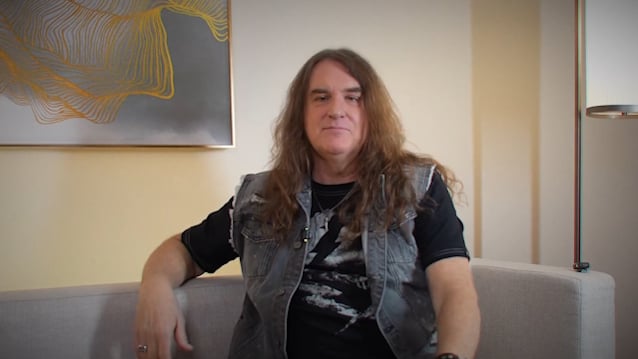
April 30, 2026In a new interview with Rock Kommander, David Ellefson reflected on his early years with MEGADETH as well as how he has kept himself busy with multiple bands and other projects in the years away from the Dave Mustaine-led outfit. The bassist said (as transcribed by BLABBERMOUTH.NET): "For me, MEGADETH is something I did for so many decades. 'Cause I was a founding member of it. So we met just like this, in an apartment, and drank some beers, talked about heavy metal, talked about rock and roll. We got guitars in our hands. The songs were starting to be written. And we just kept it moving from there.
"When you start something, you really have to believe in it, because you're ultimately trying to convince other people that this is the thing, this is cool," he explained. "Now, I was lucky because with MEGADETH, the music connected with people. They liked it. There was a story there about Dave [Mustaine] coming out of [his former band] METALLICA. So right from the beginning there was a story. Because what makes my band any different than your band or his band or her band? What's the hook, as they say, right? So there has to be something of interest. And so I was lucky with that, to move from Minnesota out to Hollywood and land in something like that right away — and at the very beginning. I didn't join the group; I helped form it."
Ellefson continued: "The first 20 years — I call it the Capitol Records years — those first 20 years of the group was really what defined the sound of it. The sound evolved. It constantly was being kind of tended to. You wanna do what you wanna do as an artist, and then sometimes some other things come along. Like in our case, the '90s was very interesting because the Seattle movement showed up — NIRVANA, PEARL JAM, all that we know it is. [It was] very different, because that affected what things outside of us were gonna be reacting to — MTV, the media, radio. And as we need those vehicles to help our fans always be connected with us, probably one of the greatest things that happened was this new thing called the World Wide Web, otherwise known as the Internet. And Capitol Records came to us in 1994, when we launched an album called 'Youthanasia', and they asked us if we would be interested in forming basically the very first-ever band web site, which we did, called Megadeth Arizona — 'cause the band was based in Arizona at that time. And so we were a very much an early adapter. We were always an early adapter with technology, with kind of the new way of doing things. We were dubbed, at one point, the world's state-of-the-art speed metal band. And, so when the Internet opportunity came to us, we said, 'Absolutely.' So we did. And the Internet, Megadeth Arizona was used as a way to launch that album in 1994. And then we secured Megadeth.com. Some fans actually had already bought it, because that's what they do, right? They would buy and and hold on to it. So we were able to acquire that from them. We started Megadeth.com. We had our chat rooms, we had our message boards, so we were in this long before today the news sites and people with the leaving comments open and all this kind of stuff. The Internet, for us, was a very useful tool to be connected with our fans all around the world, 'cause we were a big international rock group."
Ellefson added: "I was just talking to an artist yesterday, a brand new artist, and they were talking about how much the Internet has helped them to gain this very big worldwide fanbase, and they're just now starting to go on tour and they're very young group. Young people understand the Internet. It's been their friend from the beginning. And so I'm glad I got to be part of that generation at the very beginning, to understand what it is. And it's always kind of an ongoing learning about that. But any way that we can to try to connect with our fans.
"So fast forward all these years later, there was a season — MEGADETH disbanded," David said. "I wasn't part of the reuniting in 2004 and [200]5, but I went back to the band in 2010 and had another 11 years with the group. And we did some big things, with the 'Big Four' — METALLICA, SLAYER, MEGADETH, ANTHRAX. We put out more records, one of which finally won us a Grammy nomination, or a Grammy Award, actually, finally. We had, I think, 11 nominations, and then we finally won one. And, to our fans, did they care if we won a Grammy? Probably not. For the industry, I think it was a cool acknowledgement that we always mattered, we were always relevant, we were always important not only to our fans, but even inside the industry of music and entertainment, we were always a leader. So, finally to have won the award was kind of, like, 'Okay, good. Check. Got that done.' And that was on the 'Dystopia' album, which was really one of the great MEGADETH records; I feel like that was really one of the great ones. So, time to move on from the, from the group.
"For me, I had spent a lot of time concentrated in that band during the '80s and '90s. In the 2000s, when the group disbanded, I quickly moved on to some other things. I actually went to college. I got my business degree. I worked for Peavey, doing artist relations, which was a way to sort of connect to companies' musical products with the artist community. And at the time, a lot of young groups like SLIPKNOT, Kid Rock, NICKELBACK were coming up the ranks, and I interfaced with them very early on. And they became tomorrow's big rock groups. They became the KISS of tomorrow. So I understood it. I also started some other groups. I had a band called F5. I did some guest appearances, like with Max Cavalera on two of his SOULFLY records. So that kind of opened and it expanded my musical horizons to be able to do more than just be in one group. So I got to do both then. So when I went back to MEGADETH, now I had this experience as a founding member of MEGADETH and as a songwriter and a contributor to that band, but also to have my world wide enough that I knew how to step into situations to record, to perform with them. I started another all-star group called METAL ALLEGIANCE that we put on the MOTÖRHEAD 'Motörboat' cruise. And that kind of started the all-star thing on these cruises where famous rockers get together and they do the all-star jam kind of thing. So, I got to be part of a lot of early ideas, early things that stuck and caught the attention of other people."
Ellefson was originally in MEGADETH from the band's inception in 1983 to 2002, when the group briefly broke up because MEGADETH leader Dave Mustaine suffered severe nerve damage that left him unable to play.
Mustaine reformed MEGADETH 22 years ago. Originally setting out to record a solo album, Mustaine enlisted studio musicians to play on what ultimately became MEGADETH's 2004 "The System Has Failed" comeback album, subsequently recruiting former ICED EARTH bassist James MacDonough to take Ellefson's place for the album's touring cycle.
Ellefson sued Mustaine in 2004 for $18.5 million, alleging that the MEGADETH guitarist/vocalist still owed him substantial merchandise and publishing royalties. In January 2005, the case was dismissed in court, and five years later, Ellefson rejoined MEGADETH.
In his first book, Ellefson admitted that he became a salaried employee upon his return to MEGADETH 16 years ago. He told Metal-Rules.com in an interview: "Going from being a co-founding owner to just a sideman musician was initially why I didn't come back in 2004. I was not happy with the participations that were presented to me. In recent times, coming back, I found great joy in doing music with a lot of other people in other settings that helped me fall back in love with playing music. Now I can come back into or go into musical situations and be able to be there for a purpose and level of pay. Being a sideman absolves you from being involved in all the other stuff. At this point in my life, I would rather leave that stuff on the sidelines. Like American Express says, 'membership has its privileges,' being a sideman has its benefits. In my case, it helps retain a friendship too. In order to have a friendship, I had to give up some ownership."
In his 2004 lawsuit against Mustaine, Ellefson claimed that he "attempted to resolve his differences with Mustaine on an amicable basis and offered to continue to perform with [MEGADETH]." However, his "offers were met with verbal abuse, threats, lies and continued invective from Mustaine." Ellefson also said that Mustaine — a veteran of at least 17 drug rehab stints, according to the bassist — resented Ellefson, a former drug addict, for having kicked his own habit. According to Ellefson's court papers, the battle of the band spread to the Internet when Mustaine posted on Megadeth.com that Ellefson was trying to extort him.
Mustaine gave his version of why the 2004 reunion with Ellefson didn't pan out in a message posted on the MEGADETH web site. In lengthy essay, Mustaine claimed that Ellefson missed several deadlines to accept his offer, which included 20% of the artist royalties on "The System Has Failed", none of the publishing royalties and a $2,500-a-week salary while the band was on the road.
Ellefson was fired from MEGADETH nearly five years ago after sexually tinged messages and explicit video footage involving the bassist were posted on Twitter.


 Prev
Prev 