


HULU 'Into The Void' Documentary Creators Shed New Light On Metal Music: 'It Has Been Exploited In So Many Ways On Television'
October 7, 2025By David E. Gehlke
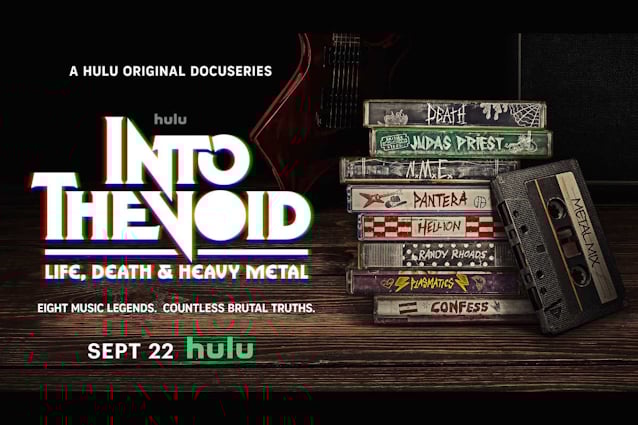
The new eight-episode "Into The Void" series on Hulu takes the route less traveled when documenting our beloved genre that is heavy metal. While some notable metal documentaries have done the job (namely, Banger Films's excellent "Metal Evolution" series),the rest have often been left in the hands of large network studios sensationalizing the genre with trite storytelling and "experts" who know nothing about metal. Such happenings were part of the impetus for filmmakers Evan Husney and Jason Eisener ("Dark Side Of The Ring") to embark on "Into The Void", bringing out the human element in a music style that prides itself on being the genuine article.
Given the limited format they were given to tell the otherwise complex stories regarding the likes of OZZY OSBOURNE's Randy Rhoads, PANTERA's "Dimebag" Darrell Abbott, DEATH's Chuck Schuldiner, THE PLASMATICS' Wendy O. Williams and the 1991 JUDAS PRIEST Reno trial, not to mention lesser-known individuals like NME guitarist/vocalist Kurt Struebing, HELLION frontwoman Anne Boleyn and Iranian metal band CONFESS, Husney and Eisener deserve a significant amount of credit for both humanizing these individuals and telling their stories the right way. A week before the episodes were to hit Hulu, BLABBERMOUTH.NET caught up with Husney and Eisener to learn more.
Blabbermouth: How much of a foundation did your "Dark Side Of The Ring" series provide for you to do "Into The Void"?
Evan: "Metal specifically has been a huge part of my life and was very formative to me. I do credit it in many ways for helping me develop my individuality or giving me a sense of individuality. I grew up in the suburbs of Minnesota, where it was very milquetoast and heavily religious, predominantly Christian. It was extremely challenging to find anything at that time that could distinguish you from the rest. Wrestling took me into metal, actually. Watching old ECW Pay Per Views and seeing the wrestlers walking out to PANTERA, AC/DC, or METALLICA, that's how I got into that stuff when I was young. Like, 'What is this music? It's amazing.' Then I learned to play guitar and wound up idolizing Randy Rhoads and Dimebag Darrell. That, I credit, for making me who I am. If I hadn't found that stuff, I'm not sure who I would be or where I would be. Metal is ingrained in me. I feel a personal connection to the series, but to the music itself. I have a sense of loyalty to it. Having the opportunity to create a new platform for these stories has been incredible. I'm so lucky and humbled that we've had the opportunity to do it."
Jason: "Evan and I, our friendship started 15 years ago, and it was over our love of movies, wrestling and metal. The things we get into, we really get into them. We want to try to take those passions and put them into our work. Our dream has always been to take those passions and find a way to be part of it or create our own art within it. It's crazy that we went down the road of making 'Dark Side Of The Ring' and now we've made over 70 documentaries in the last eight years on wrestling. I'm glad we went down that path before we went down this road with 'Into The Void'. We took everything we learned from 'Dark Side Of The Ring' and applied it to 'Into The Void' and the world of metal. With 'Dark Side Of The Ring', we had the luxury of making a pilot, and that was on the death of Bruiser Brody. We spent almost a year making a documentary, which helped us get our foot in the door with other wrestlers, such as Bret Hart and 'Stone Cold' Steve Austin. With this show, we didn't have that opportunity. The first episode we did was the story of Chuck and DEATH. But we didn't have a finished episode to be able to show other people yet. We may have had some clips; I can't remember."
Evan: "It was pretty much starting with no credibility or even presence in this community or this world. That was a big challenge. I think it's also tough when you're coming out of the woodwork with these guys. We had this show, and we're passionate guys; we want to make it. Metal itself, as a genre, has been sort of exploited or misrepresented in so many different ways on television over the years. I think a lot of bands and a lot of management are very sensitive to the portrayals and making sure it doesn't fall into a lot of clichéd territory with how it's being presented. That was a big challenge for us because of the other shows. It made it hard to navigate the world and to convince people, 'Hey, we're not going to take that route. We are fans.' And, 'Hey, we're putting more pressure on ourselves than anybody else in terms of making a show we'd want to see as fans, that's still honest and warts and all.' It would be something that also appeals to fans. That's also important."
Blabbermouth: What was the selection criteria for the eight episodes? There's a lot to work with when it comes to metal.
Evan: "It's such a personal thing to me. My connection to the music is so personal that I was picky at first, wanting to select the stories, not all of them, but the majority that personally resonated with me. If you're going to make something, you should make what you know in a way. For me, straight out of the gate, Randy Rhoads was my guitar idol and hero when I was getting into music. He inspired me to play the guitar. And then Dimebag Darrell was the next step in terms of trying to learn his solos. I've always been personally fascinated with trying to understand more about them as individuals and what makes them tick, and with creating content similar to what we did with 'Dark Side Of The Ring', featuring people we appreciate. We're trying to humanize them and to give a deeper understanding of who they were, while also taking into account the things that happened to them. I remember exactly where I was when I heard about Dimebag's murder. I remember the exact moment when my mom told me about it. She saw it on the news. I don't think I had a close family member pass away up until that point. His passing and Owen Hart's in wrestling — they were the ones with whom I had the closest connection. It was very heavy. I felt a strong connection to Dimebag and wanted to pay my respects, as well as try to meet the people who were closest to him and had the most insight into the story, to gain a deeper understanding.
"Being such a fan of his creativity, his constant innovation, and being one of the true great visionaries of extreme music, I wanted to do the same with Chuck and DEATH. With wrestling, we get a lot into the contrasting sides of different people's personalities. They play a character in the ring, but outside, they're a totally different person. They're a father, a son. Chuck is very similar in that way to me. His music is so aggressive and puts out this very visceral, at least in the early days, very Satanic, very colorful, intense façade, but beneath that, he's the guy wearing the Christmas sweaters and putting up the stockings and decorating everything and being the most down-to-earth guy, totally against stereotypes and clichés. That always fascinated me to show that duality. Then, the other stories were discoveries. One quick example was when we were researching, and we had this amazing opportunity to put on what would be great stories for the show. I was going through my record collection and stopped on HELLION, the 'Screams In The Night' album. I had it for years. I said, 'This record is great! It sounds so good, and her voice [Anne Boleyn] is so amazing. Great female metal vocals. Why didn't this band make it? There has to be a story here.' I stopped and put down the record and fired off an email to our team and said, 'We should look into HELLION. There may be a story there.' There was. It's a funny thing where your record collection can take you on a journey.
"The NME story with Kurt Struebing. That story, I had seen that cover, 'Unholy Death', through my metal collection journey, but I never stopped to listen to it. I do know the headline about 'Guitar player murders mother.' It was one of these unspeakable, sort of crazy stories. I even thought at first, 'That might be too over the line for our show. It might be perceived as too sensational.' I was sensitive to that. Once we started speaking to the family and band members of NME, it was like, 'There's a much bigger story here that's way more complicated.' That was in terms of coming to terms with the fact that someone you know and love who is close to you and has a full psychotic episode and perpetrates something with murder. How do you reckon with that? You don't turn your back on this person because you can empathize with what they're going through. You can still be there. The fact that he was able to get out, rejoin the band and regain people's trust brought him back into the fold. It's an unbelievable story. You can't even write it.
"We didn't want this to be conventional. So many metal series seem to misinterpret what the genre is, like, you see a heavy metal series and it's Bret Michaels' [POISON] stories. [Laughs] We really wanted to try and make sure we were making as close to a pure metal show as possible. Even though we do color outside the lines with THE PLASMATICS, we wanted to do something different, even if these are the stories you've heard ad nauseam for years and years."
Blabbermouth: You referenced the families of Kurt Struebing and Chuck, who all took part. Were there any roadblocks in terms of not getting the people you wanted on camera?
Evan: "It was hearkening back to the difficulty of getting access to these stories by two guys who are unknown in this community. It was about people knowing we had the best of intentions and building trust. There were a few stories we couldn't get because of the lack of access. Or, even more frustrating, in the process of trying to make a show like this, when timing becomes an issue. Where do you get the access? Then the band and the management, then clearing the music, 'We're good to go.' Then it's, 'Well, actually, we can't do it. We can't have this thing come out during this part of the year. Sorry.' We have no flexibility on our end. It doesn't happen based on time. There are various factors that went into a couple of stories not happening. But, I hope with this season and people getting a chance to see it and like it, that will end up in us getting another season. If that does happen, one would hope that we can revisit these stories."
Jason: "There were some stories that we wanted to tell, but the timing didn't work. There was a great story that felt like everyone was on board, everything was in place, but the timing didn't work because we had a crazy schedule to deliver the show. It took a considerable amount of time to develop. By the time we got to shoot it and deliver it, it was so quick. There was one really great story that almost came together, but the timing didn't work out. Hopefully, we get an opportunity to make more of these, and we can go back to them and do that episode."
Blabbermouth: Can you go into the challenge of condensing someone's life into 43 minutes? How hard is that?
Jason: "It was so difficult, especially with Chuck. I think the first cut was over an hour or even an hour and a half. Even going that long was still not enough time. It was heartbreaking to have to cut stuff out. As you know, there's so much to his story. Making something fit within 44 minutes is extremely difficult. Because we want people who are not necessarily fans of metal to be able to digest these stories. We're given only 44 minutes to tell them. It's hard to fit it in."
Evan: "It's something we have sort of crafted or worked on over the years with 'Dark Side' because it's the same format in terms of the length and time. With Chuck's episode, it was very tough. From the beginning, one of the things we set out to do in the development process was to avoid approaching them like they were career biographies. That's also something networks want, but they want them to be more accessible, not just for fans. Sometimes a career-based thing can be really for the fans, where you're going through the process of all the albums and everything. I love that stuff, too, but it's a different art form."
Blabbermouth: It sounds like you really homed in on the non-metal crowd without forgetting who your target audience is.
Evan: "Absolutely. I had my wife watch the Chuck episode, although she's not a fan of death metal. She likes a lot of heavy music, but death metal is pretty extreme for her. If I were to show her that music out of context, it might not make the same impression when you listen to 'Pull The Plug' in the context of who Chuck is and how lovable and likeable he is. It recontextualizes that music and makes you understand it. And the fact that you're understanding that his music is coming from a much deeper, more soulful, lived-in experience than your average metal guy. You get such a deeper appreciation for that stuff. All that said, my goal is to introduce more people to this concept who aren't already familiar with it. In order to do that, you have to make it digestible and accessible more than anything, so you're not losing the people."
Jason: "I also want to mention this was a discovery with DEATH and spending time with Chuck's family and his close ones. It was very powerful. To hear his sister talk about how much his brother Frank's death affected him, and when you hear the song 'Open Casket' and how that is about the experience of seeing his brother's open casket when he was a kid, and how traumatic it was, that makes the song so powerful. That made me a huge fan of him."
Blabbermouth: Out of the eight episodes, what surprised you the most? Was it anything from the JUDAS PRIEST trial?
Evan: "We tried to show the other side with that episode. We've heard the JUDAS PRIEST or rock music side of it. I was fascinated by the real circumstances, whether it was the surroundings those two boys grew up in that would have more sincerely caused them to go down that dark path of attempting to take their own lives, and of course, one did. Also, what makes metal so unique as a genre? In the '80s, it was the original. Obviously, you can say this about rock and roll in the '50s; it seemed that on the scale, it was one of the first big cultural scapegoats. Not only were people pointing to it because it was driving teens toward delinquency or inspiring violence, but this genre was weaponized by some of the far-right Christian groups at the time. It was such easy, low-hanging fruit for them to weaponize it and spread their own agendas. That's what kick-started so much of the misunderstanding that the average person has about this music. It's really a raw, unfiltered form of expression."


 Prev
Prev 